
Canton
Facade insulation — Fribourg
Contribution per insulated m².
Fribourg support for thermal insulation of facades and roofs.
www.leprogrammebatiments.chFacade insulation · Bulle
Small project
CHF 20'000 – CHF 41'400
Typical project
CHF 36'800 – CHF 73'000
Large project
CHF 62'100 – CHF 120'400
Computed with our estimator for Bulle (regional factor included), standard finish. Only the project size changes.
1 °C and approximately 108 frost days per year. With heating requirements reaching 3544 Kj/year, facade insulation becomes a major lever for reducing energy consumption.6 °C.
It is recommended to undertake these works before signs of facade degradation become structural or during overall renovations. As a Gold Energy City, Bulle actively encourages these initiatives.
Acting now helps stabilize indoor comfort while sustainably enhancing your real estate assets in the face of local climatic requirements.
The choice of insulation system depends on the nature of your walls and your energy efficiency goals. External thermal insulation systems allow you to wrap your building in a continuous protective layer, thereby eliminating thermal bridges.
Different materials such as mineral wool, polystyrene panels, or bio-sourced insulation can be used, each providing a specific response depending on the thickness available on your facade.
The range of products varies not only in insulation capacity but also in durability and water vapor permeability. It is crucial to evaluate the compatibility of materials with the existing substrate to avoid any risk of internal condensation.
Finishing options, whether mineral plasters or cladding, also contribute to the long-term value of your investment in the face of climatic conditions in the Fribourg region.
The real estate stock in Bulle features varied typologies ranging from historic constructions to more recent buildings. If your house was built before 1990, particular attention must be paid to the potential presence of hazardous materials, such as asbestos, often hidden in old insulation or coatings.
A diagnosis before work begins is an essential step to identify these substances.
In addition, the condition of drainage systems at the base of the walls must be checked before installing any insulation. Poor moisture management in the basement could compromise the thermal performance of the new insulation.
It is also necessary to analyze the structure of the facade : some older buildings require specific breathability to prevent hygrometric damage. Rigorous planning allows for adapting the insulation technique to the construction peculiarities of your building.
External insulation changes the architectural appearance of your building, which systematically requires verification with the municipal administration of Bulle before work begins.
Even if the project seems minor, the change in facade thickness or modification of colors can impact the overall appearance of the neighborhood. It is highly recommended to contact the local urban planning department to learn about the specific requirements for your area of residence.
Compliance with alignment and property boundaries is also a crucial point for any external insulation project. Adding insulation thickness can encroach on the public domain or reduce the distance to neighbors, sometimes requiring derogation permits. Never assume that the work is free of authorization.
A proactive approach with municipal authorities guarantees the conformity of your project and avoids any subsequent administrative blockages.
The building program offers Fribourg grants for thermal insulation in the form of a contribution per isolated square meter. To benefit from this support, a grant application must be submitted before the start of the work. Once the work is finished, you can benefit from advantageous tax deductions.
Investments aimed at improving energy efficiency are deductible from your taxable income.
Regarding taxation, if the deductible expenses exceed the income of the building for the current tax period, the excess can be carried forward to the two following tax periods. You can opt for a deduction of effective costs or apply a flat-rate deduction of 20% for buildings over 10 years old.
For buildings less than 10 years old, the flat rate is 10%. This optimized tax management makes investment in insulation particularly attractive for owners over the long term.
The planning of insulation works must take into account the weather conditions of the region. With 108 frost days per year in Bulle, it is best to avoid the coldest periods for facade works requiring mortars or plasters that need stable temperatures.
The best season for the construction site is ideally from spring to autumn, when the risk of night frost is ruled out.
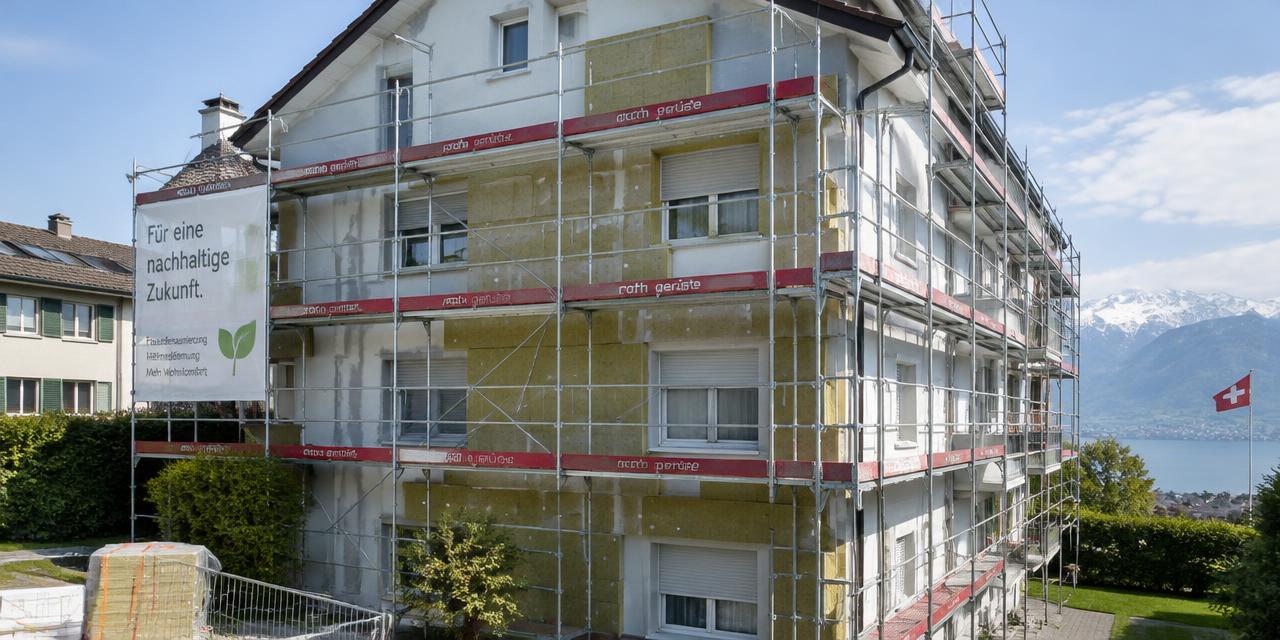
The construction site begins with the installation of scaffolding. It is highly recommended to group the facade, window replacement, and roof renovation during this stage, as the scaffolding represents a significant part of the cost.
After installing the insulation, exterior finishing is applied, followed by dismantling. Organized coordination with the various trades ensures fast execution and minimizes the duration your house is exposed to bad weather.
A common mistake is to neglect the administrative steps, in particular submitting the grant application before work starts. Another mistake is to insulate the facade without checking the condition of the windows or roof, which creates thermal imbalances.
Here are some points of vigilance : ensure quotes include the treatment of thermal bridges, ensure municipal permits are obtained in writing, request an expert assessment for asbestos if the building dates from before 1990, and demand a guarantee of proper completion of works.
It is also necessary to compare fastening systems to avoid long-term damage. Finally, do not forget to include plumbing work or modifications to window sills in your initial budget, as these are often forgotten when installing new external insulation.
Contribution per insulated m².
Fribourg support for thermal insulation of facades and roofs.
www.leprogrammebatiments.chCheck amounts and conditions with the provider before signing: apply before work starts in most cases.
1630 Bulle · about 0 km
Specialist in the design and construction of agricultural and industrial buildings using glulam timber frames and concrete storage facilities.
agribat-concept.com1630 Bulle · about 0 km
Specialist in scaffolding for facades, roofs, and photovoltaics, including painting and building renovation services based in Bulle.
dms-echafaudage.com1630 Bulle · about 0 km
Petrini Peinture is a company based in Bulle specializing in interior and exterior painting as well as facade insulation.
petrinipeinture.ch1630 Bulle · about 0 km
Fribourg specialist in the assembly, dismantling, and rental of scaffolding for construction, facade renovation, and roofing projects.
pyramide11.chSuggestions from the commercial register by distance and activity. Not an endorsement or partnership.
Yes, external insulation changes the architectural appearance and requires a permit from the municipality. Contact the urban planning department before taking any action.
The grant application must be submitted before the actual start of the work. Any project started without prior agreement cannot be subsidized.
Yes, the cost of scaffolding is significant. It is therefore recommended to group facade insulation with roof renovation and window replacement.
Investments in energy efficiency are deductible. You can carry forward excess expenses to the two following tax periods if necessary.
If your building dates from before 1990, hazardous materials may be present. A diagnosis is necessary to ensure the safety of the site.
The ideal period is between spring and autumn to avoid the risk of night frost, which is very common in Bulle during winter.
Bulle is a Gold Energy City and has a municipal energy fund created in 2019 to support local energy measures.
Source : swisstopo – service d'altitude (MNT)
Source : Open-Meteo Historical Weather API (réanalyse ERA5, moyenne 2015-2024)
Source : Open-Meteo Historical Weather API (réanalyse ERA5, moyenne 2015-2024)
Source : Open-Meteo Historical Weather API (réanalyse ERA5, moyenne 2015-2024)
Source : Open-Meteo Historical Weather API (réanalyse ERA5, moyenne 2015-2024)
Source : Open-Meteo Historical Weather API (réanalyse ERA5, moyenne 2015-2024)
Source : Administration Cantonale des Impôts du Canton de Fribourg
Source : Ville de Bulle