
Canton
Solar PV — one-off payment (Fribourg)
Calculated on capacity (kWp).
Federal one-off payment for PV installations in the canton of Fribourg.
www.pronovo.chSolar panels · Fribourg
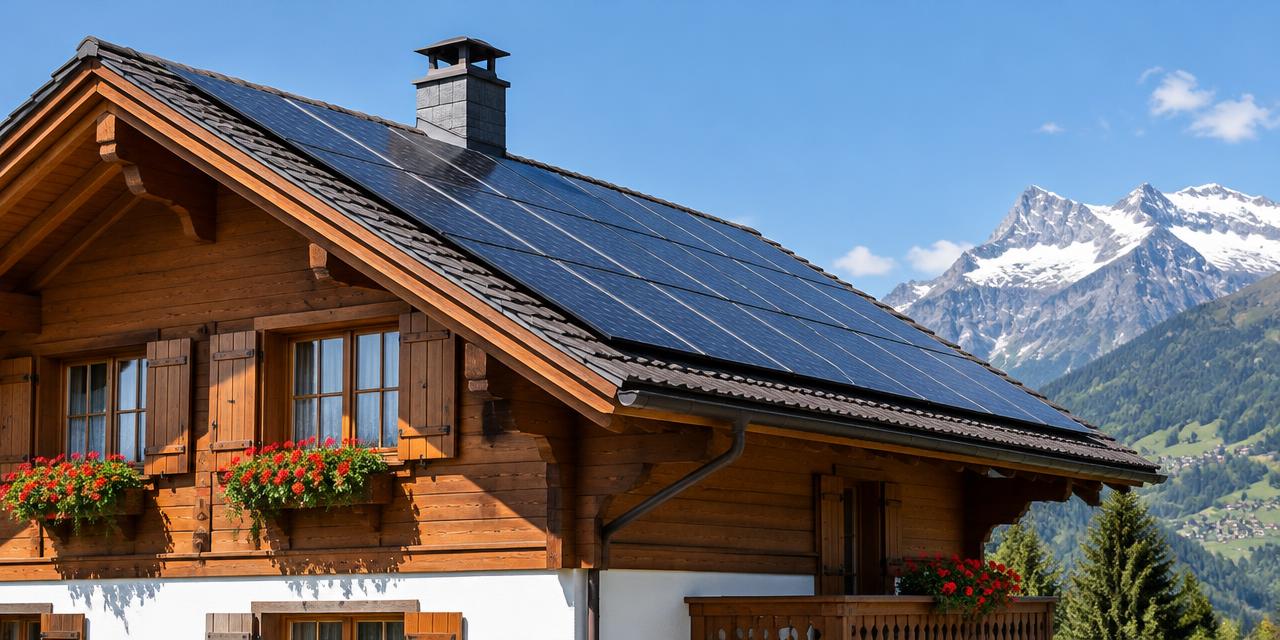
Small project
CHF 9'800 – CHF 18'500
Typical project
CHF 18'100 – CHF 32'900
Large project
CHF 31'400 – CHF 55'800
Computed with our estimator for Fribourg (regional factor included), standard finish. Only the project size changes.
In Fribourg, located at an altitude of 587 meters, the climate places significant thermal demands on buildings with 3233 heating degree-days per year. This figure highlights the importance of improving your property's energy efficiency to reduce reliance on traditional heating systems.
Investing in photovoltaics transforms your roof into a clean energy source, benefiting from the region's attractive annual global irradiation. Planning this installation during a roof renovation is often the most opportune moment, as it optimizes labor costs and structural integration.
7 °C. Integrating solar panels, beyond electricity production, can spur a holistic reflection on insulation and thermal management. The energy transition is not limited to production but is part of a strategy for global demand reduction.
Acting now means enhancing property value while aligning with cantonal climate goals that encourage the transition to renewable and sustainable energy.
The success of a photovoltaic installation in Fribourg relies on rigorous technical choices. The range of panels influences not only efficiency but also durability against winter conditions.
On-roof systems are common, but integrated solutions (replacing tiles) offer a more refined aesthetic, particularly in sensitive areas. The peak power (kWp) must be sized according to your actual needs, as profitability depends primarily on your self-consumption rate.
Prioritize modules with a good temperature coefficient to limit losses during cold but sunny days.
Beyond the panels, the choice of the inverter is crucial. There are central inverters for simple installations and micro-inverters for roofs with partial shading. The latter allow for the independent management of each panel, maximizing the installation's overall production.
Do not overlook the importance of intelligent energy management systems, which allow you to control your appliances or heat pump when there is excess production. A well-thought-out installation considers snow, wind, and the specific orientation of your roof, ensuring optimal durability over several decades.
The adaptation of solar panels to Fribourg roofs depends greatly on the age of your building. For houses built before the 1990s, particular attention must be paid to the load-bearing capacity of the roof structure, which may require reinforcement before installation.
Furthermore, these older buildings may present risks related to insulation or the presence of asbestos in old roofing materials. Before any project, a complete assessment of the roofing is essential.
If the roof is due for renovation soon, it is highly recommended to pair these works with the solar installation to achieve significant economies of scale.
For more recent constructions, integration is often facilitated by structures already compliant with current thermal standards. However, systematically check the condition of the internal electrical network. It is essential to ensure that your electrical panel can accommodate new connections from the inverters.
Dwellings dating back several decades may require bringing their electrical installation into compliance to meet current safety requirements.
In short, each construction era presents its own challenges, from asbestos checks to upgrading electrical capacity, and requires specific expertise to ensure safe and sustainable integration.
The installation of solar panels in Fribourg is governed by urban planning rules aimed at preserving the architectural identity of the canton. In many cases, a correctly integrated on-roof installation is subject to a simple notification procedure.
However, this does not exempt you from checking compliance with your municipality. It is crucial to consult local urban planning services before signing any contract, especially if your building is in a protected area, near a historic site, or within a perimeter requiring specific prior authorization.
Heritage protection remains a priority.
While cantonal rules are clear, details can vary from one municipality to another depending on local planning. A non-compliant installation can lead to significant delays or costly modification requests. To avoid these pitfalls, start by asking for the specific requirements in your area of residence.
Keep in mind that an aesthetic installation, respectful of the surrounding volume and materials, is more likely to receive quick approval. Respecting urban planning rules is a guarantee of peace of mind for years to come and ensures the successful integration of your project into the existing Fribourg building fabric.
The energy transition benefits from incentive support in Fribourg. The federal one-off payment, managed via Pronovo, is a major aid to reduce the initial cost of your installation.
It is essential to carry out your aid application procedures before starting the work, as no funding can be granted for an already completed installation.
This financial support is calculated based on the peak power (kWp) of your system and aims to encourage the development of renewable energy throughout the territory.
Regarding taxation, the canton of Fribourg offers interesting deductions for investments in energy efficiency. Expenses related to the photovoltaic installation are deductible from your taxable income.
If these expenses exceed your rental income for the current tax year, you can carry over this excess to the following two tax periods.
For buildings older than 10 years, you can choose between deducting effective costs or a flat rate of 20% of the rental value, while this flat rate is 10% for buildings less than 10 years old.
These tax levers, combined with the one-off payment, make the investment particularly attractive to owners aware of the long-term value of their assets.
The flow of a solar project in Fribourg follows logical steps to ensure safety and compliance. It all starts with a feasibility study and the aid application through Pronovo. Once municipal authorizations are obtained, the logistics planning phase can begin.
It is preferable to avoid periods of extreme cold or frost days, which complicate access to the roof and working at heights for installers. Spring or early autumn are often favored periods, offering more stable weather conditions for installing panels and wiring.
The project is generally divided between roof work, for mounting the structure and panels, and interior work, for installing the inverter and connecting to the electrical panel. Once the components are installed, a technical inspection is necessary before official commissioning and grid connection.
Following this order is essential to ensure nothing is left to chance. Rigorous preparation beforehand limits the duration of the project, ensuring your system is operational as quickly as possible to start producing your own clean energy.
Planning a solar installation requires careful attention to avoid costly mistakes. Among common pitfalls are undersizing power relative to actual consumption or forgetting to check the roof structure before committing. It is crucial to anticipate self-consumption, as it guarantees the best profitability.
Before soliciting companies, systematically check that your roof does not require upcoming renovation, as it would be inefficient to install panels on an aging support. Also ensure you have identified your heritage protection zone to avoid any administrative rejection.
Checklist before requesting quotes : 1. Check the condition of your roof structure and covering. 2. Seek advice from your municipality on local urban planning restrictions. 3. Assess your current annual electricity consumption. 4. Ensure your electrical panel meets current connection standards. 5.
List potential shaded areas on your roof throughout the year. 6. Learn about Pronovo aids. 7. Compare several quotes detailing materials and services. 8. Verify that the installer is certified. By following these points, you maximize your chances for a smooth and efficient project.
The durability of your solar investment in Fribourg depends on a few simple maintenance actions.
Although photovoltaic installations are designed to withstand bad weather, including frost days and snowfall, occasional cleaning of the panels can be useful to maintain optimal efficiency, especially if dust or leaves accumulate.
Rain usually provides natural cleaning, but an annual visual inspection helps detect any potential damage after a harsh winter or storm. The durability of components, inverters, and panels is excellent if the chosen material is of high quality.
It is advisable to have a technical inspection carried out by a professional after a few years to verify the integrity of electrical connections and the operating status of the inverter.
The latter, being the most stressed electronic element, may require replacement after a certain period, generally longer than that of the panels themselves. By adopting a proactive attitude, you maximize the production of your system in the long term.
A well-maintained system is the key to ensuring your energy production remains consistent with initial estimates, thus protecting your asset for decades to come while respecting the Fribourg environment.
Calculated on capacity (kWp).
Federal one-off payment for PV installations in the canton of Fribourg.
www.pronovo.chCheck amounts and conditions with the provider before signing: apply before work starts in most cases.
1700 Fribourg · about 0 km
Fribourg-based company specializing in tinwork, roofing, plumbing, heating systems, and solar panel installations.
jr-sarl.ch1700 Fribourg · about 0 km
Electrical engineering office in Fribourg specializing in inspection, compliance, electrical panels, and energy consulting.
lexel.ch1700 Fribourg · about 0 km
ATERRE Electricité Sàrl is a company specializing in electrical installations, home automation, and photovoltaic systems for residential and commercial clients.
aterre.ch1700 Fribourg · about 0 km
Fribourg-based company specializing in electrical installations, maintenance, and electrical equipment services.
alain-electroservice.comSuggestions from the commercial register by distance and activity. Not an endorsement or partnership.
Yes, the yield depends on the annual global sunlight. Cold, sunny days are actually favorable to panel efficiency.
Yes, a notification is often required, and authorization is needed if you are in a protected area. Always check with your municipality.
You must submit your application on the Pronovo portal before starting work. The aid is paid out after project completion.
Yes, investments in energy efficiency are deductible in the canton of Fribourg. Carry-over to two tax periods is possible.
The panels have a lifespan of several decades. The inverter will usually need replacement after 10 to 15 years.
Rain is usually enough for maintenance. An annual check is recommended to inspect the overall condition and connections.
You must ensure the electrical panel can support the new power. A compliance upgrade might be necessary for old buildings.
Source : Open-Meteo Historical Weather API (réanalyse ERA5, moyenne 2015-2024) · estimate
Source : swisstopo – service d'altitude (MNT)
Source : Open-Meteo Historical Weather API (réanalyse ERA5, moyenne 2015-2024)
Source : Open-Meteo Historical Weather API (réanalyse ERA5, moyenne 2015-2024)
Source : Open-Meteo Historical Weather API (réanalyse ERA5, moyenne 2015-2024)
Source : Open-Meteo Historical Weather API (réanalyse ERA5, moyenne 2015-2024)
Source : Open-Meteo Historical Weather API (réanalyse ERA5, moyenne 2015-2024)
Source : Ville de Fribourg
Source : Administration Cantonale des Impôts du Canton de Fribourg