
Canton
Solar PV — Geneva support
Variable additional grants; federal one-off payment by capacity.
Geneva strongly supports solar PV, with grants in addition to the federal one-off payment.
www.pronovo.chSolar panels · Genève
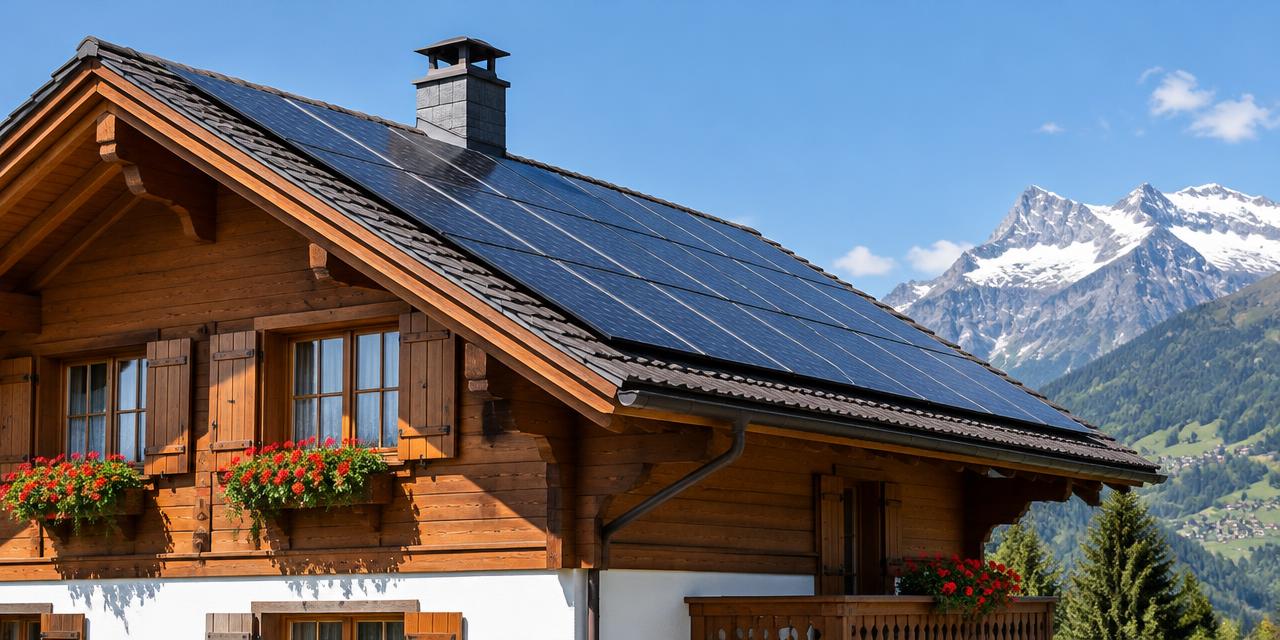
Small project
CHF 9'800 – CHF 18'500
Typical project
CHF 18'100 – CHF 32'900
Large project
CHF 31'400 – CHF 55'800
Computed with our estimator for Genève (regional factor included), standard finish. Only the project size changes.
The canton of Geneva benefits from favorable sunshine, with global irradiation estimated at 1378 kWh/m²/year, offering interesting potential for photovoltaic electricity production.
7 °C and about 50 frost days per year, climatic conditions are favorable for harnessing solar energy, provided the project is well-sized for the household's needs. Undertaking these works not only reduces reliance on traditional networks but also increases the value of your local real estate.
The choice of timing is strategic. It is often advisable to combine the solar installation with roof renovation to optimize costs and integration. The overall profitability of such an installation depends mostly on the share of electricity consumed on-site.
Therefore, analyzing your annual consumption is an essential prerequisite before launching any technical study, ensuring a better match between solar production and your actual needs.
The technical design of a photovoltaic installation in Geneva depends on several key factors. The quality of the panels varies, and different ranges allow adaptation to surface constraints. A roof facing south with an inclination of about 30 degrees allows for optimal yields, estimated at around 1213 kWh/kWp/year.
The choice of mounting system, whether mounted above or integrated into the roof, influences not only the final aesthetics but also the overall cost of the project and future maintenance ease.
Besides the panels themselves, the inverter is a crucial component that converts the direct current produced into alternating current. Its quality and durability guarantee the system's longevity.
Some options, such as coupling with a storage battery or an intelligent energy management system, allow increasing the self-consumption rate, which is the main factor determining profitability.
It is advisable to carefully study these options with a certified installer to maximize the energy yield of your roof according to its specific configuration.
In Geneva, the real estate stock presents varied and sometimes constrained construction contexts. While precise data per municipality is limited, energy renovation requires taking into account the construction era.
For old buildings, the structure of the framework must be checked by a professional to ensure it supports the additional weight of the panels.
Furthermore, thermal insulation of the roof is often a priority step: installing panels on a poorly insulated roof is counterproductive, as part of the energy produced could be saved by a better thermal envelope.
The presence of old materials, such as asbestos in certain roof elements dating from before 1990, requires particular attention when installing fixing systems. It is mandatory to seek a professional diagnosis if there is any doubt about material composition.
Finally, the internal electrical networks of old houses may sometimes require compliance upgrades to handle the injection or management of photovoltaic current. A prior inspection of the electrical panel is a necessary step to avoid any unforeseen extra costs during the deployment of your solar installation.
In Geneva, administrative procedures are overseen by the Office of Urban Planning. A photovoltaic installation is subject to a building permit, but with a simplified procedure if certain conditions are met, particularly for power below 100 kVA.
The procedure may be limited to a prior declaration for compliant pitched roofs or non-visible flat roofs. Federal law takes precedence over local regulations for "sufficiently adapted" installations, meaning a simple announcement is often enough, except for listed buildings or those located in protected areas.
Heritage protection is a central aspect. If your building is located in an ISOS zone, in the Old Town, or if it is a historical monument, constraints are stricter. For buildings of high heritage value, panels can only be installed on mansard roofs, flat roofs, or annexes, and must be laid flat.
In protected villages (zone 4B), a notice of commencement of work may suffice. It is strongly advised to consult the municipal services before any commitment, as landscape integration rules remain paramount in the canton.
The incentive system in Geneva is based on two pillars. First, the federal one-off remuneration via Pronovo significantly reduces the initial investment for small installations. This aid is supplemented by variable Geneva grants.
It is crucial to note that the order of procedures must be respected: the aid application must be filed before the start of works. A late application could lead to the refusal of any subsidy.
Profitability depends closely on the self-consumption rate, as the electricity you consume yourself does not require purchasing from the grid. In addition to direct aid, tax deductions are often possible for energy-saving investments.
We advise you to check with your cantonal tax administration about the deductible amounts applicable to your situation. The combination of the federal one-off remuneration and local support, coupled with favorable taxation, is a powerful lever to make your photovoltaic project financially attractive in the long term.
The deployment of a solar installation follows a structured process. The first step consists of a technical feasibility study and an analysis of your electricity consumption.
Once needs are established, administrative procedures, including the building permit application or prior declaration to Geneva authorities, must be carried out. This phase may vary according to the complexity of the file and the heritage classification of the building.
It is recommended to start these steps well in advance to secure necessary permits before ordering equipment.
Regarding the operational schedule, the ideal period for work is outside periods of heavy frost, although the Geneva climate is relatively moderate with about 50 frost days per year. Planning outside of winter ensures better safety conditions for installers and smoother execution.
The site includes installing mountings, modules, wiring up to the electrical panel, and finally commissioning with grid connection. Good project monitoring ensures every step complies with current standards.
Before requesting quotes, ensure you have completed a full energy audit of your home. A common mistake is undersizing the installation or, conversely, ignoring the specific heritage constraints in Geneva.
Check that your roof is in good condition before installing panels, as future repairs would be more expensive after installation. Systematically request multiple quotes to compare technical solutions and the quality of equipment offered by different providers.
Checklist before contacting professionals : verify the available surface and orientation of your roof; list your total annual consumption; inquire about the heritage protection zone of your plot with the municipality; ensure your electrical panel complies with current standards; and finally, check that you are aware of the conditions for obtaining the federal one-off remuneration.
By following these points, you will avoid unpleasant administrative or technical surprises and greatly facilitate communication with your future installer.
Variable additional grants; federal one-off payment by capacity.
Geneva strongly supports solar PV, with grants in addition to the federal one-off payment.
www.pronovo.chCheck amounts and conditions with the provider before signing: apply before work starts in most cases.
1204 Genève · about 0.1 km
Opus Solar SA, based in Geneva, develops, designs, builds and operates renewable energy production and distribution installations.
elektro-blitz.ch1204 Genève · about 0.1 km
Chris Energies is a Geneva-based company specializing in the installation, maintenance, and repair of heating systems, heat pumps, as well as photovoltaic and solar thermal equipment.
chris-energies.ch1205 Genève · about 0.8 km
Geneva-based company specializing in electrical installations, telecommunications, home automation, and energy transition solutions for various buildings.
eggtelsa.com1205 Genève · about 0.8 km
Founded in 1934 in Geneva, Cometel SA is a general electrical company that also installs photovoltaics.
cometel.chSuggestions from the commercial register by distance and activity. Not an endorsement or partnership.
Most roof installations are subject to a simplified procedure or a simple announcement. However, protected buildings require prior authorization.
You can benefit from the federal one-off remuneration via Pronovo. Additional Geneva grants may also be available depending on the project.
Yes, the profitability of your installation depends mainly on the share of electricity you consume directly in your household.
The Geneva climate allows for serene installation, but frost periods should be avoided to ensure the safety and quality of the construction site.
It is possible with strict constraints, notably a flat layout and mandatory prior authorization to respect the heritage.
The aid application must be made before any work begins. An application filed after the work is finished will be rejected.
It is recommended to renovate insulation before installing panels to maximize the building's overall energy efficiency.
Source : Open-Meteo Historical Weather API (réanalyse ERA5, moyenne 2015-2024) · estimate
Source : swisstopo – service d'altitude (MNT)
Source : Open-Meteo Historical Weather API (réanalyse ERA5, moyenne 2015-2024)
Source : Open-Meteo Historical Weather API (réanalyse ERA5, moyenne 2015-2024)
Source : Open-Meteo Historical Weather API (réanalyse ERA5, moyenne 2015-2024)
Source : Open-Meteo Historical Weather API (réanalyse ERA5, moyenne 2015-2024)
Source : Open-Meteo Historical Weather API (réanalyse ERA5, moyenne 2015-2024)
Source : ge.ch
Source : Guide Installations Solaires et Thermopompes - Canton de Genève