
Canton
Solar PV — one-off payment (Valais)
Based on installed capacity; municipal premiums possible.
Federal one-off payment for PV; some Valais municipalities add premiums.
www.pronovo.chSolar panels · Martigny
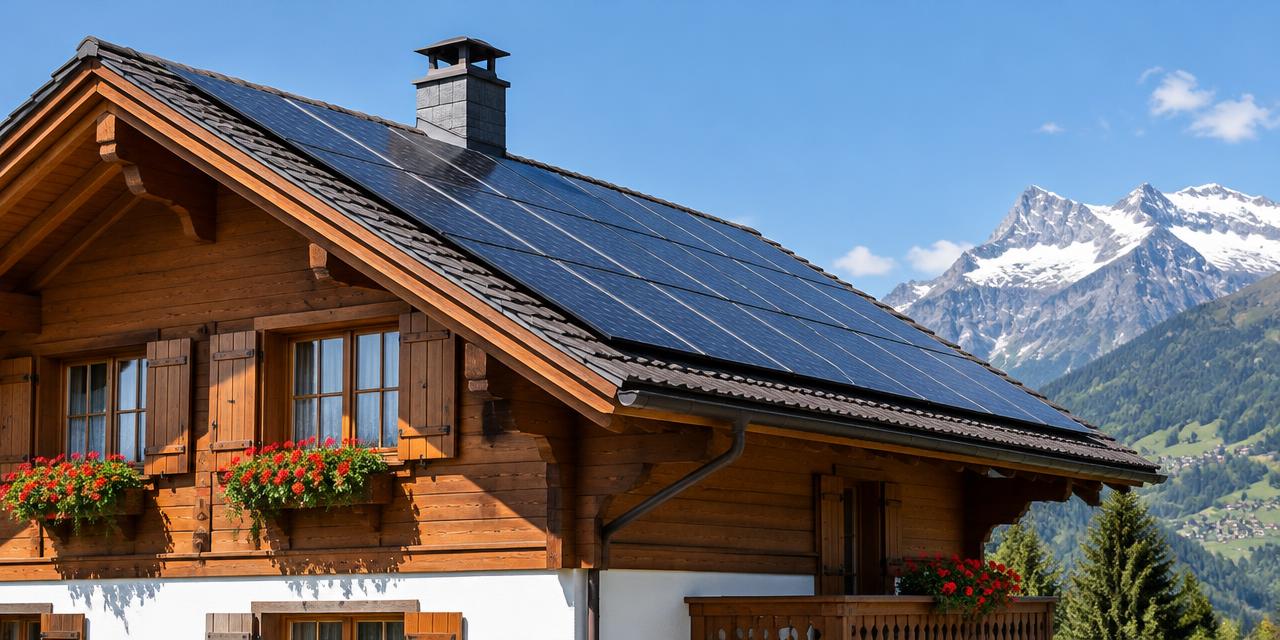
Small project
CHF 9'800 – CHF 18'500
Typical project
CHF 18'100 – CHF 32'900
Large project
CHF 31'400 – CHF 55'800
Computed with our estimator for Martigny (regional factor included), standard finish. Only the project size changes.
Martigny benefits from an attractive global irradiation reaching about 1,423 kWh/m²/year on horizontal surfaces, offering significant photovoltaic potential.
With an altitude of 471 meters and about 50 frost days per year, local climatic conditions require robust technical choices to ensure the durability of your installation. Undertaking these works allows you to benefit from local production, especially during months with optimal sunshine.
The estimated yield can reach 1,252 kWh/kWc/year on a roof facing south with a tilt of about 30 degrees.
The decision to install solar panels is wise when your roof requires repairs or during a comprehensive energy renovation of your home. Given the heating needs (2,482 Kj/year), coupling your solar installation with a heat pump allows you to optimize your self-consumption.
By acting now, you add value to your real estate while contributing to the reduction of your carbon footprint, in line with cantonal energy transition goals. It is essential to consult a professional to accurately assess the capacity of your structure to support the loads associated with solar equipment.
The choice of equipment is decisive for the long-term performance of your solar plant. There are different ranges of photovoltaic modules, from standard monocrystalline to more advanced technologies that offer better efficiency in low light conditions.
The integration into the building, whether the panels are mounted on your existing roof or integrated directly into the roof (replacing tiles), is a major factor in cost and aesthetic variation.
An integrated installation is often preferred for architectural reasons, while mounting over the roof remains the most common and simplest to implement.
Beyond the panels themselves, the choice of the inverter or micro-inverters plays a crucial role. These components convert direct current into alternating current usable by your home.
In some cases, adding a storage battery allows you to increase your self-consumption rate by storing surplus energy produced during the day for nighttime use.
Each project must be studied individually by a certified installer to balance the installed power, the capacity of your inverter, and the configuration of your roof, in order to maximize the overall profitability of the investment.
Martigny presents an architectural diversity that requires special attention before any installation. For buildings constructed before 1990, it is imperative to identify the potential presence of polluting materials, particularly asbestos, before starting work on the roof or frame.
Prior expertise helps avoid additional costs related to waste management or protecting the health of the workers. The load-bearing structure of older houses must be rigorously checked: a roof may require reinforcement if it was not initially designed to support the weight of solar panels and potential snow loads.
The electrical networks of older buildings may also require upgrading to current standards. Injecting electricity produced by your solar installation requires ensuring that your electrical panel supports the new configuration without risk of overload.
It is highly recommended to call upon a local electrician to assess the state of the existing installation before finalizing your quote.
If your building benefits from period thermal insulation, the solar project can be an opportunity to couple the installation of panels with a renovation of the thermal envelope, thus optimizing the overall energy efficiency of your home in the long term.
In Martigny, the situation regarding solar installation authorizations is evolving. The municipality is currently conducting an inventory of its built heritage. The sectors concerned include ISOS perimeters as well as zones concentrating historic buildings.
These zones will soon be integrated into the new zoning plan (PAZ) and the future construction and zoning regulation (RCCZ). If your building is located in a protected perimeter or is classified as heritage, the aesthetic and technical constraints will be stricter.
For any project, the first step is to contact the town planning department of the municipality to find out the precise status of your building and the required formalities.
It is important to note that an installation on a sufficiently adapted roof is often subject to a simple notification procedure. However, this facility may be limited depending on the specific geographic zones of the municipality. Never assume that no authorization is required.
Before incurring any costs or signing a quote, check with the local authorities if a building permit or a simple notification is sufficient. Failure to comply with current rules may lead to the stoppage of work or the obligation to remove non-compliant installations.
Respecting the heritage character of the city is a priority for local authorities.
To lighten your investment, it is essential to know the available support mechanisms. The federal one-off remuneration, managed by Pronovo, helps to significantly reduce the cost of your installation. This aid varies according to the installed power.
It is crucial to note that this request must be submitted before starting the work. In addition, some Valais communes offer specific local premiums to encourage the energy transition. Inquire with the commune of Martigny about current measures, as these aids can change and are not always cumulative.
The profitability of your project depends mainly on the share of electricity you consume on-site (self-consumption). The surplus is fed back into the grid, but the direct use of your own production remains the most effective financial lever.
Regarding taxation, investments made to save energy and protect the environment are, in many cases, deductible from your taxable income. Be sure to keep all invoices and documents related to your installation.
Consult your tax advisor to find out the deduction terms applicable to your particular situation in the canton of Valais. Following administrative procedures in the correct order is the key to securing your funding.
The realization of a solar project in Martigny follows a structured schedule to ensure the safety and compliance of the work. Everything starts with the audit and quote phase, followed by the funding request from Pronovo and the authorization request from the municipality.
Once authorizations are obtained, construction can begin. Seasonality is an important factor: it is better to plan the installation outside of periods of intense frost.
Although the Valais climate is rather mild, winter conditions can make work on the roof more complex and dangerous for installers, which naturally influences the availability of companies.
Once the structure is installed, technicians proceed to install the panels, wiring, and connection to the electrical panel. Commissioning is carried out after a rigorous inspection of the installation by an authorized body. This process ensures that your system meets Swiss technical standards.
Throughout these steps, communication with your installer is capital to follow the progress. Anticipate administrative delays, as they may vary.
The physical assembly itself represents only a fraction of the total project time, with the preparatory phases being those that ensure the longevity and performance of your installation.
To avoid disappointment, never sign a quote before clarifying urban planning requirements with the municipality of Martigny. A classic mistake is neglecting the condition of your roof before installation; it is essential to check if your roof frame is suitable for this extra weight.
Do not choose your provider solely on price, but prefer certified companies capable of providing local references. Always check if your home insurance covers the risks associated with the solar installation.
Here is your checklist before requesting quotes : make sure you know the year of construction of your building to assess risks related to asbestos; confirm with the municipality if an authorization or a simple notification is required for your plot; have the capacity of your electrical panel assessed to support the electricity injection; ask each company to include Pronovo procedures in their offer; check that the warranty for the panels and the inverter is clear and detailed; ask for an estimate of the expected self-consumption rate according to your consumption habits; finally, ensure you have secure access to your roof for future maintenance.
A photovoltaic installation is designed to last several decades, but its performance depends on regular maintenance. Although cleaning by rain is often sufficient, a periodic inspection is recommended to check for the absence of deposits, plant debris, or micro-cracks on the panels.
In Martigny, the geographic location can lead to an accumulation of snow or dust depending on the exposure, so it is useful to plan a visual inspection at least once a year by a professional. This maintenance ensures that the system always produces its optimal yield.
In addition to the panels, the inverter, which is a sensitive electronic part, requires special attention and may need replacement during the life of the installation. The durability of your system also relies on the quality of the monitoring.
Most modern installations allow for real-time monitoring via an app, alerting you in case of an abnormal drop in production. By remaining attentive to these indicators, you secure your investment while optimizing your local production.
Do not forget to keep in touch with your installer for any future technical intervention or to optimize your system settings according to the evolution of your energy needs.
Based on installed capacity; municipal premiums possible.
Federal one-off payment for PV; some Valais municipalities add premiums.
www.pronovo.chCheck amounts and conditions with the provider before signing: apply before work starts in most cases.
1920 Martigny · about 0 km
Valais-based group specializing in construction, painting, solar energy, and general renovation, led by a certified site manager.
globat.ch1920 Martigny · about 0 km
Based in Martigny, i-watt Sàrl specializes in the design, installation, and maintenance of solar photovoltaic systems in Valais.
i-watt.ch1920 Martigny · about 0 km
Electrical engineering office in Martigny specializing in planning, OIBT inspections, project management, and professional training.
btconcept.ch1920 Martigny · about 0 km
Martigny-based company founded in 1959, specializing in electrical installations, telephony, electronics, and telecommunications.
salaminsa.chSuggestions from the commercial register by distance and activity. Not an endorsement or partnership.
Most photovoltaic panels are designed to operate efficiently for more than 25 to 30 years. The inverter has a shorter lifespan, generally estimated between 10 and 15 years.
Yes, any installation requires a verification with the town planning department. A simple notification may suffice, unless your building is in a protected or heritage zone.
Yes, they continue to produce electricity even in cloudy weather. The yield is, however, reduced compared to a sunny day without clouds.
You must submit an application to Pronovo before starting the work. This is a crucial step to ensure your eligibility for this federal aid.
Absolutely, flat roofs are suitable for solar. Tilted structures are used to orient the panels optimally.
Routine maintenance is inexpensive and often limited to an annual visual inspection. Cleaning can be done if you notice a significant drop in yield.
They are optional but allow you to increase your self-consumption. They are particularly interesting if you consume a lot of energy in the evening.
Source : Open-Meteo Historical Weather API (réanalyse ERA5, moyenne 2015-2024) · estimate
Source : swisstopo – service d'altitude (MNT)
Source : Open-Meteo Historical Weather API (réanalyse ERA5, moyenne 2015-2024)
Source : Open-Meteo Historical Weather API (réanalyse ERA5, moyenne 2015-2024)
Source : Open-Meteo Historical Weather API (réanalyse ERA5, moyenne 2015-2024)
Source : Open-Meteo Historical Weather API (réanalyse ERA5, moyenne 2015-2024)
Source : Open-Meteo Historical Weather API (réanalyse ERA5, moyenne 2015-2024)
Source : Martigny.ch