
Canton
Facade insulation — Valais
Contribution per m² depending on requirements met.
Valais support for envelope insulation via the Buildings Programme.
www.leprogrammebatiments.chFacade insulation · Monthey
Small project
CHF 20'000 – CHF 41'400
Typical project
CHF 36'800 – CHF 73'000
Large project
CHF 62'100 – CHF 120'400
Computed with our estimator for Monthey (regional factor included), standard finish. Only the project size changes.
With an altitude of 407 meters and approximately 64 days of frost per year, Monthey presents real climatic challenges for maintaining comfortable indoor temperatures.7 °C, placing a high demand on existing heating systems.
Undertaking facade insulation helps reduce energy needs, aligning with the city's goals as an 'Energy City Gold' to promote energy renovations.
The ideal time to consider these works is when you notice deterioration of the external plaster or a persistent increase in heating bills despite having high-performance equipment.
By insulating your building envelope, you directly impact the durability of your structure while meeting the priorities of the 2023-2027 energy policy program. The latter emphasizes energy efficiency, making every renovation project an active contribution to the commune's ecological vision.
The success of facade insulation relies on the choice of materials, which depends on both your budget constraints and the desired thermal performance. You can choose from synthetic, mineral, or bio-sourced insulation.
Each material has specific thermal conductivity that influences the final thickness of the insulation system. This choice impacts not only the overall thermal resistance of your wall but also its permeability to water vapor, a crucial point for avoiding condensation issues.
The installation system, whether glued, mechanically fixed, or ventilated, is another major variable. A ventilated facade system, for example, allows for better moisture management by creating an air gap between the insulation and the outer cladding.
It is important to clearly define the desired level of quality during the design phase, as this will determine the durability of the final finish. It is essential to consult qualified professionals to validate the compatibility of the chosen system with your building's structural characteristics.
Monthey's building stock is diverse, ranging from older buildings to modern constructions. For houses built before 1990, particular attention must be paid to the potential presence of harmful substances, particularly asbestos in old plasters or joints.
Before any intervention, an asbestos assessment may be necessary to secure the worksite. The structure of the walls, whether solid masonry or concrete, requires different anchoring techniques to ensure the stability of the insulation system.
Furthermore, older buildings often have thermal bridges at floor slabs and lintels, which must be addressed to maximize energy efficiency. In the case of major renovations, the condition of utility lines embedded in facades, such as rainwater downspouts or external electrical wiring, should also be checked.
By anticipating these elements, you avoid extra costs related to unforeseen changes. A detailed analysis by an expert will allow for an assessment of your building's structural health and help adapt technical choices to avoid issues related to poorly managed sealing.
Any change to the exterior appearance of a building requires particular vigilance. In Monthey, as elsewhere, exterior insulation changes the dimensions and appearance of the facades, which generally implies a building permit application to the communal authority.
It is imperative to check the building regulations in advance to see if your building is subject to specific restrictions or is located within a protected area.
The final aesthetic look, including the choice of finishing materials and the color of the plaster, may also be subject to validation by the urban planning department.
If you are planning to install thermal insulation, ensure that the added thickness does not violate distance rules from property lines. Changing the facade alignment can effectively reduce the existing setback.
Contact the commune's urban planning department to clarify local administrative requirements before incurring any costs. Rigorous planning including these steps will help you avoid significant delays in your project and ensure that your work complies with local authorities.
The canton of Valais offers incentive measures for building envelope insulation as part of the 'Programme Bâtiments'. These subsidies, calculated per m², are a major financial lever to support your renovation work.
It is fundamental to remember that any subsidy application must be submitted and validated before the actual start of work. Undertaking work without this prior step would permanently deprive you of the right to cantonal aid.
Regarding taxation, expenses aimed at improving the energy efficiency of your home can be deductible from your income tax. Check with your cantonal tax authority regarding deduction modalities for maintenance and energy improvement work.
Tax optimization, coupled with direct subsidies, can significantly reduce the final cost of your project. Consult the official 'Programme Bâtiments' portal to know the specific technical requirements that must be met to obtain the per-m² contributions.
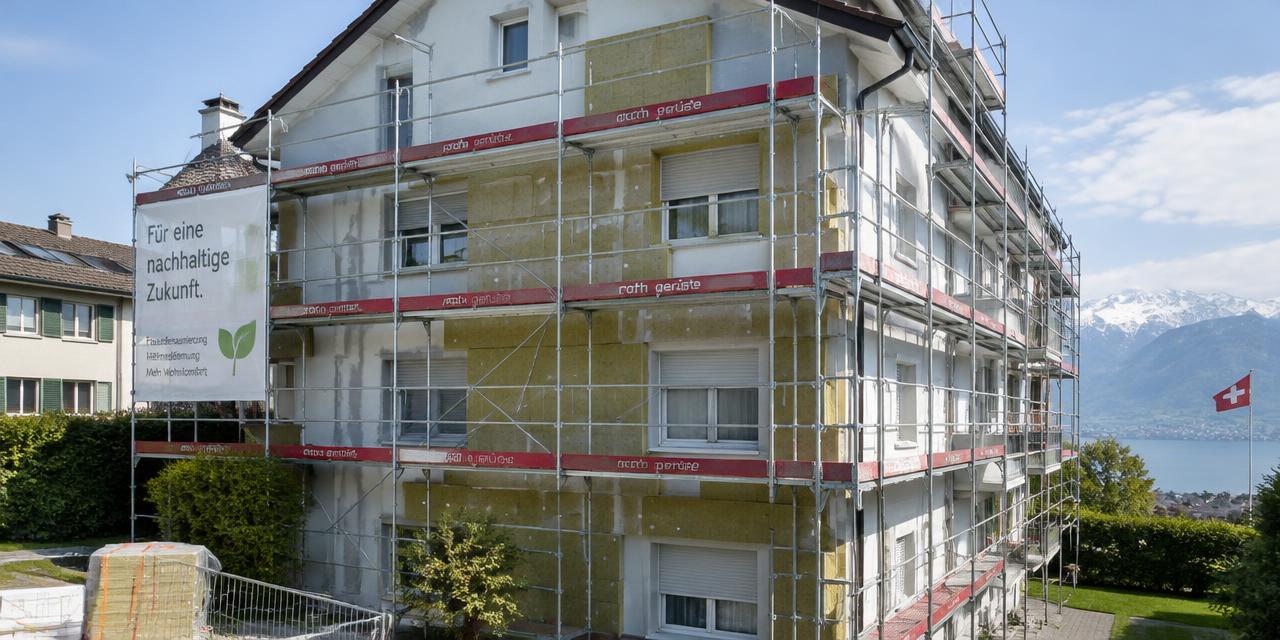
The progression of a thermal insulation project requires rigorous coordination to guarantee implementation quality. The initial phase consists of preparation, including the installation of scaffolding, which represents a significant portion of the overall cost.
It is therefore highly recommended to group your facade work with any interventions on the roof or window replacements to limit these fixed costs. Once the scaffolding is in place, cleaning and preparing the substrate are crucial to ensure good adhesion of the insulation materials.
The choice of season is decisive, especially in Monthey where temperatures can drop. The installation of insulation and the application of the final plaster require stable climatic conditions, without prolonged night frost.
Ideally, prefer the spring or autumn months to avoid extreme heat that can impair mortar setting, or freezing periods that would damage the material.
A well-planned project allows for the sequence of steps—insulation installation, reinforcement, base coat, and finishing—to be carried out with optimal efficiency, thereby minimizing construction-related disturbances for the neighborhood.
Never neglect the administrative aspect by starting work before obtaining official agreements, which would void your subsidy rights. Avoid underestimating the importance of protecting thermal bridges, otherwise mold may appear later.
Do not choose a contractor solely based on price, but check references and technical qualifications. Ensure that the insulation is compatible with your building's existing ventilation system to ensure healthy air. Finally, do not forget to include the cost of scaffolding in your total budget.
Checklist : Ensure you have identified all thermal bridges on your facade. Ensure you have consulted the Monthey urban planning department to understand local requirements. Request several detailed quotes to compare the technical solutions proposed by different contractors.
Check your project's eligibility for the 'Programme Bâtiments' and submit your subsidy application. Plan other heavy work, such as the roof, to be done at the same time. Check the condition of your windows, as facade insulation over defective windows is ineffective.
Contribution per m² depending on requirements met.
Valais support for envelope insulation via the Buildings Programme.
www.leprogrammebatiments.chCheck amounts and conditions with the provider before signing: apply before work starts in most cases.
1870 Monthey · about 0 km
Eni-Tech Peinture Sàrl is a company based in Monthey that specializes in interior and exterior painting work as well as plastering services.
eni-tech-peinture.ch1870 Monthey · about 0 km
RABO SA is a general contractor active in plastering, painting, tiling, and insulation works.
rabosa.ch1870 Monthey · about 0 km
L.A Lebrun Rénovation provides various renovation and maintenance services, including masonry, painting, as well as insulation and renovation of roofs and facades.
lebrun-renovation-la.ch1870 Monthey · about 0 km
Company based in Collombey specializing in waterproofing, thermal insulation, and roof maintenance services across French-speaking Switzerland.
visaretfilsetancheite.chSuggestions from the commercial register by distance and activity. Not an endorsement or partnership.
Yes, any modification to the exterior appearance generally requires a building permit application. It is advisable to contact the Monthey urban planning department before proceeding.
You can benefit from aid under the 'Programme Bâtiments' for insulating your envelope. The application must be submitted before work begins.
Yes, grouping facade, roof, and window work makes scaffolding costs cost-effective. It is a highly recommended strategy to optimize your budget.
The potential presence of asbestos in old materials must be checked before work. A structural assessment is also necessary to treat thermal bridges.
It is best to avoid frost periods and extreme heat. Spring and autumn generally offer more stable weather conditions.
Yes, work aimed at improving energy efficiency is often deductible. Consult your tax authority for specific details.
Monthey is an 'Energy City Gold' and prioritizes reducing energy consumption. Renovations are strongly encouraged by its action plan.
Source : swisstopo – service d'altitude (MNT)
Source : Open-Meteo Historical Weather API (réanalyse ERA5, moyenne 2015-2024)
Source : Open-Meteo Historical Weather API (réanalyse ERA5, moyenne 2015-2024)
Source : Open-Meteo Historical Weather API (réanalyse ERA5, moyenne 2015-2024)
Source : Open-Meteo Historical Weather API (réanalyse ERA5, moyenne 2015-2024)
Source : Open-Meteo Historical Weather API (réanalyse ERA5, moyenne 2015-2024)
Source : monthey.ch