
Canton
Facade insulation — Buildings Programme (VD)
Contribution per insulated m², depending on energy requirements met.
Grants for thermal insulation of the building envelope (walls, roof) via the Buildings Programme.
www.leprogrammebatiments.chRoof renovation · Lausanne
Small project
CHF 16'400 – CHF 37'600
Typical project
CHF 29'700 – CHF 65'400
Large project
CHF 49'600 – CHF 107'200
Computed with our estimator for Lausanne (regional factor included), standard finish. Only the project size changes.
In Lausanne, located at an altitude of 493 meters, your roof is subject to significant climatic constraints.8 °C, the roof must offer optimal insulation to limit energy losses, illustrated by heating needs reaching 2914 Kj/year.
An aging roof quickly becomes a major weak point, especially in a city labeled Cité de l'énergie Gold, where thermal performance standards are becoming essential.
It is advisable to act before the appearance of structural damage caused by water infiltration or premature material wear. By anticipating the refurbishment, you not only benefit from better thermal efficiency but also actively contribute to the municipality's Climate Plan.
Timely intervention avoids costly emergency repairs and improves the heritage value of your property in a housing stock composed of approximately 24% single-family homes.
The choice of materials for your roof must take local conditions into account. At altitude, snow loads and frost directly influence the durability of the roofing. You can opt for clay tiles, concrete, or even metal solutions depending on the building's aesthetics.
It is essential to integrate a reflection on solar energy, as with global irradiation of 1363 kWh/m²/year, the production potential is significant, estimated at approximately 1199 kWh/kWp/year for a south-facing roof with a 30° slope.
When renovating, consider insulating the roof at the same time as the roofing, as this approach is often eligible for the Building Program. If solar panels are installed, their removal and reinstallation must be budgeted for from the start of the project.
The choice of materials also affects the exterior appearance, a crucial point if your building is part of protected inventories. Be sure to consult professionals to evaluate the best ratio between performance, cost, and durability in the Lausanne climate.
Lausanne's housing stock is rich and diverse, requiring special attention during roofing work according to the construction era. Older buildings are often subject to strict rules via the Architectural Census of the Canton of Vaud.
Before 1990, there is a risk of asbestos in old insulation or roofing materials, which requires a professional diagnosis before any demolition or work on the framework. The treatment of electrical networks and the improvement of insulation are major issues for old houses.
More recently, buildings incorporate better performance, but may require upgrades to meet the objectives of the current Climate Plan. Roof insulation must be harmonized with existing structures to avoid any thermal bridges.
It is imperative to check federal, cantonal, and municipal inventories to see if your building benefits from heritage protection. A good understanding of these specifics allows you to enhance your property while respecting the history and energy requirements of the city.
In the Canton of Vaud, the building permit procedure is standardized. For a roof renovation, it is common to use a simplified building permit procedure or even obtain an exemption from the building permit, unless the building is protected or located in a protected area.
In the event of a change in exterior appearance or significant dimensions, authorization becomes mandatory. The municipality or the prefect is the competent authority to validate this work.
If you are considering the installation of solar panels, the procedure is simplified or subject to an exemption from a building permit. For heat pumps, noise nuisance must be taken into account. For windows and facades, the rules are similar.
It is strongly advised to contact the municipality's urban planning services to check the status of your building before launching the project.
As heritage protection is a priority, Lausanne relies on precise inventories, and failure to comply with these rules can lead to work stoppages or restoration obligations at your expense.
Energy renovation is encouraged by tax mechanisms and subsidies. The Building Program (VD) offers subsidies for the thermal insulation of the building envelope, including the roof. It is crucial to submit your application before the start of the work to be eligible.
Tax-wise, the taxpayer can choose, for each building, between the deduction of effective costs and the flat-rate deduction. Investments intended to save energy are 100% deductible.
If these costs cannot be fully considered during the year of the work, the balance can be carried forward to the following two tax periods.
It is important to note that the flat-rate deduction is excluded if you claim carried-forward expenses or if the building is used for commercial purposes with high gross rental yields. The flat-rate deduction rates vary according to the age of the building and whether it is the taxpayer's home or other properties.
In the event of a move or sale, the right to deduct the balance of carried-forward expenses is retained.ch before validating your budget, as conditions change regularly.
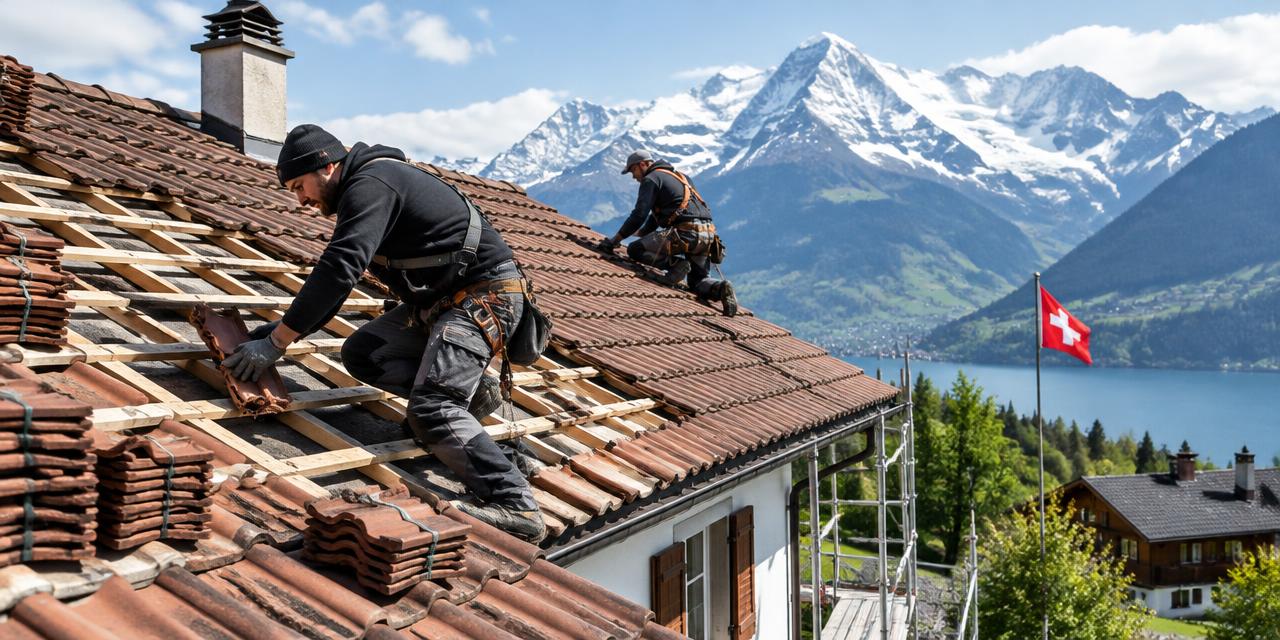
The planning of a roof renovation in Lausanne must imperatively integrate weather constraints., in spring, summer, or early autumn. The site generally begins with the installation of collective safety (scaffolding), followed by the dismantling of existing elements and waste management.
If insulation is planned, it is laid after checking the condition of the frame. Then comes the installation of the waterproofing and finally the final roofing.
A crucial step is the integration of solar panels, whose installation must be coordinated with the roofers. Throughout the work, protection against bad weather is paramount to avoid damaging the interior of the building. Acceptance of the work marks the end of the site and must be subject to rigorous control.
Keep in mind that local weather conditions can lead to schedule postponements. Regular communication with your roofing company is essential to adjust the schedule in real-time and ensure the success of your project.
One of the most common errors is forgetting to coordinate insulation work with roofing work, thus losing eligibility for subsidies. Never neglect to apply for municipal permits before starting work. Systematically check if your property is subject to heritage protection rules to avoid irreversible modifications.
It is imperative to include the removal and reinstallation of solar panels in your budget, if applicable. Do not launch your calls for tenders without a precise diagnosis of the state of the framework and the absence of asbestos.
Here is your checklist : submit your subsidy applications before signing any quotes. Have the framework inspected by a professional to detect any weaknesses. Check your building's protection status with the municipality. Coordinate your roofing and insulation work.
Ensure that solar panels are included in your overall cost planning. Finally, request several detailed quotes and compare the services offered rather than focusing only on the price. This rigorous preparation will protect you against costly surprises during the renovation.
Contribution per insulated m², depending on energy requirements met.
Grants for thermal insulation of the building envelope (walls, roof) via the Buildings Programme.
www.leprogrammebatiments.chCheck amounts and conditions with the provider before signing: apply before work starts in most cases.
1010 Lausanne · about 0.5 km
Claude Favre SA, based in Lausanne, carries out architectural sheet metal, roofing and facade work for new buildings, renovations, alterations and building maintenance.
claude-favre.ch1012 Lausanne · about 0.8 km
INHOX Sàrl is a Lausanne-based company specializing in sanitary installations, heating systems, and tinwork.
inhox.ch1005 Lausanne · about 1.5 km
Atelier LTC is a Lausanne-based cooperative specializing in heating systems, solar thermal installations, and sheet metal work.
atelierltc.ch1005 Lausanne · about 1.5 km
Based in Lausanne, E. Deléderray Toitures SA carries out roofing, architectural sheet metal work and facade cladding for renovations and new builds.
delederray.chSuggestions from the commercial register by distance and activity. Not an endorsement or partnership.
The procedure depends on the final appearance and location of your building. Contact the municipality, as a simplified procedure or an exemption may apply if you do not change the dimensions.
Yes, if you meet the insulation criteria. You must absolutely submit the application before the start of the work for it to be valid.
Asbestos can be found in old insulation materials. A professional diagnosis is required before any work on the roof to avoid exposure.
Energy investments are 100% deductible. You can choose between the deduction of effective costs or the flat-rate deduction depending on your tax situation.
It is better to avoid the winter period because of frost. Spring and summer seasons are optimal for the execution of the work.
Constraints are stricter to preserve heritage. You must consult Lausanne's urban planning services before considering any changes.
Yes, Lausanne has excellent solar potential. Remember to budget for the dismantling of the panels during future roofing renovations.
Source : swisstopo – service d'altitude (MNT)
Source : Open-Meteo Historical Weather API (réanalyse ERA5, moyenne 2015-2024)
Source : Open-Meteo Historical Weather API (réanalyse ERA5, moyenne 2015-2024)
Source : Open-Meteo Historical Weather API (réanalyse ERA5, moyenne 2015-2024)
Source : Open-Meteo Historical Weather API (réanalyse ERA5, moyenne 2015-2024)
Source : Open-Meteo Historical Weather API (réanalyse ERA5, moyenne 2015-2024)
Source : Protection du patrimoine : cadre légal et réglementaire – Ville de Lausanne · estimate
Source : Canton de Fribourg: Permis de construire (example, this is Fribourg) · estimate
Source : Règlement sur la déduction des frais relatifs aux immeubles privés (RDFIP)
Source : lausanne.ch
Source : Open-Meteo Historical Weather API (réanalyse ERA5, moyenne 2015-2024) · estimate