
Canton
Facade insulation — Neuchâtel
Per cantonal schedule.
Neuchâtel grants for energy renovation of the building envelope.
www.leprogrammebatiments.chFacade insulation · Neuchâtel
Small project
CHF 18'200 – CHF 37'600
Typical project
CHF 33'500 – CHF 66'400
Large project
CHF 56'500 – CHF 109'500
Computed with our estimator for Neuchâtel (regional factor included), standard finish. Only the project size changes.
5 °C, the climate in Neuchâtel imposes high requirements on buildings. The 51 frost days per year place a heavy load on external walls, making facade insulation essential to limit heat loss. With 2866 heating degree days per year, thermal performance is a major lever to stabilize energy costs throughout the year.
As a 'Gold Energy City', the city actively encourages the renovation of the building stock to meet cantonal climate goals.
The best time to consider such work is when exterior plasters reach the end of their life or during an overall envelope renovation. If you notice thermal bridges, internal condensation, or constantly rising heating bills despite efficient equipment, intervention becomes urgent.
Anticipating this work not only improves your building's energy rating but also durably protects the structure against external climatic aggressions, thus enhancing your property value in a demanding market.
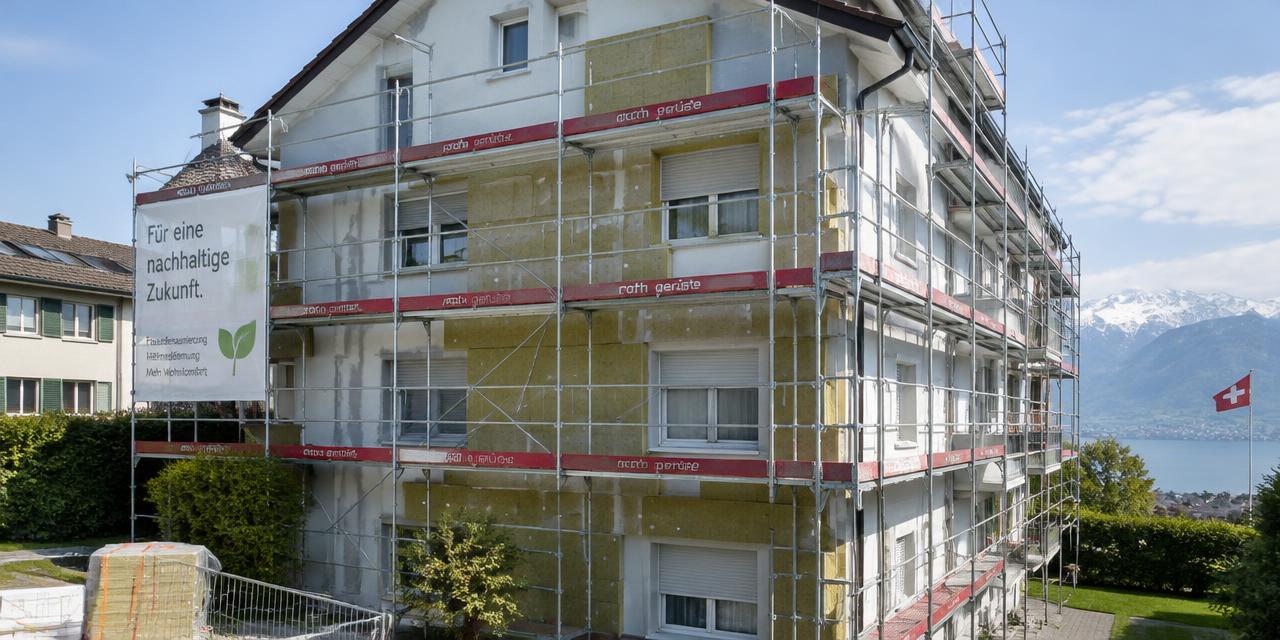
The insulation technique depends mainly on the structure of your walls and your energy performance goals. Exterior thermal insulation (ETI) is the most common method, allowing the building to be wrapped without reducing living space.
The choice of insulation materials, whether synthetic or natural, influences not only thermal performance (lambda) but also humidity behavior and the project's ecological footprint. There are different ranges of thicknesses and plaster finishes that impact the longevity of the facade.
An often recommended option is to combine facade insulation with window replacement. Since scaffolding represents a significant part of the cost, grouping facade, window, and roof work is a sound economic strategy.
Each project should be specifically studied by a specialist to define the optimal solution that respects the building's physical characteristics while maximizing comfort gains. High-end finishes offer better resistance to local weather conditions, thus reducing future maintenance needs in the long term.
The building stock in Neuchâtel presents varied challenges depending on the age of construction. Buildings erected before 1990 require special attention regarding the potential presence of harmful substances, particularly asbestos, often hidden in certain building materials or glues.
Before any project, an asbestos diagnosis may be necessary to secure the site. For older buildings, moisture management and wall breathability are critical; inappropriate insulation could cause structural disorders such as mold or condensation problems on interior walls.
The distribution network and technical elements integrated into the facades (cornices, balconies, anchors) are unique points to be treated with care. Integrating a new insulating layer changes the depth of window reveals, sometimes requiring custom adjustments of window sills to prevent water infiltration.
It is essential to consult original plans or call upon an architect familiar with regional specifics to avoid design errors that could harm your building's durability and structural integrity in the long term.
Exterior insulation modifies the building's visual appearance and almost systematically requires a building permit from the competent municipal authority. In a city rich in heritage like Neuchâtel, these applications are carefully examined, especially if your property is in a protected area or is listed.
The goal is to ensure that the modifications do not distort local architecture. Before starting, inquire with your municipality's urban planning department to understand the specific constraints applicable to your plot.
It is highly recommended to integrate this step very early into your project planning. Even if simplified procedures exist for certain elements, modifying the facade remains a significant structural change in the eyes of the authorities.
Prepare a complete file including plans, material types, and planned facade finishes. Failure to comply with local rules can lead to a site stoppage or an obligation to restore the building to its initial state.
Collaboration with a local professional familiar with the authorization processes in Neuchâtel greatly facilitates obtaining the necessary permits and ensures the compliance of your project.
Energy renovation is supported by concrete incentive schemes in Neuchâtel. A subsidy application must generally be submitted before the start of work, otherwise, it may be refused. Grants for facade insulation are available according to the cantonal scale via The Buildings Program.
These contributions help to reduce the overall cost of your project. It is essential to check the grant conditions and submit your complete file as soon as technical choices are validated, but strictly before work begins.
Regarding taxation, you can deduct expenses intended to save energy. If your maintenance and improvement expenses exceed the net income of the building in year N, you have the possibility to carry forward the non-deducted part to the next two tax years (N+1 and N+2).
This rule applies to work declared in full in the year of billing. Note that if you choose the flat-rate deduction for maintenance, you cannot cumulate other actual deductions for that building. The Tax Administration determines the carry-forward expenses.
Consult a tax advisor to optimize your tax return according to your particular wealth situation.
The flow of a facade insulation project follows several methodical steps. After obtaining permits and validating subsidies, the site starts with the installation of scaffolding. This step is crucial and costly; it is the ideal time to carry out other facade, roof, or window work to optimize the investment.
Workers then proceed to prepare the support (cleaning, crack treatment), install the insulation, and then apply the finishing plaster. Weather plays a key role in the proper adhesion of materials, particularly due to frost periods that can affect the setting of exterior plasters.
Ideally, work is carried out during the warm season to guarantee optimal drying conditions. It is advisable to plan your project well in advance to include administrative phases and company availability. The site ends with the dismantling of scaffolding and final site cleanup.
The total duration depends on the building's surface and complexity. Good coordination between the different trades ensures smooth execution and limits inconveniences for occupants.
One of the most frequent errors is starting renovation work without having previously submitted the required subsidy applications, making any financial aid impossible. It is also risky to ignore local rules regarding the building's visual appearance, which can lead to heavy administrative sanctions.
Another classic error is neglecting the condition of windows or the roof when installing scaffolding, thus missing an opportunity to group work to reduce fixed costs. Never underestimate the costs of preparing the support.
Checklist before asking for quotes : - Have you checked the municipal requirements related to your facade's appearance? - Have you submitted your subsidy application to the cantonal program before signing any contract? - Have you identified complementary work (windows, roof, networks) to carry out at the same time?
- Have you performed an asbestos diagnosis if your building dates from before 1990? - Have you planned a global thermal analysis to ensure the consistency of the insulation? - Have you properly distributed costs between maintenance and added value to optimize your taxation?
- Have you consulted a local professional accustomed to the specifics of Neuchâtel?
Per cantonal schedule.
Neuchâtel grants for energy renovation of the building envelope.
www.leprogrammebatiments.chCheck amounts and conditions with the provider before signing: apply before work starts in most cases.
2000 Neuchâtel · about 0 km
Isol-Express SARL in Neuchâtel specializes in facade insulation, flooring installation, and terrace cleaning.
net-express2000.ch2000 Neuchâtel · about 0 km
JENOSA SA is a Swiss company that finances, acquires, and operates photovoltaic power plants, battery storage systems, and heat production facilities.
jenosa.ch2000 Neuchâtel · about 0 km
PHIDA is a company specializing in waterproofing, metal roofing, roofing, facades, and sanitary services.
phida.ch2000 Neuchâtel · about 0 km
Neuchâtel-based company specializing in painting, plastering, and complete interior and exterior renovations for residential and commercial projects.
les-couleurs-infinies.chSuggestions from the commercial register by distance and activity. Not an endorsement or partnership.
You can benefit from aid via The Buildings Program for the energy renovation of your facade. The amount is calculated according to the applicable cantonal scale.
Yes, because external insulation modifies the appearance of the facade. You must consult the competent municipal authority before starting the work.
Yes, investments intended to save energy are deductible. You can carry forward the non-deducted part to the next two tax years.
Yes, it is essential for buildings constructed before 1990. This secures the site and allows for the removal of hazardous substances.
It is preferable to carry out this work during the warm season to ensure proper drying of materials. Avoid periods of heavy frost.
It is highly recommended, especially with changing windows or roof. This optimizes the cost of the scaffolding required for the project.
You have the choice between actual costs and flat rate. However, if you opt for the flat rate, you cannot deduct energy expenses additionally.
Source : swisstopo – service d'altitude (MNT)
Source : Open-Meteo Historical Weather API (réanalyse ERA5, moyenne 2015-2024)
Source : Open-Meteo Historical Weather API (réanalyse ERA5, moyenne 2015-2024)
Source : Open-Meteo Historical Weather API (réanalyse ERA5, moyenne 2015-2024)
Source : Open-Meteo Historical Weather API (réanalyse ERA5, moyenne 2015-2024)
Source : Open-Meteo Historical Weather API (réanalyse ERA5, moyenne 2015-2024)
Source : azprojet.ch
Source : SCCO_I772_Notice4_PP.pdf
Source : Ville de Neuchâtel