
Canton
Solar PV — one-off payment and Vaud support
One-off payment calculated on installed capacity (kWp).
Federal one-off payment for PV installations, sometimes topped up by cantonal or municipal grants.
www.pronovo.chSolar panels · Nyon
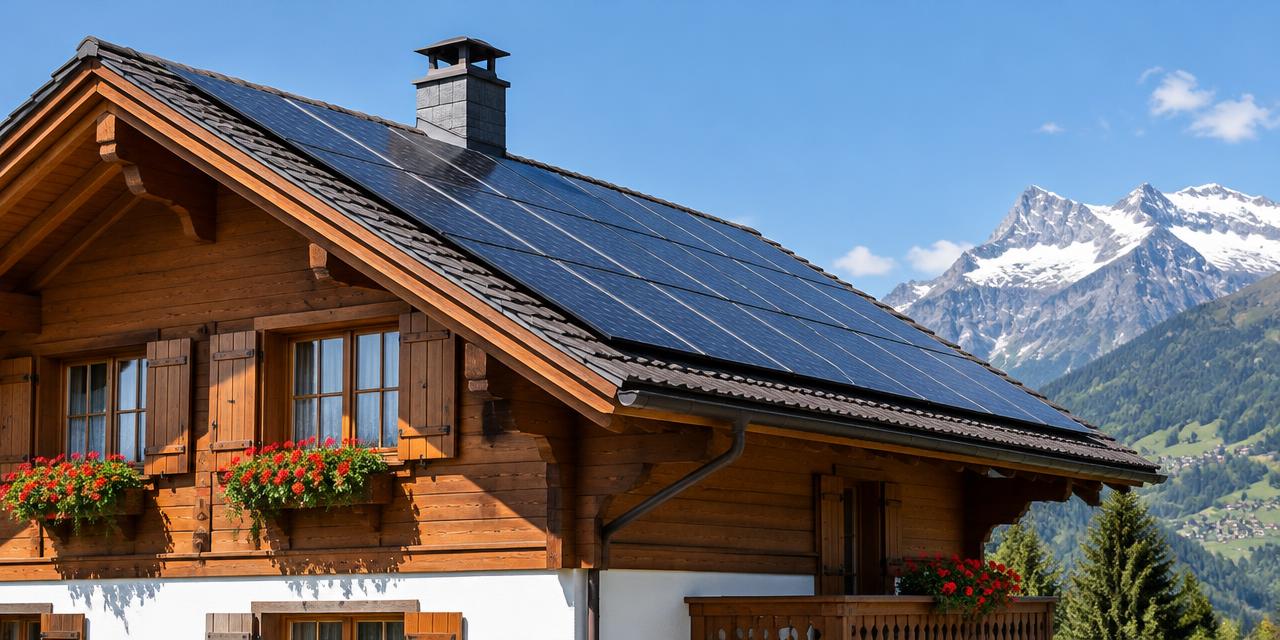
Small project
CHF 9'800 – CHF 18'500
Typical project
CHF 18'100 – CHF 32'900
Large project
CHF 31'400 – CHF 55'800
Computed with our estimator for Nyon (regional factor included), standard finish. Only the project size changes.
The City of Nyon has officially received the European Gold Energy City label, testifying to its active commitment to carbon neutrality by 2050. With an ambitious climate plan, the municipality strongly encourages energy transition.
Installing photovoltaic panels in Nyon allows you not only to reduce your individual carbon footprint but also to align with the city's collective goals, which aim for a 50% reduction in direct greenhouse gas emissions by 2030.
Climatically, Nyon benefits from favorable sunshine, with a global irradiation estimated at 1376 kWh/m²/year. The profitability of your investment will mainly depend on the share of electricity consumed on-site. In a period of rising energy costs, producing locally becomes a strategic lever.
Undertaking this work today allows you to secure your supply and enhance the value of your real estate by making it more efficient in the face of tomorrow's energy requirements.
The choice of equipment is decisive for the performance and aesthetics of your installation. On the market, panels vary according to their efficiency, durability, and architectural integration.
Roof-integration solutions, where panels replace tiles, are particularly popular for their aesthetics, especially in sensitive areas.
The federal one-off payment via Pronovo significantly reduces the initial cost for small installations, which often allows opting for more efficient technologies without increasing the final budget.
Different options exist depending on the configuration of your roof: central inverters for simple installations or micro-inverters to optimize yield in case of partial shading. The sizing of the installation must be calculated based on your actual consumption habits to maximize self-consumption.
An installation on a sufficiently adapted roof is often subject to a simple notification. The final choice must balance the initial investment with the expected production, while taking into account the longevity of the components.
Nyon's building stock is varied and requires a tailored approach. For older buildings, especially those built before the 90s, it is imperative to anticipate the presence of harmful materials such as asbestos during roof renovations to accommodate panels.
The local structure must also be assessed to support the additional load of solar panels. In some neighborhoods, the state of the roof's thermal insulation may justify a comprehensive renovation rather than a simple solar installation, in order to improve the overall energy rating of the building.
The cantonal building register (RCB) provides essential information about your property to evaluate its typology. Protected buildings require special attention.
However, the Municipality of Nyon is increasingly open to new technologies, and solutions such as solar tiles allow for harmonious integration of installations on complex or old roofs without distorting the historical character, especially in areas like the Rive district.
Nyon's heritage situation is governed by cantonal classification. For non-classified buildings (Note 3 to 6), the installation of solar panels generally benefits from a simplified procedure.
If your building is classified as Note 1 (national interest) or Note 2 (regional interest), or located in the protected perimeter of the Old Town (ISOS), a municipal authorization is mandatory. A 'Permis B' and a positive notice from the DGIP will be required.
It is advisable to consult the urban planning services before submitting any file to validate technical feasibility.
In the Old Town and the Rive district, the Municipality is now open to installing solar tiles on buildings not classified as note 1 or 2, via a simplified form. This technology allows for respecting architectural constraints while producing clean energy.
For any project, the golden rule remains early consultation with the municipality to avoid any late refusal due to an impact on the exterior appearance or the dimensions of the building.
The financing of a photovoltaic installation is supported by several mechanisms. The federal one-off payment via Pronovo helps cover part of the investment costs. In addition, the City of Nyon offers direct aid of 300 CHF per installed kWc, with a cap of 5'000 CHF per installation and a maximum of 15'000 CHF per owner.
It is crucial to submit your subsidy applications before the work begins, as no retroactive effect will be applied. These aids are cumulative, which significantly improves the project's profitability.
Regarding taxation, investments aimed at saving energy are 100% deductible from your taxable income. If the costs exceed your net income for the year, you have the option to carry over the balance to the next two tax periods.
Note, however, that in case of carry-over, you cannot benefit from the flat-rate deduction for maintenance costs in that same year. The choice between actual costs and flat rate will depend on your personal tax situation; it is recommended to do a simulation with your annual tax return.
The realization of a photovoltaic project follows a rigorous flow. Everything starts with a feasibility analysis and a request for quotes from certified professionals.
Once the partner is chosen, the next step is to submit the applications for municipal authorization and subsidies, which are essential prerequisites for any start.
The site itself usually begins with the preparation of the roof, followed by the installation of the mounting structure, the installation of the modules, and then the wiring and connection to the local electrical grid.
Seasonality is important : although installers can work throughout the year, it is preferable to avoid periods of intense cold, as Nyon counts about 33 days of frost per year. Working on a frozen roof carries increased risks for workers and can alter materials.
An optimized schedule ideally foresees the installation during the milder months, allowing for secure deployment. Administrative delays vary, so it is prudent to initiate steps well ahead of the desired installation season.
Among common mistakes, not consulting the municipality at the very beginning of the project is often a source of complications. It is imperative to avoid signing a contract before having received confirmations of subsidy grants.
Forgetting to check the general condition of the roof before installation can also be expensive if it has to be replaced a few years later. Finally, neglecting the optimization of self-consumption, for example by using energy-intensive appliances during the day, prevents achieving optimal profitability.
Here is your checklist : Check if your building is classified by the canton. Obtain at least three detailed quotes from certified local companies. Submit your subsidy application to the municipality before any commitment. Confirm the compliance of the chosen materials with heritage requirements.
Ensure that the installer includes administrative procedures in their services. Have a self-consumption plan drawn up based on your current electricity bills. Check the suitability of the roof structure to support the photovoltaic panels.
A photovoltaic installation is designed to be robust and requires little maintenance. The tilt of the panels generally favors cleaning by rain, which limits the accumulation of dust or snow. However, an annual visual inspection is recommended to check for the absence of debris or obstructions that could affect yield.
Inverters, as electronic components, may require replacement after about ten years, which should be budgeted during the initial investment. The average lifespan of the panels themselves is very high.
The durability of your installation also relies on regular monitoring of production via the tracking applications provided by the installers. In the event of an abnormal drop in production, a technical check allows for the rapid identification of a connection problem or hardware failure.
As an owner, rigorous management from the installation onwards, including a good manufacturer's warranty, ensures lasting peace of mind. Simple maintenance of your system helps maintain optimal production over several decades, thereby strengthening the long-term profitability of your energy investment in Nyon.
One-off payment calculated on installed capacity (kWp).
Federal one-off payment for PV installations, sometimes topped up by cantonal or municipal grants.
www.pronovo.ch300 CHF / kWc (max 5'000 CHF / installation)
Aide communale directe pour capteurs solaires photovoltaïques sur toiture ou façade. Plafond de 15'000 CHF par propriétaire. Cumulable avec l'aide fédérale Pronovo.
www.nyon.chCheck amounts and conditions with the provider before signing: apply before work starts in most cases.
1260 Nyon · about 0 km
Louis Bally et fils S.A. is an electrical contractor serving the Nyon and Rolle region, installing photovoltaic systems and offering battery storage and energy management solutions.
electricitebally.ch1260 Nyon · about 0 km
AstroVolt Sàrl in Nyon specializes in photovoltaic installations, charging stations, and general electrical work for private customers.
astrovolt.ch1260 Nyon · about 0 km
Swiss specialist in energy solutions: photovoltaics, heat pumps, solar batteries, charging stations, and sanitary installations.
stg-energy.ch1260 Nyon · about 0 km
Based in Nyon since 1982, Hanhart Electricité carries out electrical and photovoltaic installations and provides repairs, OIBT inspections and home automation services throughout the Lake Geneva region.
hanhart-electricite.chSuggestions from the commercial register by distance and activity. Not an endorsement or partnership.
Yes, it is possible under certain conditions. Municipal authorization is required, and the use of solar tiles is often favored to respect the aesthetics of the heritage.
You must submit your application to the municipality before starting any work. The aid is 300 CHF/kWc, which can be combined with the federal one-off payment.
Most rooftop installations follow a simplified procedure or a permit waiver. However, in protected areas, municipal authorization remains mandatory.
Yes, investments aimed at saving energy are 100% deductible. The balance can be carried over to the next two tax years if necessary.
Absolutely. Nyon benefits from a global irradiation of 1376 kWh/m²/year, which provides an excellent yield for a standard photovoltaic installation.
It is a federal subsidy paid as a lump sum based on installed power. It helps significantly reduce the initial investment.
It is highly recommended to renovate the roof before installing the panels. This avoids future dismantling costs and improves overall energy efficiency.
Source : Open-Meteo Historical Weather API (réanalyse ERA5, moyenne 2015-2024) · estimate
Source : swisstopo – service d'altitude (MNT)
Source : Open-Meteo Historical Weather API (réanalyse ERA5, moyenne 2015-2024)
Source : Open-Meteo Historical Weather API (réanalyse ERA5, moyenne 2015-2024)
Source : Open-Meteo Historical Weather API (réanalyse ERA5, moyenne 2015-2024)
Source : Open-Meteo Historical Weather API (réanalyse ERA5, moyenne 2015-2024)
Source : Open-Meteo Historical Weather API (réanalyse ERA5, moyenne 2015-2024)
Source : Ville de Nyon - Actualités
Source : Canton de Fribourg: Permis de construire (example, this is Fribourg) · estimate
Source : Règlement sur la déduction des frais relatifs aux immeubles privés (RDFIP)