
Canton
Solar PV — one-off payment (Valais)
Based on installed capacity; municipal premiums possible.
Federal one-off payment for PV; some Valais municipalities add premiums.
www.pronovo.chSolar panels · Sierre
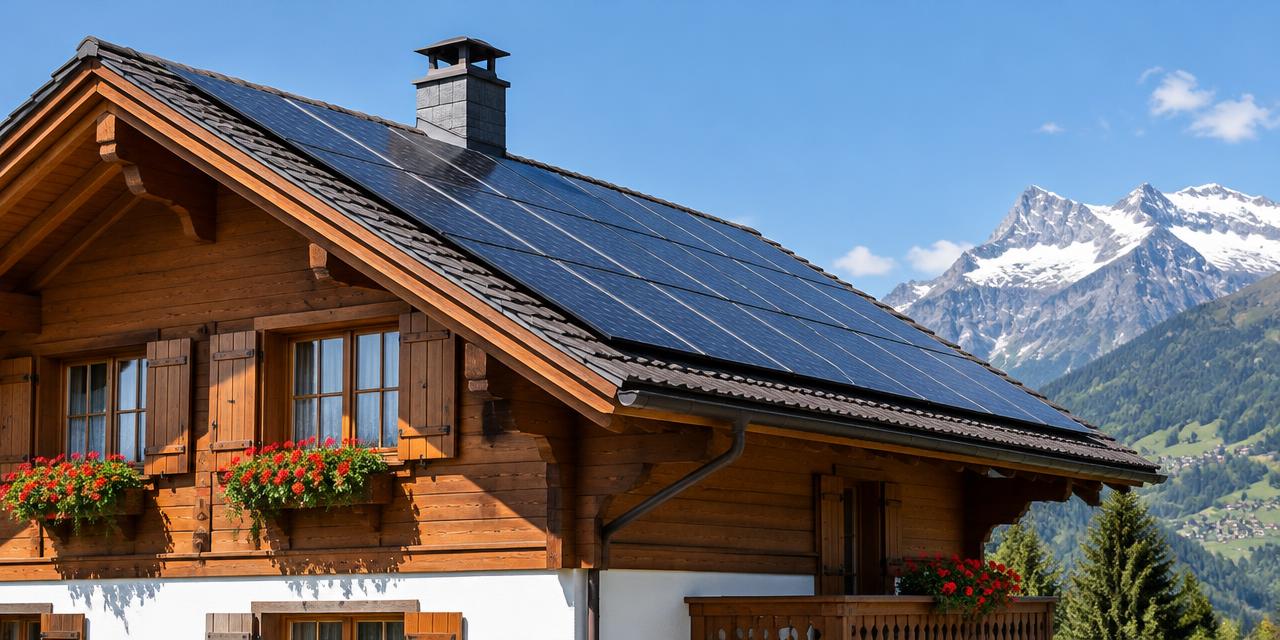
Small project
CHF 9'100 – CHF 17'200
Typical project
CHF 16'800 – CHF 30'500
Large project
CHF 29'100 – CHF 51'700
Computed with our estimator for Sierre (regional factor included), standard finish. Only the project size changes.
Sierre benefits from a privileged geographical location with an estimated annual global irradiation of 1451 kWh/m²/year, making it an ideal site for photovoltaics.3 °C and generous sunshine, installations on south-facing roofs achieve efficient yields of approximately 1277 kWh/kWp/year.
Starting work now allows for active participation in the goals of the Energy Policy Program and 2024–2027 Action Plan, strengthening the municipality's strategy as a Cité de l'énergie Gold.
The timing is strategic to take advantage of current support policies. The combination of federal aid and local dynamics favors increased profitability, especially when the portion of electricity consumed on-site is high.
Considering the 72 days of frost per year and a winter design temperature of -10 °C, it is preferable to schedule installations outside periods of intense cold to ensure safe working conditions and quick commissioning before winter consumption peaks.
The sizing of your solar installation depends primarily on the available roof surface and your annual consumption profile. An installation on a suitably adapted roof is often subject to a simple notification, but the choice of materials strongly influences production.
You can opt for monocrystalline panels, known for their high efficiency, or more aesthetic building-integrated models, although the latter require a more in-depth structural study.
The inverter, the heart of the system, must be precisely sized to convert DC to AC, taking into account losses linked to roof slope and orientation.
Options such as battery storage are becoming increasingly relevant for maximizing self-consumption. By storing excess production during the day to use it in the evenings, you significantly improve overall profitability.
It is also possible to integrate intelligent management systems that automatically control your energy-intensive appliances such as heat pumps or electric vehicle charging stations.
These technical choices require prior analysis to ensure that each component is compatible with your existing electrical installation while complying with current safety standards in the municipality.
In Sierre, the real estate stock presents great diversity, from traditional village houses to recent villas. For buildings constructed before 1990, it is imperative to include a technical assessment of construction materials.
Risks related to the presence of asbestos in old coverings or insulation can impact the construction process, particularly when fixing the support structures for the panels.
In addition, old electrical installations often require compliance checks to support the injection of solar electricity and ensure adequate protection against surges.
Roof insulation is another critical point. If your roof dates back several decades, it is recommended to take advantage of the panel installation to carry out a comprehensive energy renovation or, at a minimum, check the tightness of the roofing.
A poorly insulated roof can lead to significant heat loss, especially in a region marked by cold winters. Household electrical networks must also be evaluated: their ability to manage a bidirectional flow is decisive.
An upgrade to a smart meter is often necessary to accurately account for the energy injected into the grid, thus ensuring the long-term functioning of your system.
The municipality of Sierre actively encourages energy transition while ensuring the preservation of local heritage. For any solar panel installation, it is essential to check if your building is located in a protected zone or is subject to a heritage inventory.
If the building is listed or located in a sensitive historic perimeter, aesthetic constraints may apply, limiting the choice of materials or the placement of photovoltaic modules on the roofs.
It is advisable to contact the town planning department of the municipality before validating any technical quote to obtain precise guidelines regarding current administrative procedures.
In general, an installation on a suitably adapted roof is often subject to a simple notification. This means that the process is simplified compared to a full building permit application, provided the project complies with local regulations.
The notification must be submitted to the competent authorities with detailed installation plans. This step allows you to obtain an official opinion guaranteeing the compliance of your project with the local development plan and public safety rules.
Caution is advised : do not start any work without receiving confirmation of the validity of your notification or, if applicable, the required authorization.
The financing of your project can be optimized through several support mechanisms. The main pillar is the federal one-off payment for photovoltaics (managed via Pronovo), which reduces the initial investment according to the installed power.
It is crucial to note that this request must be made before the start of the work; any installation already completed cannot generally benefit from this aid.
In addition to federal support, some Valais municipalities offer supplementary communal premiums, which should be checked individually with the Sierre administration to know their current availability.
Profitability depends mainly on the share of electricity consumed on-site. Beyond direct aid, the installation can have a tax impact. In Switzerland, investment costs related to energy saving and environmental protection measures can sometimes be deducted from taxable income.
Ask your cantonal tax authority about the deduction methods applicable to energy renovation work.
By combining the federal one-off payment, potential local subsidies, and the optimization of your tax burden, you accelerate the return on investment of your installation while actively contributing to the climate goals of your region.
The flow of a photovoltaic construction site follows a rigorous logic to guarantee the quality of the work. After obtaining the necessary authorizations and the validation of aid, the preparation phase consists of ordering the material adapted to the specificities of your roof.
Then, the actual installation begins with the placement of the fixing system and solar panels. The installation of electrical wiring and connection to the domestic distribution board constitutes the next technical step.
It is preferable to avoid marked periods of frost, with 72 frost days per year in Sierre, in order to ensure the safety of workers on the roofs and the proper hold of the fixings.
Once the panels are installed, the commissioning phase follows. This phase includes performance tests to verify that the actual production complies with the simulations. Finally, the acceptance of the work allows for checking compliance with the initial file.
The overall schedule depends on the size of your project and the availability of the installers, but careful preparation beforehand often helps reduce unforeseen events.
Make sure to include margins for climatic hazards in your discussions with professionals, especially if your roof is particularly exposed, so as not to compromise the quality of the waterproofing after the installation.
To guarantee the durability of your installation, avoid neglecting the structural condition of your roof before installing the panels, as any subsequent repair will be expensive.
Never start work without receiving written confirmation regarding financial aid, as eligibility for subsidies depends on following this chronological order. Avoid underestimating your future electricity needs, especially if you plan to purchase an electric vehicle.
It is also risky to choose a provider solely based on the lowest price without checking their local references and experience with the specificities of Sierre's buildings.
Before requesting quotes, verify that your roof is well oriented and free from excessive shading. Prepare a copy of your annual electricity bills to allow for an accurate simulation of your self-consumption. Contact the urban planning department to confirm if a notification is sufficient or if a permit is required.
Finally, ensure that your electrical panel has the space required for the new components. By following these points, you secure your investment and ensure that the project complies with the region's energy requirements.
Based on installed capacity; municipal premiums possible.
Federal one-off payment for PV; some Valais municipalities add premiums.
www.pronovo.chCheck amounts and conditions with the provider before signing: apply before work starts in most cases.
3960 Corin-de-la-Crête · about 0 km
Domelec Sàrl is a Valais-based company specializing in photovoltaic installations, battery storage, and optimized energy home automation.
domelec.ch3966 Chalais · about 3 km
Solalpes Energie SA, based in Chalais, specializes in the design, installation, and distribution of photovoltaic systems in the Valais region.
solalpes-energie.ch3975 Randogne · about 3.3 km
Somiral Energy Supplies SA offers heating, ventilation and air conditioning installation, along with the design and turnkey delivery of electromechanical and solar energy projects.
somiral.com3963 Crans-Montana · about 4.7 km
Solartech Group provides sustainable energy solutions, including the installation of photovoltaic systems, battery storage, and heat pumps.
solartech-group.chSuggestions from the commercial register by distance and activity. Not an endorsement or partnership.
A suitably adapted roof installation is often subject to a simple notification. However, check with Sierre's urban planning department if your building is in a protected zone.
The federal one-off payment via Pronovo reduces the initial investment. Some Valais communal premiums may be added, inquire locally before signing.
Profitability depends mainly on the share of electricity consumed on-site. The more you use your own production during the day, the faster your return on investment.
Avoid winter periods marked by the 72 annual frost days. Installation in spring or summer facilitates the work and guarantees optimal commissioning.
Yes, it is highly recommended to check the condition of the roof. An energy renovation coupled with the photovoltaic installation optimizes the overall performance of the building.
For buildings built before 1990, yes. An assessment is necessary to avoid any health risks when fixing the structures to the roof.
Sierre benefits from an annual global irradiation of 1451 kWh/m²/year. This excellent exposure allows for yields estimated at 1277 kWh/kWp/year.
Source : Open-Meteo Historical Weather API (réanalyse ERA5, moyenne 2015-2024) · estimate
Source : swisstopo – service d'altitude (MNT)
Source : Open-Meteo Historical Weather API (réanalyse ERA5, moyenne 2015-2024)
Source : Open-Meteo Historical Weather API (réanalyse ERA5, moyenne 2015-2024)
Source : Open-Meteo Historical Weather API (réanalyse ERA5, moyenne 2015-2024)
Source : Open-Meteo Historical Weather API (réanalyse ERA5, moyenne 2015-2024)
Source : Open-Meteo Historical Weather API (réanalyse ERA5, moyenne 2015-2024)
Source : Ville de Sierre