
Canton
Heat pump grant — Valais
Flat contributions per kW or per installation depending on technology.
Valais supports renewable heating via the Buildings Programme and additional cantonal grants.
www.leprogrammebatiments.chHeat pump installation · Sion
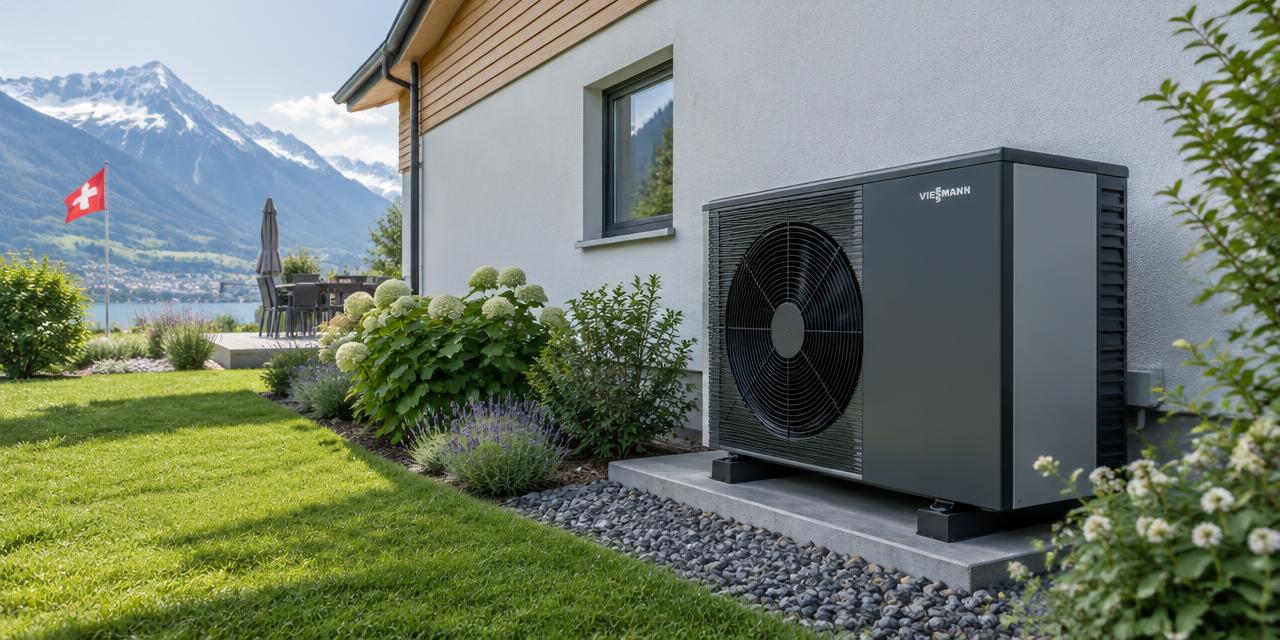
Small project
CHF 32'900 – CHF 60'300
Typical project
CHF 41'600 – CHF 77'500
Large project
CHF 54'600 – CHF 103'300
Computed with our estimator for Sion (regional factor included), standard finish. Only the project size changes.
Located at an altitude of 515 meters, Sion features a climate with significant thermal needs, illustrated by 2737 heating degree days per year.7 °C, choosing a high-performance system is crucial to ensure your comfort during the average of 57 frost days per year.
The Sion building stock, facing these conditions, must now modernize to align with the goals of the Sion Region Climate Plan. This plan, which brings together several neighboring municipalities, aims for a significant reduction in overall energy consumption and an acceleration of the transition to renewable energies.
It is recommended to anticipate the replacement of your fossil heating system before a total failure occurs. The process is part of a desire to increase the value of your property while contributing to local energy policy.
Before making any decisions, it is mandatory to check whether your neighborhood can be connected to the Sion district heating network, operated by OIKEN, which utilizes heat from the Central Valais Waste Treatment Plant.
If your sector is not covered, the heat pump represents a robust alternative, provided that the power is sized according to the local temperature to optimize energy efficiency over the long term.
The choice of a heat pump depends on several technical factors. Air-to-water technology is the most common, but it requires special attention regarding noise pollution. In dense urban areas, outdoor units must be positioned to strictly comply with the noise limits imposed on neighbors.
Overall performance will depend on the seasonal coefficient of performance (SCOP) of the chosen device, which must be able to operate efficiently even during cold spikes in Sion, where temperatures can drop well below zero.
Beyond the machine itself, integration with the existing heat emission system is decisive. If your home is equipped with high-temperature radiators, it may be necessary to replace them with low-temperature models or fan coils to maximize the pump's efficiency.
Options such as home automation connectivity now allow you to manage your consumption in real time. Finally, do not forget that the local design temperature determines the power required to avoid systematic reliance on an electric backup.
A prior thermal study is strongly recommended to correctly size the installation and ensure an optimal lifespan for your equipment.
The built heritage of Sion is rich and diverse, ranging from the medieval old town to more recent residential areas. In protected areas, constraints are strict. For buildings classified at grades 1 and 2, technical integration is complex.
Conversely, for grades 4 and 4+, solutions are more easily achievable provided that careful integration conditions are respected.
It is crucial to consult the urban planning department before planning the location of your outdoor unit, especially if you reside in a sensitive hillside area where the visual aspect is paramount.
The construction era of your home also influences risks. Buildings constructed before 1990 may contain traces of asbestos in insulation or glues. When modifying the heating network, asbestos removal work may be necessary. In addition, the overall thermal insulation of the building must be assessed.
A heat pump is more cost-effective the better insulated your house is. If walls or windows are old, it is often preferable to pair the heat pump project with work to improve the thermal envelope to reduce the required heating power and thus lower the initial investment.
Installing a heat pump in Sion requires compliance with municipal and cantonal rules. Although some installations are exempt from a full building permit, prior notification to municipal authorities is almost always required to verify compliance with zone plans and heritage protection regulations.
If your building is located within the old town perimeter or in a protected sector, the procedure will be more rigorous. Authorities will assess the visual and acoustic impact of the equipment on the neighborhood.
It is strongly advised to contact the technical department of the Sion municipality before signing any quote. Prepare a complete file including technical data sheets of the equipment, a precise location plan indicating the position of the outdoor unit, and an explanatory note on measures taken to limit noise emissions.
This step is crucial, as failure to comply with neighborhood rules or heritage prescriptions can lead to the refusal of your project or an obligation to relocate the installation at your own expense afterward.
Also, ensure your project meets current local environmental standards regarding the refrigerants used by the pump.
Valais actively supports the transition to renewable heating systems via The Building Program and complementary cantonal grants. These contributions generally take the form of flat-rate subsidies per kilowatt of power or per installation, depending on the chosen technology.
It is important to emphasize that the subsidy application must be submitted before work begins. Any installation started without prior authorization or a validated aid request could make you ineligible for the available financial support.
The amount of aid varies based on the performance of your system and the specifics of the project. Regularly check the official website of The Building Program to learn about updated scales applicable to the canton of Valais.
Alongside direct grants, investments in energy efficiency can often be deducted from your taxes. It is wise to consult a tax expert to optimize your tax return. Keep all your vouchers and detailed invoices carefully, as they will be required for the payment of the grants.
This rigorous financial planning is the best way to significantly reduce the final cost of your energy renovation project in Sion.
Realizing a heat pump project requires rigorous organization. The first phase consists of carrying out a thermal study to validate power needs. Once the study is complete, you submit your financial aid application and your work notification to the municipality.
It is strongly recommended to wait for the formal validation of both files before ordering the material. The ideal time for the installation itself is outside the main heating season, to minimize the discomfort associated with shutting down the existing system.
Once authorizations are obtained, work begins with the dismantling of the old boiler. This step includes draining the circuit, disassembling the equipment, and then connecting the new heat pump.
In the case of air-to-water systems, installing the outdoor unit is a delicate phase that requires precise preparation of the floor or wall support to limit vibrations. The technician then performs commissioning, adjusts heating curves, and verifies the tightness of the circuits.
Plan a testing phase under real conditions, even if not exhaustive at the time of delivery, to ensure the system reacts well to the first autumn temperature drops.
To ensure the success of your project in Sion, avoid certain common mistakes. Never neglect to request several quotes to compare the technical solutions proposed by different local installers.
Avoid choosing an undersized machine in the hope of reducing costs, as this will increase your electricity consumption on cold days. Do not overlook the insulation of your home, as a heat pump cannot alone compensate for the heat loss of an unrenovated building.
Finally, never underestimate the importance of noise for your neighbors.
Before requesting quotes, check the following : 1) Is your neighborhood connectable to a district heating system? 2) Do you have a clear idea of the state of your insulation? 3) Does the location of your outdoor unit respect the legal distance from property lines?
4) Have you reviewed the subsidy criteria for The Building Program? 5) Are your current radiators compatible with the low-temperature regime? 6) Have you budgeted for the ecological removal of your old boiler?
By answering these questions, you will be prepared to speak calmly with professionals and obtain offers consistent with your actual needs and the specifics of your home.
Flat contributions per kW or per installation depending on technology.
Valais supports renewable heating via the Buildings Programme and additional cantonal grants.
www.leprogrammebatiments.chCheck amounts and conditions with the provider before signing: apply before work starts in most cases.
1950 Sion · about 0 km
Valais-based company specializing in sanitary installations, heating, roofing, and terrace waterproofing with over 30 years of experience.
sanifer.ch1950 Sion · about 0 km
Valais-based company specialized since 1972 in heating, sanitary installations, and renewable thermal solutions.
christinat-courtine.ch1950 Sion · about 0 km
Based in Sion, Electroalpes provides general electrical installations, renovations, lighting, charging stations, and heating for residential and commercial sites.
electroalpes.ch1950 Sion · about 0 km
Valais specialist since 1982 in heating, ventilation, air conditioning, automation, and solar energy for building comfort and efficiency.
gdclimat.chSuggestions from the commercial register by distance and activity. Not an endorsement or partnership.
Prior notification is almost always required from the municipality of Sion. Some specific cases require a full permit, especially in protected areas.
Valais offers subsidies through The Building Program for renewable heating systems. You must mandatory submit your application before starting work.
Sion records an average of 57 frost days per year. Your heat pump must be chosen to operate efficiently under these local conditions.
No, you must respect noise limits towards your neighbors. An analysis is necessary to avoid excessive noise nuisance.
Check for the presence of asbestos before work and evaluate insulation. A well-insulated building will make your heat pump more cost-effective.
Yes, check with OIKEN if your neighborhood can be connected. This is often the recommended energy priority in Sion.
The local design outdoor temperature is set at -8.7 °C. Your system must be calibrated for this climatic severity.
Source : swisstopo – service d'altitude (MNT)
Source : Open-Meteo Historical Weather API (réanalyse ERA5, moyenne 2015-2024)
Source : Open-Meteo Historical Weather API (réanalyse ERA5, moyenne 2015-2024)
Source : Open-Meteo Historical Weather API (réanalyse ERA5, moyenne 2015-2024)
Source : Open-Meteo Historical Weather API (réanalyse ERA5, moyenne 2015-2024)
Source : Open-Meteo Historical Weather API (réanalyse ERA5, moyenne 2015-2024)
Source : Open-Meteo Historical Weather API (réanalyse ERA5, moyenne 2015-2024) · estimate
Source : sion.ch
Source : Sion.ch