
Canton
Solar PV — one-off payment (Valais)
Based on installed capacity; municipal premiums possible.
Federal one-off payment for PV; some Valais municipalities add premiums.
www.pronovo.chSolar panels · Sion
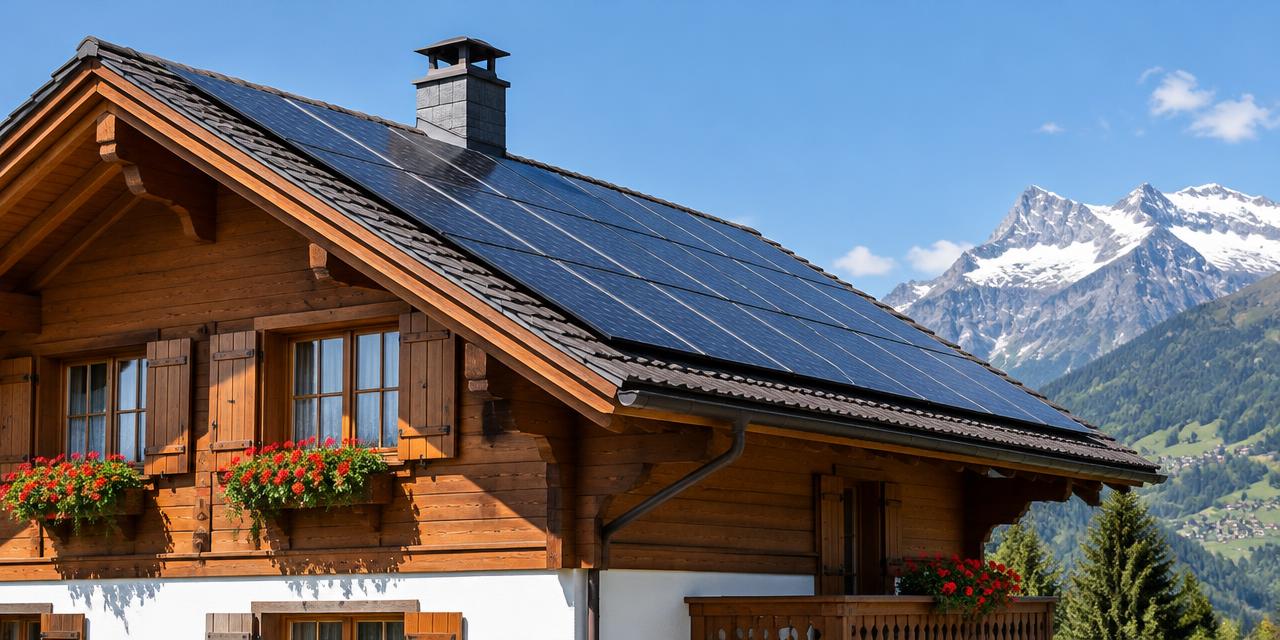
Small project
CHF 9'800 – CHF 18'500
Typical project
CHF 18'100 – CHF 32'900
Large project
CHF 31'400 – CHF 55'800
Computed with our estimator for Sion (regional factor included), standard finish. Only the project size changes.
Sion benefits from a favorable annual global irradiation of approximately 1421 kWh/m². This data confirms the region's significant solar potential for sustainable electricity production.9 °C and heating needs based on heating degree days, optimizing your roof is a relevant strategy.
The Sion region climate plan actively encourages this energy transition to reduce overall energy consumption. By acting now, you benefit from optimal sunlight conditions while anticipating the evolution of the local real estate stock toward greater efficiency.
The timing is strategic to harmonize the installation with your thermal renovation projects. Taking advantage of a roof repair, for example, allows for optimal integration.7 °C and about 57 frost days per year, require a robust installation.
Anticipating your works helps prepare your home for greater future autonomy, aligned with the sustainability goals set for municipalities in the region such as Arbaz, Ayent, or Savièse, which are integrated into the joint climate planning.
The success of your photovoltaic installation relies on technical choices adapted to your structure. On average, a south-facing roof with a tilt of about 30 degrees allows for an interesting yield estimate. However, the quality of components and cell technology influence overall performance.
There are several quality levels, from standard panels to high-efficiency solutions designed for limited areas. It is essential to choose certified equipment capable of withstanding significant thermal variations between hot days and frost periods in the region.
In addition to the panels, energy management options are crucial. Adding a storage battery increases your self-consumption, which is particularly relevant if your consumption profile is high during the evening. Home automation also allows you to control your appliances based on instantaneous solar production.
Do not forget that the one-time federal remuneration via Pronovo reduces the initial investment, while your profitability will depend directly on the share of electricity that you consume on-site rather than feeding it into the grid.
The feasibility study must therefore integrate these technical parameters to maximize your return on investment.
The building stock in Sion presents specific challenges depending on the construction period. For older buildings, it is necessary to verify the load-bearing capacity of the roof structure before any installation, as the weight of solar panels must be supported without compromising structural safety.
If your home was built before 1990, increased vigilance is recommended regarding the potential presence of asbestos in certain roofing materials, which might require asbestos removal before installation.
Thermal insulation of the attic is another critical point : a well-insulated and ventilated roof is essential to avoid overheating of photovoltaic modules in summer, which reduces their electrical yield.
The electrical networks of older buildings may require upgrading to support solar electricity injection. It is therefore essential to assess the condition of your current electrical panel with a professional. Moreover, the geography of Sion, between the plain and the hillsides, involves variable exposures.
In sensitive hillside areas, specific requirements are set by the authorities to ensure harmonious aesthetic integration.
A well-designed installation must take into account the solidity of the roof and the durability of internal electrical connections to avoid premature damage linked to the extreme thermal constraints of Valais.
In Sion, the management of built heritage strongly influences photovoltaic projects. Although the ban on installing solar panels in the old town has been lifted, this remains subject to strict conditions. For buildings classified as degrees 1, 2, and 3, the rules remain very restrictive.
Buildings classified as degrees 1 or 2, of national or cantonal importance, generally have solar installations refused a priori. For degree 3, which corresponds to communal importance, a balancing of interests is conducted.
Buildings classified as degrees 4 and 4+ have better chances of obtaining authorization, provided that heritage integration requirements are met.
If your building is not classified but is located in a protected perimeter, such as the old town or certain villages and hamlets, panels are in principle allowable subject to a specific evaluation. Integration must be adequate, particularly in the medieval part.
Installation on flat-roof annexes visible from neighboring homes is generally prohibited. In sensitive hillside areas, increased requirements apply regarding color, surface, and regularity of shapes.
It is essential to contact the municipal urban planning department before any order to validate the conformity of your project, as each request is subject to an individual analysis.
Financial support for photovoltaic solar power is mainly based on the federal one-time remuneration (Pronovo). This aid helps to significantly reduce the amount of your initial investment.
To benefit from it, strict compliance with the order of steps is imperative: you must imperatively submit your application for support before starting work. Any installation started before the application could be refused the grant.
It is also recommended to check with your municipality in Sion, as some Valais municipalities offer additional premiums or specific local support in addition to federal aid.
Regarding taxation, the installation of photovoltaic panels is generally considered an energy-saving measure or ecological added value, which can influence the tax treatment of your investments. However, as rules evolve, it is advisable to carefully keep all invoices related to the installation.
These supporting documents are essential for your tax returns and to confirm that the work has been completed in compliance.
Remember that overall profitability will also depend on your ability to optimize your own consumption, as a sufficiently adapted rooftop installation is often only subject to simple notification to the competent authorities if it complies with integration standards.
The execution of a solar project in Sion requires rigorous planning to avoid the unforeseen. The first phase consists of a technical feasibility study and validation by urban planning services. Once authorizations are obtained and financial aid validated, the actual construction can begin.
It is preferable to avoid marked frost periods, which count for about 57 days per year, to facilitate roofing work and ensure the safety of workers on slopes. Months offering milder temperatures are therefore preferred for efficient execution without climatic delays.
The work generally begins with the installation of supports and fastening systems on the existing structure. Then, the panels are installed, followed by electrical connection work, including the installation of the inverter and the possible integration of a management system.
The last step is commissioning and conformity testing. This process must be coordinated to minimize inconvenience. Although the duration depends on the complexity of your roof, regular monitoring of steps ensures the conformity of the installation.
Once operational, the system will immediately produce electricity while respecting local requirements for landscape integration.
To make your project a success, avoid some common mistakes. Never fail to check local urban planning rules before choosing the panel model, otherwise you might have to dismantle your installation.
Do not start any work before receiving confirmation for the Pronovo one-time remuneration, as you would lose your right to the aid. Avoid underestimating the condition of your roof: if it needs repairs, do them before installing the panels. Also, ensure your electrician is qualified for photovoltaic installations.
Checklist before requesting quotes : 1. Check with the Sion urban planning department whether your building is subject to specific heritage restrictions. 2. Have a health check of your roof and its thermal insulation performed by a professional. 3.
Analyze your annual electricity consumption to correctly size the power of your installation. 4. Request several comparative quotes detailing the components used and the guarantees offered. 5. Confirm that the chosen professional handles the grant application with Pronovo for you. 6.
Check the compatibility of your electrical panel for electricity injection. 7. Ensure that the visual integration of the panels meets the city's requirements.
A well-maintained photovoltaic installation is a guarantee of longevity and constant performance. In the Sion region, significant climatic variations require an annual visual check, ideally in the spring.
Cleaning the panels may be necessary if an accumulation of dust or plant debris forms, so as not to reduce the cell yield. Use clean water and non-abrasive equipment.
Checking the mounting system and the condition of the inverters must be done by a professional, in accordance with manufacturer recommendations to ensure compliance with safety standards.
Durability also depends on the quality of the components chosen during the initial phase. Investing in certified equipment guarantees better resistance to Valais winter conditions. Remote monitoring via a management app allows for immediate detection of any production anomaly.
If an unexplained drop in yield is observed, call your installer for a thorough technical inspection. By following these simple maintenance tips, you protect your investment while maximizing your clean energy production over the long term.
A sustainable installation contributes directly to the valuation of your property on the Sion market.
Based on installed capacity; municipal premiums possible.
Federal one-off payment for PV; some Valais municipalities add premiums.
www.pronovo.chCheck amounts and conditions with the provider before signing: apply before work starts in most cases.
1950 Sion · about 0 km
Valais-based company specializing in the manufacture and installation of modular, repairable solar storage batteries with a lifetime guarantee.
evolium.ch1950 Sion · about 0 km
AZ Electricité Sàrl, based in Sion, provides electrical installation, maintenance and repair services, as well as photovoltaic panel installation.
azelectricite.ch1950 Sion · about 0 km
Willy Bonvin Électricité SA is a Valais-based company specializing in electrical installations, repairs, and photovoltaic systems since 1973.
willy-bonvin-electricite.ch1950 Sion · about 0 km
OIKEN Solutions SA is a company specializing in electrical installations, home automation, and photovoltaic solar energy solutions.
oiken.chSuggestions from the commercial register by distance and activity. Not an endorsement or partnership.
Yes, but under strict conditions. Each application is evaluated individually according to the building's degree of protection.
You can benefit from the one-time federal remuneration via Pronovo. Also check with the municipality for possible local premiums.
Installation is generally prohibited on annexes visible from neighboring dwellings. A case-by-case analysis is necessary.
Imperatively before starting work. Any installation started before the application may lead to a refusal.
For a well-oriented roof, the estimate is about 1250 kWh per kWp per year. This, however, depends strongly on your configuration.
Yes, the equipment must withstand marked thermal amplitudes, notably the 57 frost days per year on average.
Yes, an authorization request is necessary. In some cases, a simple notification is sufficient depending on integration rules.
Source : Open-Meteo Historical Weather API (réanalyse ERA5, moyenne 2015-2024) · estimate
Source : swisstopo – service d'altitude (MNT)
Source : Open-Meteo Historical Weather API (réanalyse ERA5, moyenne 2015-2024)
Source : Open-Meteo Historical Weather API (réanalyse ERA5, moyenne 2015-2024)
Source : Open-Meteo Historical Weather API (réanalyse ERA5, moyenne 2015-2024)
Source : Open-Meteo Historical Weather API (réanalyse ERA5, moyenne 2015-2024)
Source : Open-Meteo Historical Weather API (réanalyse ERA5, moyenne 2015-2024)
Source : Sion.ch
Source : batimag.ch