
Canton
Facade insulation — Fribourg
Contribution per insulated m².
Fribourg support for thermal insulation of facades and roofs.
www.leprogrammebatiments.chFacade insulation · Villars-sur-Glâne
Small project
CHF 20'000 – CHF 41'400
Typical project
CHF 36'800 – CHF 73'000
Large project
CHF 62'100 – CHF 120'400
Computed with our estimator for Villars-sur-Glâne (regional factor included), standard finish. Only the project size changes.
3°C, Villars-sur-Glâne presents demanding climatic conditions for the building envelope. The heating demand, illustrated by heating degree days of 3472 Kj/year, highlights the importance of efficient insulation.
With 96 frost days per year, repeated thermal shocks on non-insulated structures accelerate the degradation of traditional building materials, leading to thermal bridges and significant energy loss. Facade insulation allows for internal temperature stabilization, thus reducing excessive stress on your heating system.
It is wise to undertake this work as soon as signs of wear appear, such as visible cracks, moisture infiltration, or when heating bills become disproportionate to the living space.
Taking proactive action, especially if you are considering a global renovation, allows you to take advantage of milder weather conditions for installing materials and avoid irreversible structural damage linked to the freeze-thaw cycles frequent in the Fribourg region.
The choice of materials for external insulation depends mainly on energy requirements, the type of existing substrate, and the building's aesthetic constraints. In Villars-sur-Glâne, external thermal insulation composite systems (ETICS) are preferred for their ability to eliminate thermal bridges.
Options range from bio-sourced insulators, such as wood fiber, to mineral or synthetic solutions like expanded polystyrene. The finish range, whether mineral plaster, wood siding, or stone elements, influences not only the final appearance but also durability against local weather conditions.
Each technical solution imposes different thicknesses that impact construction details, particularly at window jambs, roof overhangs, and fastenings of external elements such as shutters.
It is crucial to choose an insulation thickness adapted to reach current energy standards while maintaining an aesthetic consistent with the neighborhood.
A preliminary study by a professional helps define the ideal compromise between cost, thermal performance, and the sustainability of the new envelope, ensuring that wall breathability is correctly managed to avoid any risk of internal condensation.
The real estate stock in Villars-sur-Glâne is varied, ranging from traditional detached houses to more recent constructions.
Buildings dating from before 1990 require special attention regarding the potential presence of harmful substances, particularly asbestos, which can be found in tile adhesives, joints, or old facade coverings.
Before any intervention, a rigorous asbestos diagnosis is essential to protect workers and residents during drilling or partial demolition operations. The structure of the walls, whether brick, concrete, or stone, also dictates the choice of the insulation anchoring method.
Embedded networks, such as electrical cables or external water pipes, represent another critical point. A facade renovation is the ideal opportunity to check the integrity of these networks and modernize them if necessary.
For older buildings, care must be taken not to block the natural moisture of the masonry, which could lead to mold.
An in-depth analysis makes it possible to adapt the technical solution—such as choosing vapor-permeable materials—to guarantee the longevity of your investment while preserving the health of the old building.
In Villars-sur-Glâne, as in the rest of the canton, external thermal insulation changes the external appearance of your property, which generally requires a building permit. It is imperative to check with the commune's technical department before initiating any orders or material purchases.
Changing the wall thickness can influence property boundary setbacks or encroach on public land, points that are strictly controlled by the municipal administration.
A correctly prepared permit application, including material samples and facade plans, is a necessary step to avoid unnecessary administrative bottlenecks.
Furthermore, some areas of the commune may be subject to specific heritage protection rules or local planning schemes.
It is therefore recommended to check your project's compliance with the Municipal Climate Plan adopted on October 28, 2024, which may contain specific guidelines on the energy efficiency of renovations.
In the absence of additional specific data, the professional advice is to submit a complete file to the competent authority and await the official decision before signing any company contract. This procedure secures your project and protects you against potential orders from authorities for restoration.
The canton of Fribourg offers specific subsidies for facade insulation, particularly via "The Buildings Programme". This aid, calculated per isolated m², is a major lever for reducing the initial investment cost.
It is important to emphasize that a grant application must be submitted and validated before the actual start of work. Any project started without prior authorization is ineligible for financial support.
It is advisable to regularly consult official cantonal aid portals for current conditions and the exact amount of contributions per square meter.
Tax-wise, the canton of Fribourg allows the deduction of investments aimed at improving the energy efficiency of your property. If you own a property older than 10 years, you can choose between deducting actual costs or a flat rate of 20% of the rental value.
Investment costs in energy efficiency are deductible from your taxable income.
Better yet, if the amount of these investments exceeds the income of your property for the current tax period, the carry-forward rule allows this surplus to be deducted over the next two tax periods, offering valuable flexibility for long-term tax optimization.
The progression of a facade renovation follows a precise logic that must anticipate the weather constraints of Villars-sur-Glâne. The installation of insulation and plaster is strongly discouraged during freezing periods, given the 96 frost days recorded annually.
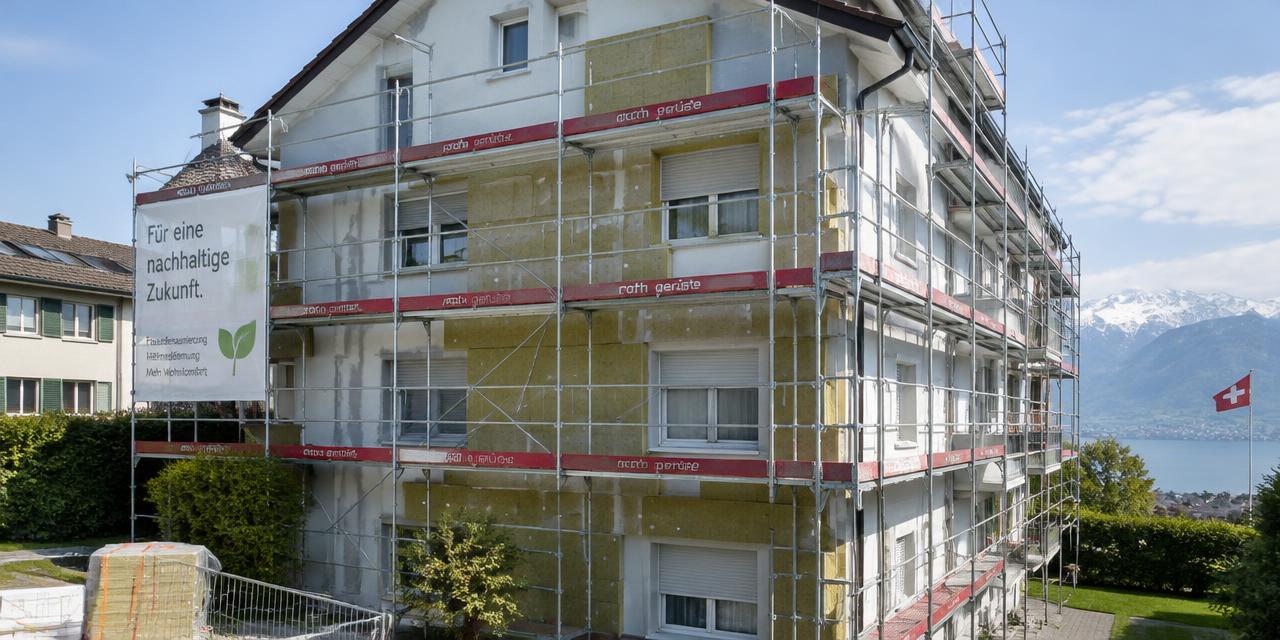
The ideal season is therefore between late spring and early autumn, ensuring proper setting of mortars and adhesives. After obtaining authorizations, the project begins with the installation of scaffolding, which represents a significant part of the total cost.
It is therefore recommended to group facade work with window replacement or roof renovation to optimize this investment.
Key steps include preparing the supports (cleaning, crack repair), installing insulation panels, treating jambs, applying the base coat with reinforcement, and finally the decorative finish. This sequence must be respected to guarantee the durability of the insulation.
A well-planned project limits noise disturbance for the neighborhood and allows for efficient management of material storage on site.
By coordinating the interventions of different trades, you minimize downtime and reduce the risk of weather unnecessarily interrupting the site, ensuring delivery in the best possible conditions.
The success of your work relies on meticulous preparation. Before requesting any quotes, ensure you have established a complete assessment of your building, including any potential moisture or dilapidation problems.
A common error is to neglect the overall picture : always check the condition of your roof and windows, as facade insulation must be coordinated with these elements to avoid persistent thermal bridges.
Do not sign any financial commitments before receiving authorization confirmations and, if applicable, grant approvals. It is also crucial not to choose a company solely based on the lowest price without comparing material quality and guarantees offered.
Here is your checklist : 1. Have you checked if a building permit is required from the commune? 2. Has the asbestos diagnosis been carried out for older buildings? 3. Have you applied for subsidies before starting any work? 4. Have you grouped the insulation with other renovation works to save on scaffolding costs? 5.
Are the chosen materials adapted to your wall structure and local climatic constraints? 6. Have you consulted a professional to validate the most appropriate insulation system? 7. Does the work schedule avoid winter frost periods? These points guarantee a coherent and secure project.
Contribution per insulated m².
Fribourg support for thermal insulation of facades and roofs.
www.leprogrammebatiments.chCheck amounts and conditions with the provider before signing: apply before work starts in most cases.
1752 Villars-sur-Glâne · about 0 km
Italgyps SA is a company specializing in plastering, drywall, painting, and facade insulation services.
italgyps.ch1752 Villars-sur-Glâne · about 0 km
M.M Peinture is a company based in Luins specializing in painting, plastering, and peripheral insulation services.
mpeinture.ch1752 Villars-sur-Glâne · about 0 km
Based in Villars-sur-Glâne, this family business provides painting, plastering, wallpapering and thermal insulation services throughout French-speaking Switzerland.
riedopeinture.ch1752 Villars-sur-Glâne · about 0 km
V & K Peinture Sàrl is a company specializing in painting, facade renovation, thermal insulation, and interior works in the cantons of Fribourg and Vaud.
vkpeinture.chSuggestions from the commercial register by distance and activity. Not an endorsement or partnership.
First, you must check the need for a municipal permit. Then, submit a grant application to official programs before starting the work.
No, frost periods in Villars-sur-Glâne harm the installation of materials. It is better to plan your work between spring and autumn.
Yes, investments for energy efficiency are deductible in the canton of Fribourg. A carry-forward to the next two years is possible if the investment exceeds income.
Yes, to ensure compliance with standards and access to subsidies. Professionalism also ensures correct management of moisture and asbestos.
This allows for sharing scaffolding costs. These structures are expensive and should be installed only once to optimize the budget.
The altitude of 664 m and 96 frost days per year are critical. You must choose materials adapted to low winter temperatures.
An asbestos diagnosis is mandatory before any drilling. This protects your health and that of those working on the site.
Source : swisstopo – service d'altitude (MNT)
Source : Open-Meteo Historical Weather API (réanalyse ERA5, moyenne 2015-2024)
Source : Open-Meteo Historical Weather API (réanalyse ERA5, moyenne 2015-2024)
Source : Open-Meteo Historical Weather API (réanalyse ERA5, moyenne 2015-2024)
Source : Open-Meteo Historical Weather API (réanalyse ERA5, moyenne 2015-2024)
Source : Open-Meteo Historical Weather API (réanalyse ERA5, moyenne 2015-2024)
Source : Administration Cantonale des Impôts du Canton de Fribourg
Source : Commune de Villars-sur-Glâne