Heat pump installation · Montreux

Heat pump installation in Montreux: A comprehensive guide for homeowners

The energy transition in the municipality of Montreux, which holds the "Cité de l'énergie Gold" label, is becoming a priority for property owners. This guide details the essential steps to successfully install a heat pump while considering local specifics.
Heat pump installation – Montreux

Worked examples in Montreux

Small project

CHF 32'900 – CHF 60'300

Typical project

CHF 41'600 – CHF 77'500

Large project

CHF 54'600 – CHF 103'300

Computed with our estimator for Montreux (regional factor included), standard finish. Only the project size changes.

Cost split (typical project)

  • Labour : CHF 23'300 (40 %)
  • Materials : CHF 29'100 (50 %)
  • Other costs : CHF 5'800 (10 %)

Why and when to undertake these works in Montreux

Montreux, located at an altitude of 382 meters by Lake Geneva, experiences specific climatic conditions with approximately 2560 heating degree days per year.8 °C and an average of 31 frost days per year, choosing a high-performance heating system is crucial for maintaining thermal comfort.

The municipal Climate Plan, whose first generation dates back to January 2026, sets ambitious targets: reducing greenhouse gas emissions by 70% and reaching 80% renewable energy by 2040. Choosing a heat pump helps meet these environmental requirements while enhancing your property's value in the long term.

It is wise to undertake these works as soon as your current installation reaches the end of its lifespan or maintenance costs become prohibitive.

Given the development of the MontCAD district heating network, supported by the municipality and Romande Energie, it is imperative to check first whether your building, located between Clarens and Territet, is eligible for connection.

This network uses thermal energy from Lake Geneva to cover 25% of the city's heating needs. If connection is not possible, switching to a heat pump becomes the ideal solution to efficiently replace obsolete fossil or electric systems.

Technical choices that influence the project

The success of a heat pump installation relies on rigorous technical analysis.8 °C. Correct sizing prevents unnecessary excess consumption or over-reliance on an electric backup. For air-water systems, it is imperative to comply with noise standards regarding neighbors.

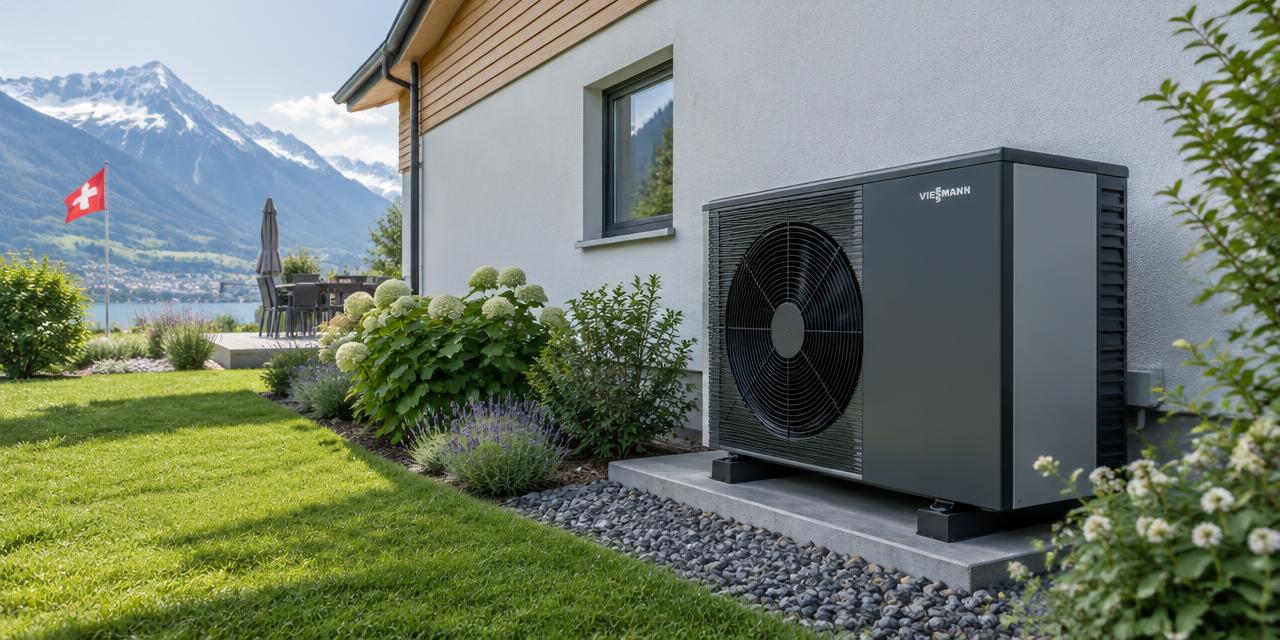
The location of the outdoor unit must be carefully chosen to minimize acoustic impact and ensure optimal air circulation.

Besides the heat pump model, compatibility with your existing heat distribution system is a major factor. Low-temperature emitters like underfloor heating are the most efficient.

If your building is equipped with conventional radiators, increasing their size or improving insulation may be necessary for the heat pump to operate optimally.

It is also recommended to explore coupling with photovoltaic installations, as with a global irradiation of 1349 kWh/m²/year, you could optimize your household's self-consumption throughout the year.

Specifics of the local building stock according to construction era

Montreux's building stock shows disparities according to construction eras. For buildings constructed before 1990, it is imperative to conduct a preliminary diagnosis regarding the potential presence of hazardous substances, particularly asbestos, before any intervention on the heating system.

These older buildings, often less well insulated, require a finer thermal loss study to adequately size the heat pump. Thermal insulation of facades or the roof may be necessary before installation to ensure satisfactory energy efficiency.

Newer buildings generally benefit from better tightness, facilitating the integration of air-water or air-air heat pumps. However, regardless of the era, the structure of internal hydraulic networks must be checked. Aging pipes might not support the pressure or outlet temperature of the new heat pump.

Verifying the compatibility of existing radiators is therefore essential during the design phase. A coherent energy renovation is not limited to replacing the boiler; it includes the overall performance of the building envelope to guarantee economical and sustainable operation of the system.

Authorizations, rules, and heritage in Montreux

In the canton of Vaud, installing a heat pump is generally subject to the simplified building permit procedure, also known as a permit exemption. This administrative formality is essential to ensure the project's compliance with current regulations.

The competent authority, the municipality or the prefect, examines in particular the management of noise pollution, a critical point for air-water or air-air heat pumps.

It is your responsibility to provide a complete file demonstrating that the noise level emitted complies with the authorized limits for surrounding residential areas.

Regarding heritage aspects, if your building is protected or located in a protected area, stricter rules apply. Although the procedure is often simplified, any change in external appearance or building volume requires special attention.

For additional solar installations, an announcement form, a location plan, a cadastral excerpt, and a photo of the building are required.

We strongly recommend consulting the town planning department of the municipality of Montreux before signing any contract, to check the constraints specific to your plot and obtain the necessary authorizations.

Financial aid and taxation

Replacing a fossil or electric heating system with a heat pump is supported by financial incentives. You can apply for the heat pump subsidy via the Swiss Buildings Program and the canton of Vaud. The amount varies according to the type of heat pump and power, generally amounting to a few thousand francs.

It is imperative to submit your request before the start of the work, as no subsidy is granted for already completed projects. This step is the first part of your budget planning.

In terms of taxation, Swiss law allows for the deduction of 100% of costs incurred for investments intended to save energy and protect the environment. These costs concern the replacement of obsolete installations.

If costs cannot be fully deducted in the year the work is done, the balance can be carried forward to the following two fiscal periods. Note that if public subsidies are received, you can only deduct the net share of costs that you actually bear.

It is advisable to consult a tax specialist to optimize your declaration based on your personal situation, especially if choosing between flat-rate and effective cost deduction.

Schedule: Typical project flow and stages

The schedule for a heat pump installation must be anticipated, ideally outside the heating season to avoid any interruption of comfort. The project begins with a deep study phase, including checking for a potential connection to the MontCAD network, followed by the subsidy application with the Buildings Program.

Once municipal permits are obtained and the financial file validated, choosing the installation company is the next step. It is advisable to plan these preparations several months before the desired commissioning to account for equipment lead times.

The site itself proceeds in several stages : dismantling the old boiler, preparing hydraulic and electrical connections, installing the outdoor unit, and final connection and commissioning.

In Montreux, although frost occurs about 31 days per year, commissioning must be done carefully to calibrate the device according to local winter rigor. Functional tests and regulation settings are essential to ensure optimal output.

Once the installation is complete, performance tests are carried out to ensure the system meets the initial energy efficiency promises.

Common errors to avoid and checklist before requesting quotes

To avoid disappointment, never skip the thermal analysis of your building. Ignoring the compatibility of your current radiators with the temperature regime of a heat pump is a major error that can limit efficiency.

Always check if your neighborhood is connectable to a priority district heating system, such as the MontCAD network in Montreux, before investing in an individual solution. Also, ensure that the location of your outdoor unit will not cause excessive noise nuisance for your neighbors, in accordance with local rules.

Here is your checklist before requesting quotes : 1. Check the condition of your insulation and identify potential thermal weaknesses. 2. Contact the municipality to learn about constraints related to heritage or protection zones. 3. Identify the current type of heating and ensure the internal network is ready. 4.

Download the subsidy application file beforehand. 5. List your domestic hot water needs. 6. Request several comparative quotes from certified companies. 7.8 °C design temperature.

Grants and subsidies

Canton

Heat pump grant — Buildings Programme

Amount varies by heat pump type and capacity (typically several thousand francs).

Support for replacing fossil or electric heating with a heat pump via the Swiss Buildings Programme and the canton of Vaud.

www.leprogrammebatiments.ch

Check amounts and conditions with the provider before signing: apply before work starts in most cases.

Companies in the area

NAO Energy SA, succursale de Montreux

1820 Montreux · about 0 km

NAO Energy SA is a company specializing in energy transition solutions, installing solar panels, heat pumps, and storage systems across French-speaking Switzerland.

naoenergy.ch

Lauffer-Borlat réalisation SA

1816 Chailly-Montreux · about 3.5 km

Family-run company in Montreux specializing in heating, ventilation, and sanitary installations for various types of buildings.

laufferborlat.ch

Amiar Services Sàrl

1816 Chailly-Montreux · about 3.5 km

Amiar Services Sàrl is a family-owned business based in Montreux specializing in heating, air conditioning, and renewable energy installations.

amiarservices.ch

Lauffer - Borlat SA

1816 Chailly-Montreux · about 3.5 km

Family business specializing in the installation, service, and maintenance of heating, sanitary, and ventilation systems in Montreux.

laufferborlat.ch

Suggestions from the commercial register by distance and activity. Not an endorsement or partnership.

Frequently asked questions

What is the average lifespan of a heat pump?

A well-maintained heat pump typically lasts between 15 and 20 years. Regular maintenance by a professional is crucial for maximizing its longevity.

Can I install a heat pump if I have conventional radiators?

Yes, it is possible, but you may need to adapt the radiators or improve insulation. Specific sizing is necessary to ensure proper operation.

Is connection to the MontCAD network mandatory in Montreux?

Connection is encouraged where the network exists, particularly between Clarens and Territet. Check your eligibility with the municipality before any other project.

Do I need to request authorization for a heat pump in Montreux?

Yes, a simplified procedure or permit exemption is necessary. The competent authority will mainly verify compliance regarding noise pollution.

Is lake water heating an option for private individuals?

The MontCAD network uses lake energy to supply buildings. Connecting to the network is the preferred option for benefiting from this resource.

Can I combine subsidies and tax deductions?

You can deduct the costs actually borne after subtracting received subsidies. The tax deduction rate for energy is 100%.

What is the best time to carry out these works?

It is recommended to act during the warm season to avoid being without heating during winter. Planning should start several months in advance.

Useful local data

Altitude — 382 m

Source : swisstopo – service d'altitude (MNT)

Heating degree days — 2'560 Kj/an (20/12 °C)

Source : Open-Meteo Historical Weather API (réanalyse ERA5, moyenne 2015-2024)

Frost days — 31 jours/an

Source : Open-Meteo Historical Weather API (réanalyse ERA5, moyenne 2015-2024)

Solar irradiation — 1'349 kWh/m²/an (horizontal)

Source : Open-Meteo Historical Weather API (réanalyse ERA5, moyenne 2015-2024)

Winter design temperature — -4.8 °C (1er percentile des minimales)

Source : Open-Meteo Historical Weather API (réanalyse ERA5, moyenne 2015-2024)

Mean temperature — 12.1 °C

Source : Open-Meteo Historical Weather API (réanalyse ERA5, moyenne 2015-2024)

Estimated solar yield — 1'187 kWh/kWc/an (toit ~30° sud, PR 0.8, estimation)

Source : Open-Meteo Historical Weather API (réanalyse ERA5, moyenne 2015-2024) · estimate

District heating

  • Note : Le réseau de chauffage à distance fournira de la chaleur et du rafraîchissement. L'énergie est tirée du Lac Léman et représente 90% de l'approvisionnement, le reste étant de l'énergie verte. Les travaux se déroulent en plusieurs phases de 2027 à 2035. La société MontCAD a été créée par la commune de Montreux et Romande Energie pour déployer le CAD. Le réseau couvrira 25% des besoins de chauffage de Montreux et est prévu pour raccorder 250 bâtiments. Le raccordement va de Clarens à Territet.
  • Operator : Romande Energie
  • Has network : ✓
  • Network : MontCAD
  • Energy sources : Lac Léman

Source : MontCAD - Le projet chauffage à distance Montreux

Energy policy

  • Note : Montreux a actualisé son Plan directeur communal des énergies (PDCén). Le label Cité de l'énergie Gold est la plus haute distinction et la commune le détient depuis 2016, renouvelé en 2020 puis en 2025. Le "Plan climat communal" est en cours d'élaboration et sa première génération est datée de janvier 2026.
  • Targets : Réduire de 70% les émissions de gaz à effet de serre par habitant d'ici à 2040; diminuer de 40% la consommation d’énergie primaire par habitant d'ici à 2040; atteindre 80% d’énergie finale renouvelable d'ici à 2040.
  • Label year : 2025
  • Climate plan : Plan climat Montreux
  • Label : Cité de l'énergie Gold

Source : 24 heures

Tax deductionsCanton

  • Note : Le contribuable peut choisir, lors de chaque période fiscale et pour chaque immeuble, entre la déduction des frais effectifs et la déduction forfaitaire. La déduction forfaitaire couvre les frais d'entretien, de remise en état d'immeubles acquis récemment, d'administration par des tiers, d'investissements énergétiques, de démolition et de primes d'assurances.
  • Carry-forward : Si les coûts d'investissement destinés à économiser l'énergie et à ménager l'environnement ou les frais de démolition en vue d'une construction de remplacement ne peuvent pas être entièrement pris en considération fiscalement durant l'année où ils ont été engagés, le solde peut être reporté sur les deux périodes fiscales suivantes. Les dépenses peuvent être reportées si le revenu net est négatif. Si des frais sont reportés, il n'est pas possible de faire valoir une déduction forfaitaire pendant cette période fiscale. En cas de déménagement en Suisse ou de transfert de la propriété de l'immeuble, le contribuable conserve le droit de déduire le solde des frais pouvant être reportés.
  • Maintenance costs : Le contribuable qui possède des immeubles privés peut déduire les frais nécessaires à leur entretien, les primes d'assurances relatives à ces immeubles et les frais d'administration par des tiers.
  • Energy investments : Sont réputés investissements destinés à économiser l'énergie et à ménager l'environnement les frais encourus en vue de rationaliser la consommation d'énergie ou de recourir aux énergies renouvelables. Ces investissements concernent le remplacement d'éléments de construction ou d'installations vétustes et l'adjonction d'éléments de construction ou d'installations dans des bâtiments existants. Si les mesures sont subventionnées par la collectivité publique, le contribuable ne peut déduire que les frais qu'il assume lui-même. Le taux de déduction est de 100%.

Source : Règlement sur la déduction des frais relatifs aux immeubles privés (RDFIP)

PermitsCanton

  • Competent authority : municipalité ou préfet
  • Solar panels : Soumis à la procédure simplifiée ou dispense de permis de construire
  • Heat pump : Soumis à la procédure simplifiée ou dispense de permis de construire. Pour les pompes à chaleur air-eau ou air-air, les nuisances sonores sont prises en compte.
  • Procedure : procédure simplifiée de permis de construire (dispense de permis de construire)
  • Windows and facades : Soumis à la procédure simplifiée ou dispense de permis de construire, sauf si le bâtiment est protégé ou situé dans une zone protégée, ou si les travaux entraînent un changement d'affectation, d'aspect extérieur ou de gabarit important.

Source : Canton de Fribourg: Permis de construire (example, this is Fribourg) · estimate

Other works in Montreux

Heat pump installation in nearby towns