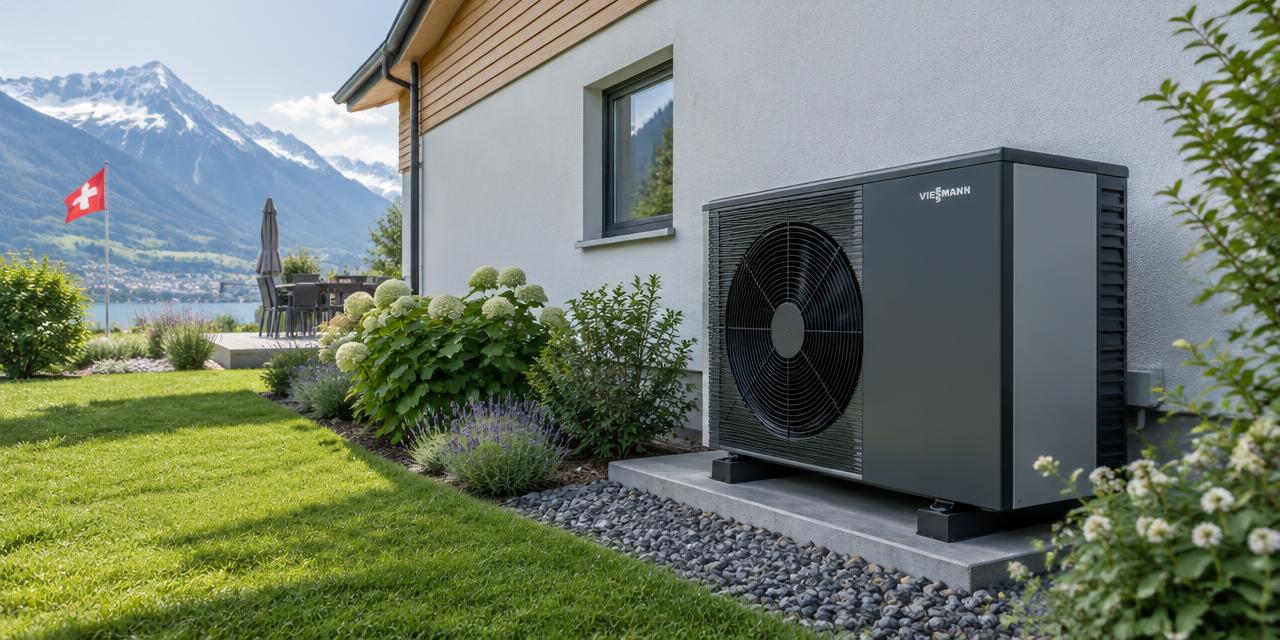
Renens, a dynamic town in the canton of Vaud, is actively committed to the energy transition with its Climate Plan aiming for carbon neutrality by 2050. For homeowners, installing a heat pump is a key step to modernize their housing while aligning with local climate goals.
Worked examples in Renens
Small project
CHF 32'900 – CHF 60'300
Typical project
CHF 41'600 – CHF 77'500
Large project
CHF 54'600 – CHF 103'300
Computed with our estimator for Renens (regional factor included), standard finish. Only the project size changes.
Cost split (typical project)
Labour :CHF 23'300(40 %)
Materials :CHF 29'100(50 %)
Other costs :CHF 5'800(10 %)
Why and when to undertake these works in Renens
5 °C and about 48 frost days per year at an altitude of 420 meters, the climate in Renens places significant demands on heating systems. The local building stock faces growing requirements for decarbonization.
Installing a heat pump not only helps to move away from fossil fuels but also meets the objectives of the local Climate Plan, which strongly encourages the reduction of fossil energy consumption.
The ideal time to replace your heating system is generally before your current boiler breaks down completely or during a comprehensive building renovation. By anticipating these works, you avoid making decisions under pressure.
Furthermore, the municipality aims for a significant increase in the share of local renewable energy, making the installation of a heat pump a step consistent with the energy vision for 2035 and 2050 for the entire territory of Renens.
Technical choices that influence the project
The choice of heat pump system depends on several crucial technical factors. For air-water installations, it is mandatory to respect the noise limits imposed by legislation to protect the neighborhood.
Since the required power is determined by the local design outside temperature, a rigorous calculation is essential to ensure equipment efficiency.
There are various options, from high-performance models to hybrid systems. It is essential to check if your home is compatible with low-temperature heating, which maximizes the heat pump's performance coefficient.
Materials and product ranges vary based on specific domestic hot water needs and the building configuration. A preliminary study by a professional allows for adjusting the technical choice, thus ensuring that the installation will perform well even during the coldest periods of the year in Renens.
Specifics of the local building stock by construction era
The building stock in Renens presents varied profiles, ranging from older constructions to more recent buildings. For structures built before 1990, it is common to encounter insufficient insulation or distribution networks that require an update. These elements can impact the heat pump sizing.
An energy audit is often recommended to assess whether insulation work on attics or window replacement is necessary before installation.
It is also necessary to remain vigilant regarding potentially hazardous materials in old structures. Furthermore, the configuration of existing distribution networks, if they were designed for high temperatures, may need to be optimized.
Each type of construction imposes different constraints in terms of space for the outdoor unit, especially in dense urban areas. By precisely assessing the thermal performance of your current housing, you will be able to better adapt the system to the realities of your structure.
Authorizations, rules and heritage in Renens
In the canton of Vaud, the installation of a heat pump is subject to the simplified procedure or exemption from building permits. For air-water or air-air models, authorities pay special attention to noise nuisance, in accordance with current regulations.
It is important to ensure that the planned location for the outdoor unit respects distances and acoustic standards towards neighbors.
If your building is protected or located in a specific zone, additional constraints related to the external appearance may apply. Before any commitment, it is advisable to contact the technical services of the municipality of Renens to confirm the procedure applicable to your specific case.
Although the procedure is simplified, administrative verification is always recommended to avoid any future complications when implementing your energy renovation project.
Financial aid and taxation
The Buildings Program, supported by the canton of Vaud, offers grants for the replacement of a fossil or electric heating system with a heat pump. The amount varies depending on the type of equipment and installed power.
It is crucial to note that the grant application must be submitted before the start of the work to be eligible.
Regarding taxation, the taxpayer can deduct 100% of energy investment costs in the tax return. In case of negative net income, these costs can be carried forward over the next two tax periods. However, note that if the work is subsidized, only the portion remaining at the owner's expense is deductible.
The taxpayer has the choice between deducting actual costs or a flat-rate deduction for maintenance, but claiming actual costs is often more advantageous for major energy renovation projects.
Schedule: typical project flow
The schedule for a heat pump installation begins with a diagnostic and planning phase. It is advisable to check the connection to the priority district heating network, if applicable, as this can be a relevant alternative in Renens.
Once the technical choice is validated, administrative procedures for authorizations are initiated.
The project itself includes the dismantling of the old system, the installation of the new unit, and the connection to the hydraulic and electrical networks. The optimal period to carry out these works is outside of extreme cold periods, ideally in spring or summer.
This allows for commissioning and necessary adjustments without stress for the occupants, anticipating needs for the following winter. A final test phase ensures the sizing is correct in relation to the local design temperature.
Common errors to avoid and checklist
Do not neglect the acoustic study of your installation, as noise is a frequent source of dispute. Ensure you have checked if your neighborhood can be connected to district heating, as this solution may be prioritized according to local strategy.
It is also risky to underestimate the required power by ignoring the local design temperature. Do not sign any quote before submitting your grant application to the Buildings Program. Finally, systematically check the constraints of your heritage area or any potential protections related to your building.
Checklist before requesting quotes : 1. Check the availability of the district heating network. 2. Have a thermal audit of your home carried out. 3. Identify the noise level allowed in your neighborhood. 4. Confirm the compliance of the outdoor location with the municipality. 5.
Prepare your grant application file before any commitment. 6. Compare several offers from certified professionals.
Grants and subsidies
Canton
Heat pump grant — Buildings Programme
Amount varies by heat pump type and capacity (typically several thousand francs).
Support for replacing fossil or electric heating with a heat pump via the Swiss Buildings Programme and the canton of Vaud.
Fürst S.A., based in Renens, sells, installs and maintains heating systems for all energy sources, with breakdown assistance seven days a week and burner and tank servicing.
Suggestions from the commercial register by distance and activity. Not an endorsement or partnership.
Frequently asked questions
What are the steps to obtain aid?
You must submit an application via the Buildings Program before starting the work. Grants are not paid retroactively if work has already begun.
Is district heating mandatory in Renens?
It is not strictly mandatory, but strongly encouraged if your zone is connectable. It is best to check with the municipality before choosing another solution.
Is a building permit required for a heat pump?
In the canton of Vaud, the project is generally subject to a simplified procedure or exemption. Check with your municipality according to your situation.
Are the costs tax deductible?
Yes, energy investments are 100% deductible. If you receive subsidies, you can only deduct the portion remaining at your expense.
How to manage noise with neighbors?
It is necessary to comply with current acoustic standards and position the outdoor unit well. Rigorous planning helps minimize noise nuisance.
What is the average lifespan of a heat pump?
A well-maintained heat pump typically lasts between 15 and 20 years. Regular maintenance is essential to ensure this longevity.
Can I carry forward the work costs?
Yes, if your costs exceed your net income, you can carry forward the balance over the next two tax periods. This allows for long-term tax optimization.
Note : CADOUEST SA opère un réseau de chauffage à distance à Renens et Prilly. Ce réseau inclut un 'Réseau 3 tubes' dans la zone de Malley, permettant de valoriser les retours à basse température pour les acheminer vers des producteurs renouvelables. Le mix énergétique est égal ou supérieur à 90% d'énergies renouvelables. SIE et Romande Energie ont créé ECUCAD pour développer un réseau de chauffage à distance dans les communes d'Ecublens, Renens et Chavannes-près-Renens, utilisant notamment du bois.
Operator : CADOUEST SA, ECUCAD (co-entreprise entre SIE et Romande Energie)
Note : La commune vise la neutralité carbone à l'horizon 2050 pour les émissions produites sur son territoire. Le Plan Climat est un instrument stratégique, transversal et opérationnel, composé d'une stratégie (vision et objectifs jusqu'à 2050) et d'un plan d'actions (projets 2023-2027), structuré en 8 thématiques avec plus de 170 actions. Le Plan Climat sera revu tous les 5 ans. Réaudit Cité de l'énergie Gold prévu en été 2023.
Targets : Neutralité carbone des émissions territoriales à l’horizon 2050. Adapter le territoire aux effets des changements climatiques. Réduction au maximum des émissions extraterritoriales. Réduire drastiquement les émissions de gaz à effet de serre. Objectifs spécifiques pour la chaleur (ex: 30% de consommation d'énergie finale par habitant d'ici 2035 par rapport à 2015, +51% de part d'énergie renouvelable locale dans l'approvisionnement en chaleur d'ici à 2035), électricité (ex: -14% de consommation d'électricité par habitant d'ici 2035 par rapport à 2015, +21% de part d'énergie renouvelable locale), et mobilité (ex: 61% de distances parcourues en transport individuel motorisé en 2030, 50% de véhicules nouvellement immatriculés sont électriques ou hybrides rechargeables en 2025).
Note : Le contribuable peut choisir, lors de chaque période fiscale et pour chaque immeuble, entre la déduction des frais effectifs et la déduction forfaitaire. La déduction forfaitaire couvre les frais d'entretien, de remise en état d'immeubles acquis récemment, d'administration par des tiers, d'investissements énergétiques, de démolition et de primes d'assurances.
Carry-forward : Si les coûts d'investissement destinés à économiser l'énergie et à ménager l'environnement ou les frais de démolition en vue d'une construction de remplacement ne peuvent pas être entièrement pris en considération fiscalement durant l'année où ils ont été engagés, le solde peut être reporté sur les deux périodes fiscales suivantes. Les dépenses peuvent être reportées si le revenu net est négatif. Si des frais sont reportés, il n'est pas possible de faire valoir une déduction forfaitaire pendant cette période fiscale. En cas de déménagement en Suisse ou de transfert de la propriété de l'immeuble, le contribuable conserve le droit de déduire le solde des frais pouvant être reportés.
Maintenance costs : Le contribuable qui possède des immeubles privés peut déduire les frais nécessaires à leur entretien, les primes d'assurances relatives à ces immeubles et les frais d'administration par des tiers.
Energy investments : Sont réputés investissements destinés à économiser l'énergie et à ménager l'environnement les frais encourus en vue de rationaliser la consommation d'énergie ou de recourir aux énergies renouvelables. Ces investissements concernent le remplacement d'éléments de construction ou d'installations vétustes et l'adjonction d'éléments de construction ou d'installations dans des bâtiments existants. Si les mesures sont subventionnées par la collectivité publique, le contribuable ne peut déduire que les frais qu'il assume lui-même. Le taux de déduction est de 100%.
Solar panels : Soumis à la procédure simplifiée ou dispense de permis de construire
Heat pump : Soumis à la procédure simplifiée ou dispense de permis de construire. Pour les pompes à chaleur air-eau ou air-air, les nuisances sonores sont prises en compte.
Procedure : procédure simplifiée de permis de construire (dispense de permis de construire)
Windows and facades : Soumis à la procédure simplifiée ou dispense de permis de construire, sauf si le bâtiment est protégé ou situé dans une zone protégée, ou si les travaux entraînent un changement d'affectation, d'aspect extérieur ou de gabarit important.