
Canton
Facade insulation — Buildings Programme (VD)
Contribution per insulated m², depending on energy requirements met.
Grants for thermal insulation of the building envelope (walls, roof) via the Buildings Programme.
www.leprogrammebatiments.chFacade insulation · Morges
Small project
CHF 20'000 – CHF 41'400
Typical project
CHF 36'800 – CHF 73'000
Large project
CHF 62'100 – CHF 120'400
Computed with our estimator for Morges (regional factor included), standard finish. Only the project size changes.
At an altitude of 375 meters and with a climate marked by 43 days of frost per year, the heating requirement is real in Morges, totaling 2681 Kj/year. Insulating your facade is not only a matter of energy savings, it is a direct response to the municipality's climate goals.
The municipality aims for carbon neutrality by 2050, seeking to drastically reduce emissions per inhabitant. By renovating now, you anticipate future regulatory requirements while improving the overall energy performance of your building.
The ideal time to act often occurs during a global renovation or when facade refurbishment becomes necessary. By taking advantage of maintenance work to install insulation, you optimize costs related to scaffolding.
With a global irradiation of 1371 kWh/m²/year, Morges also offers opportunities to couple this insulation with other energy production measures, aligning with the city's Energy City label.
Do not delay if your current consumption is high, as heat loss through walls represents a major portion of the losses of an unrenovated building.
The selection of materials for external insulation must take into account the climatic specifics of Morges and the structure of your building. Systems vary between synthetic insulators, often performing in terms of thickness, and natural or mineral insulators that promote the breathability of the wall.
It is essential to confirm with a professional whether your facade requires external or internal insulation depending on the architectural constraints. External insulation is generally preferred as it completely wraps the building, eliminating thermal bridges, although it changes the exterior appearance.
2 °C. Higher-quality finishes ensure better durability against bad weather. Do not forget that any change in exterior appearance, such as a change in wall thickness, may be subject to local rules.
Planning must integrate the windows : replacing them must be coordinated with the insulation to avoid condensation points at the junction between the new insulation system and the window frames.
Morges has a varied real estate heritage, with strong construction dynamics, with more than 900 housing units built between 2020 and 2022. However, for older buildings, several technical risks must be analyzed before any insulation project.
Constructions before 1990 may have traces of asbestos in glues, mastics, or old insulation boards. A prior diagnosis is essential to avoid exposure when drilling into facades or removing old elements.
In addition, the condition of embedded networks, particularly electrical or water distribution, must be evaluated, because insulating thickness can sometimes complicate access to pipes in case of future leaks.
Older buildings also have specificities in terms of moisture management: too tight insulation without adequate ventilation can lead to internal condensation problems. Local professionals are well aware of these issues.
If your building has protected architectural elements, the risks are lower because the interventions are strictly regulated by SIPAL and the Monuments and Sites section, ensuring technical preservation while aiming for thermal improvement.
Carrying out work on your facade in Morges requires special attention to local rules. If your building is not protected, energy renovation work often benefits from the simplified building permit procedure or even an exemption from the permit. However, in the old town or protected sectors, the constraints are stricter.
You must consult the Morges Building Police Office before incurring any expenses or placing orders.
For protected buildings, any change in exterior appearance is subject to the approval of the State of Vaud's Department of Real Estate, Heritage and Logistics (SIPAL), and specifically the Monuments and Sites Section. The process may include a public or administrative investigation.
These bodies ensure that energy performance does not distort the building's heritage value.
Remember that the advice provided here is for information only; only the municipality can validate the compliance of your project after reviewing your complete file, including plans, materials used, and technical details of the proposed insulation.
As an owner, you can benefit from the Program Bâtiments (VD), which provides grants for the thermal insulation of your facade. It is crucial to note that a grant application must be submitted before the start of work; starting the construction site without this prior step cancels your right to financial aid.
The amounts are calculated based on the energy requirements achieved. Visit the official website of the Program Bâtiments for details on current conditions.
Tax-wise, investment in energy-saving measures is deductible. The deduction rate is 100% for these investments. The taxpayer can choose, each tax period, between the flat-rate deduction (10 to 30% depending on the age and use of the building) or the actual costs.
If your investment costs exceed your net income for the year, the balance can be carried forward to the two following tax periods. Caution: if you receive public subsidies, you can only deduct the portion of the costs that you actually bear.
Financial planning must therefore take into account this balance between subsidies, investments, and tax optimization.
The planning of a construction site in Morges must take into account weather conditions, with 43 frost days per year that can impact wet work (plastering, finishes). Ideally, facade work is carried out in good weather, in spring or early autumn, to ensure the good adhesion of mortars and insulation.
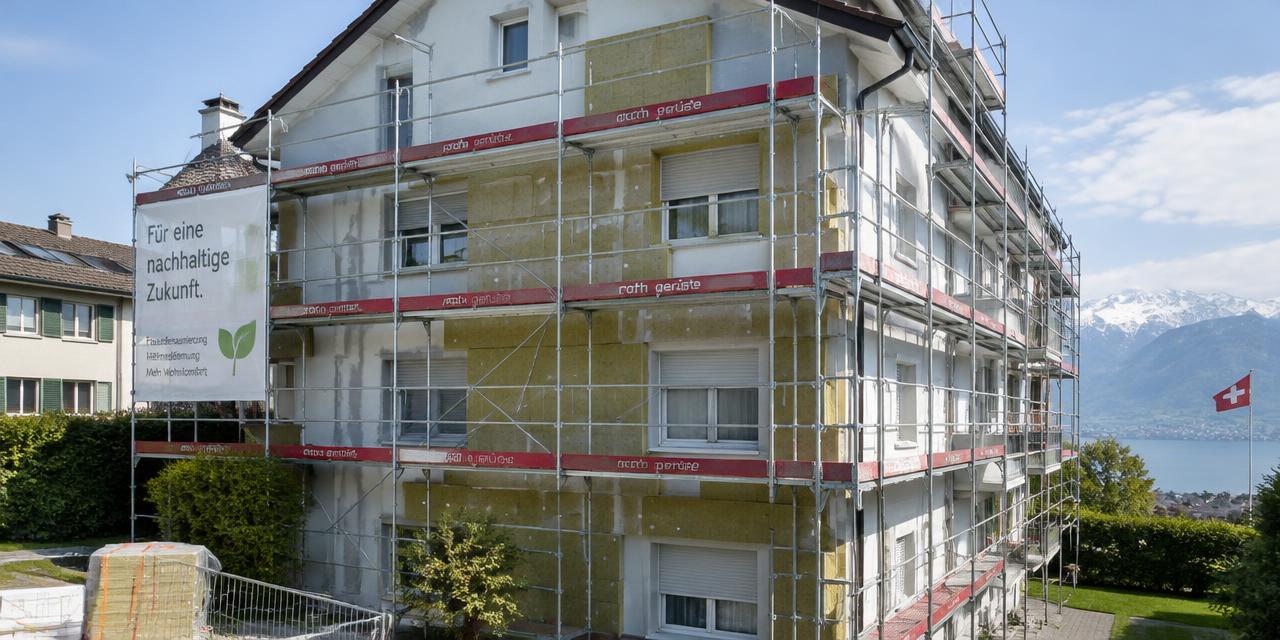
The typical process begins with the installation of scaffolding, an expensive step that it is highly recommended to make profitable by grouping the work: facade, window replacement, and roof inspection.
After installing the insulation materials, the work includes the preparation of surfaces and facade finishes. If your project concerns a protected area, the timeframe must be increased to include administrative back-and-forth with the authorities.
Once the scaffolding is mounted, the work generally follows by attaching the insulation panels, installing the reinforcement mesh, applying the undercoats, and finally the finishing plaster. Coordination with window replacement is vital to ensure overall tightness.
The reception of the work marks the end of the site, just before the scaffolding is dismantled, allowing for a final check of the junction points.
The most common mistake is to start work before having obtained the validation of the grant application or building permit if necessary. It is also imperative to avoid insulating the facade without treating thermal bridges related to windows or the roof.
Here is a checklist before requesting your quotes : Check if your building is located in a protected area with the municipality before any study. Ensure that the asbestos diagnosis is carried out for older buildings. Submit your grant application to the Program Bâtiments before signing any quote.
Provide adapted ventilation to avoid moisture problems after insulation. Request high-quality insulation capable of withstanding the 43 local frost days. Coordinate window replacement with facade insulation to maximize energy savings and make the scaffolding cost-effective.
Require detailed quotes specifying the type of insulation and the targeted thermal performance.
Contribution per insulated m², depending on energy requirements met.
Grants for thermal insulation of the building envelope (walls, roof) via the Buildings Programme.
www.leprogrammebatiments.chCheck amounts and conditions with the provider before signing: apply before work starts in most cases.
1110 Morges · about 0 km
ID GO Management is a global energy renovation company specializing in decarbonization, planning, and the execution of sustainable building projects.
afco-management.ch1110 Morges · about 0 km
Architecture and construction firm specializing in the development, transformation, and renovation of residential, public, and urban projects.
dreierfrenzel.com1110 Morges · about 0 km
General construction company based in Morges and Crans-Montana specializing in project development, construction, and full-scale renovations.
carticonstruction.ch1110 Morges · about 0 km
Tronchet J.M. is a family business in Morges providing plastering, interior and exterior painting, and external wall insulation for new builds and renovations.
tronchet-peinture.chSuggestions from the commercial register by distance and activity. Not an endorsement or partnership.
Yes, it is strongly recommended to contact the Building Police Office. Depending on the building's location, a simplified procedure or a public investigation may be required.
You must absolutely submit your grant application to the Program Bâtiments before work begins. No aid is granted for work already started.
It is often recommended for its performance, but depends on the architectural constraints of your building, especially in protected areas. Consult a professional.
Yes, investments intended to save energy are 100% deductible in your tax return. Remember to only deduct the portion you pay for.
Installing scaffolding represents a significant cost. Grouping work allows you to make this item profitable for the facade, roof, and windows all at once.
These buildings may contain asbestos-containing materials. A prior technical diagnosis is essential before drilling or modifying the facade.
Spring or early autumn are ideal, as they allow avoiding the marked frost periods in Morges that harm the drying of materials.
Source : swisstopo – service d'altitude (MNT)
Source : Open-Meteo Historical Weather API (réanalyse ERA5, moyenne 2015-2024)
Source : Open-Meteo Historical Weather API (réanalyse ERA5, moyenne 2015-2024)
Source : Open-Meteo Historical Weather API (réanalyse ERA5, moyenne 2015-2024)
Source : Open-Meteo Historical Weather API (réanalyse ERA5, moyenne 2015-2024)
Source : Open-Meteo Historical Weather API (réanalyse ERA5, moyenne 2015-2024)
Source : Morges - Démarches par travaux
Source : Canton de Fribourg: Permis de construire (example, this is Fribourg) · estimate
Source : Règlement sur la déduction des frais relatifs aux immeubles privés (RDFIP)
Source : morges.ch