
Canton
Facade insulation — Buildings Programme (VD)
Contribution per insulated m², depending on energy requirements met.
Grants for thermal insulation of the building envelope (walls, roof) via the Buildings Programme.
www.leprogrammebatiments.chFacade insulation · Yverdon-les-Bains
Small project
CHF 20'000 – CHF 41'400
Typical project
CHF 36'800 – CHF 73'000
Large project
CHF 62'100 – CHF 120'400
Computed with our estimator for Yverdon-les-Bains (regional factor included), standard finish. Only the project size changes.
In Yverdon-les-Bains, located at an altitude of 435 meters, the climate places real thermal demands with approximately 2845 heating degree days and 49 frost days per year.1 °C highlights the importance of a high-performance building envelope.
The city, which is Energy City certified, aims for carbon neutrality by 2050, making facade renovation essential to reduce energy needs. Carrying out work allows you not only to lower your bills but also to align your property with the objectives of the local Climate Plan.
The best time to act is before structural problems appear. If your building dates from an era with little insulation, signs such as cold walls or significant heat loss indicate it is time to intervene.
By grouping insulation work with the replacement of windows or roof repair, you optimize the costs associated with scaffolding, which constitutes a significant part of the overall renovation budget.
The choice of external thermal insulation (ETICS) depends on structural constraints and energy performance goals. Common insulation materials vary by origin and thermal capacity.
It is essential to validate the system's compatibility with your facade's existing materials to avoid condensation issues or building pathology. Exterior insulation modifies the building's appearance and therefore often requires authorization.
In addition to the insulation, the exterior finish influences durability and maintenance. Options for plaster, cladding, or siding must be chosen taking into account exposure to the local climate.
It is recommended to consult professionals to define the range level suitable for your budget and targeted energy requirements to optimize the investment. Also, consider the overall coherence: an insulated facade should be accompanied by reflection on air renewal to ensure a healthy interior climate.
The building stock in Yverdon-les-Bains is diverse, ranging from historical buildings to more recent constructions. Before any renovation, it is imperative to assess the state of the substrates.
Constructions before the 1990s often present risks related to the presence of asbestos in certain building materials or glues. It is therefore essential to carry out a preliminary diagnosis if drilling or demolition work is planned during the insulation installation.
Embedded networks, structural thermal bridges, and the state of waterproofing are factors to inspect. In old buildings, poor insulation is often correlated with insufficient natural ventilation that must be modernized during the envelope renovation.
A careful analysis of the structure helps to avoid technical bad surprises and ensures optimal durability for your energy investment. Owners must ensure that the intervention respects architectural integrity, especially for older buildings requiring special attention.
In Yverdon-les-Bains, as in the entire canton of Vaud, the building permit procedure is a central element.
Although many works benefit from the simplified procedure or an exemption from a permit, facade insulation may require authorization if it changes the exterior appearance, dimensions, or if the building is protected or located in a protected area.
It is crucial to inquire with the municipality or prefecture before starting any work to confirm your situation.
Compliance with local rules is necessary, especially for heritage buildings. If you reside in an area with protection constraints, insulation options might be limited or require specific finishes. A preliminary check ensures your project will be validated without administrative delay.
Never assume a permit is not needed; always request written confirmation from local authorities to secure the progress of your work in the long term.
Energy renovation benefits from support encouraging owners to act. The Buildings Program (VD) offers subsidies for thermal insulation of the envelope, based on the insulated area and achieved performance.
It is imperative to note that a subsidy application must generally be submitted before the start of work; any intervention started without prior agreement risks depriving you of this aid. Consult official information on the Buildings Program website for precise conditions.
Tax-wise, the canton allows the deduction of investments intended to save energy. These costs are deductible at 100%. If costs exceed your net income during the year of investment, the balance can be carried forward over the following two fiscal periods.
The taxpayer also has the choice, for each building, between deducting actual costs and the flat-rate deduction, depending on rental income. If measures are subsidized by the public authority, only the net costs actually borne by the owner are deductible.
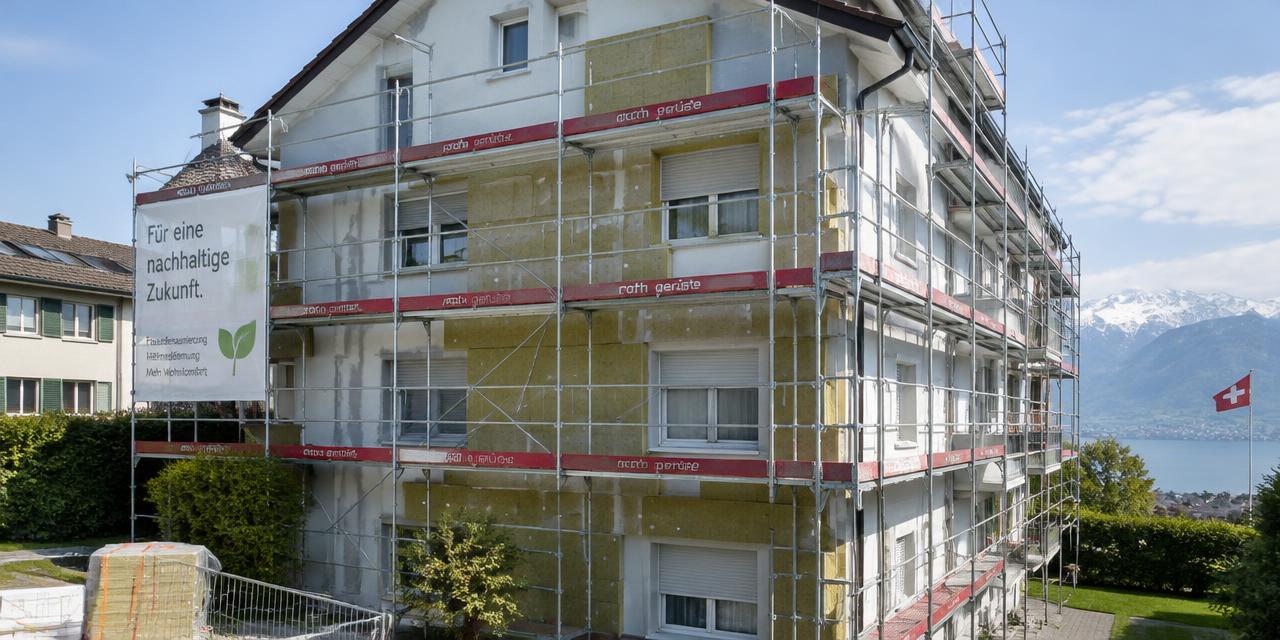
The success of a facade insulation project is based on rigorous planning. The first step consists of the permit application if necessary, followed by the submission of the subsidy file before starting. Once these validations are obtained, the work begins with the installation of scaffolding.
This step is crucial as it provides access to all facades, facilitating work on the walls but also potentially on windows or the roof. Group your work to minimize logistical costs related to temporary installations.
The execution of the work generally follows a precise order : preparation of supports, installation of insulation, finishing and window returns. It is preferable to schedule work outside of frost periods, although the schedule is mainly dictated by the availability of companies and administrative deadlines.
The weather influences the application of renders, which require mild temperatures for perfect adhesion. Regular site monitoring ensures that each step is followed according to best practices.
To avoid common pitfalls during a renovation, follow this checklist before requesting quotes. First, check if your property is located in a protected zone. Ensure you have obtained or at least requested the required administrative authorizations before placing any orders.
Never neglect to submit your subsidy file before the actual start of work. Think about grouping your interventions, such as window replacement or roof repair, to make the scaffolding installation cost-effective.
It is crucial to include in your discussions with companies a diagnosis on the state of the supports to anticipate the presence of asbestos.
Avoid choosing a technical solution based solely on price without considering durability or overall energy performance. Ensure that the project includes an adequate ventilation system to avoid interior humidity issues. Request detailed quotes allowing you to precisely compare services.
Finally, verify that the chosen company has the necessary skills for the insulation systems specific to your building, thus guaranteeing implementation that meets quality requirements.
Contribution per insulated m², depending on energy requirements met.
Grants for thermal insulation of the building envelope (walls, roof) via the Buildings Programme.
www.leprogrammebatiments.chCheck amounts and conditions with the provider before signing: apply before work starts in most cases.
1400 Yverdon-les-Bains · about 0 km
Specialist company for tinsmithing, plumbing, heating, and metal facade solutions based in Yverdon-les-Bains.
metallpfister.ch1400 Yverdon-les-Bains · about 0 km
Renovation company based in Yverdon-les-Bains, specializing in plastering, painting, plastering, and interior partition wall installation.
cako-renovation.ch1400 Yverdon-les-Bains · about 0 km
Company based in Yverdon-les-Bains specializing in painting, plastering, and interior and exterior renovation projects for individuals.
art-paint-sarl.ch1400 Yverdon-les-Bains · about 0 km
Specialist in asbestos removal, pollutant remediation, and demolition prior to renovation or transformation projects in French-speaking Switzerland.
amiante-assainissement.chSuggestions from the commercial register by distance and activity. Not an endorsement or partnership.
Not necessarily, but it is often required if the building is protected or if the insulation changes the exterior appearance. Always check with the municipality before starting.
No, a subsidy application must generally be submitted before work begins. Any intervention started too early may lead to a refusal.
It is preferable to plan work outside of intense frost periods. Applying renders requires mild temperatures for good adhesion.
Yes, investments intended to save energy are 100% deductible. The undeducted balance can be carried forward to the following two years.
Scaffolding represents a significant portion of the total cost. Grouping facade, windows, and roof work optimizes these logistical costs.
These buildings may contain asbestos in building materials. A preliminary diagnosis is necessary before drilling or modifying the facade.
The city has the Energy City label and has adopted a Climate Plan. It encourages renovations to reduce greenhouse gas emissions.
Source : swisstopo – service d'altitude (MNT)
Source : Open-Meteo Historical Weather API (réanalyse ERA5, moyenne 2015-2024)
Source : Open-Meteo Historical Weather API (réanalyse ERA5, moyenne 2015-2024)
Source : Open-Meteo Historical Weather API (réanalyse ERA5, moyenne 2015-2024)
Source : Open-Meteo Historical Weather API (réanalyse ERA5, moyenne 2015-2024)
Source : Open-Meteo Historical Weather API (réanalyse ERA5, moyenne 2015-2024)
Source : Canton de Fribourg: Permis de construire (example, this is Fribourg) · estimate
Source : Règlement sur la déduction des frais relatifs aux immeubles privés (RDFIP)
Source : energiestadt.ch