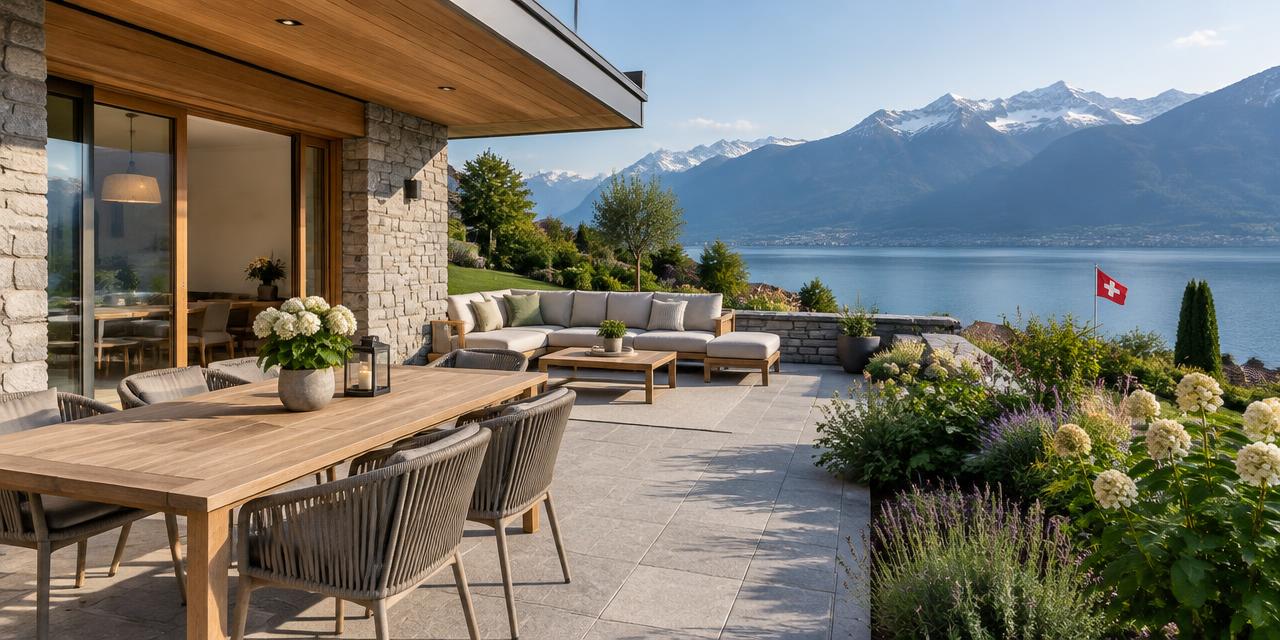
Terrace planning in Renens: A comprehensive guide for homeowners
Planning a terrace in Renens allows you to enhance your property while making the most of your outdoor space. This guide assists you through the key steps, from local technical constraints to administrative procedures.
Worked examples in Renens
Small project
CHF 4'100 – CHF 13'900
Typical project
CHF 7'000 – CHF 22'700
Large project
CHF 11'500 – CHF 36'700
Computed with our estimator for Renens (regional factor included), standard finish. Only the project size changes.
Cost split (typical project)
Labour :CHF 6'500(50 %)
Materials :CHF 5'200(40 %)
Other costs :CHF 1'300(10 %)
Why and when to start your project in Renens
Renens, located at an altitude of 420 meters, enjoys a temperate climate but requires careful attention to material selection.6°C and about 48 frost days per year, the choice of surfacing should not be left to chance.
A well-planned terrace extends your living space and optimizes the thermal comfort of your home, especially on sunny days when global irradiation reaches 1371 kWh/m²/year.
5°C, have passed. Anticipating the construction phase also allows for preparing the foundation and drainage before the heat of summer. By investing in a durable structure, you ensure the longevity of your investment against local climatic cycles.
Technical choices and materials
The success of a terrace depends primarily on the quality of its structure. The base, whether it is a concrete slab, adjustable pedestals, or a gravel bed, is the foundation for stability. In a region subject to 48 frost days per year, it is imperative to opt for materials resistant to moisture and thermal variations.
Porcelain stoneware tiles, exotic decking boards, or treated local wood are common options, each bringing distinct installation requirements.
For higher-end options, longevity depends on the integrated drainage system.5 to 2%, is necessary to drain rainwater and avoid stagnation that could weaken joints or create cracks due to freezing. Also consider using geotextiles to stabilize loose soils.
The choice between a pedestal-mounted terrace, which is simpler to install and allows for cable routing, or a poured concrete slab will radically change your project.
Specifics of local building stock and cautionary points
When working on existing buildings in Renens, it is crucial to assess the condition of the load-bearing structure. Houses built before 1990 may pose risks related to the presence of asbestos in tile adhesives or exterior joints. A preliminary analysis is recommended before any major intervention.
Furthermore, perimeter facade insulation, often added during renovations, must not be degraded by the anchoring of the terrace. Specific fastenings should be used to avoid thermal bridges between the exterior structure and the building wall.
Additionally, the routing of utilities (drainage, electrical conduits, gas pipes) must be mapped before any earthworks. Older buildings may have buried downspouts that require special attention so they are not crushed.
Also, check the waterproofing of the sub-structures if the terrace is adjacent to an underground part, such as a basement. Poor management of these utilities could compromise the overall waterproofing of your home.
Permits and regulations in Renens
For any project in Renens, it is essential to refer to the current municipal regulations. If you plan to build a raised terrace or a covered terrace, a permit may be necessary. The Canton of Vaud applies simplified procedures for certain works, but these do not always exempt you from declaring the project.
The concept of changing the exterior appearance is often the determining criterion for deciding whether a permit is required.
We advise you to contact the municipality or prefecture directly to validate the feasibility of your project. Before finalizing your plans, ensure you know the property boundary distances and the specific urban planning rules for your neighborhood.
If your building is subject to specific protection, aesthetic constraints might be stricter. Never start work without obtaining written agreement if the procedure requires it, as this could lead to costly subsequent compliance requirements.
Taxation and financial support
The question of financial support for renovation work often depends on the nature of the interventions. For standard terrace planning, no cantonal or federal aid is generally available, as this is considered a comfort improvement rather than an energy renovation.
However, it is recommended to check with the municipality of Renens if specific programs related to urban planning or rainwater management exist. The sequence of procedures remains immutable: any subsidy application must be submitted before the start of the construction work.
From a fiscal perspective, maintenance and renovation work can sometimes be deducted from your taxable income, according to Vaud tax law. It is advisable to keep all invoices and a description of the work performed. These documents serve as proof in case of an audit and help justify the value added to your property.
Do not hesitate to consult a tax advisor to optimize your declaration and know the limits of possible deductions for value-added investments.
Schedule and construction phases
A terrace project follows a well-established construction logic to ensure its durability. The first step is always site analysis and necessary earthworks. Once the soil is stabilized, the drainage system is installed, which is crucial in a region where rainfall and frost can be significant.
The load-bearing structure, whether concrete or pedestal-based, is then installed. This base must be perfectly level to ensure the longevity of the final covering.
Installing the surface material (tiles, wood, pavers) is the finishing step that requires the most attention, especially regarding the layout and joints. Ideally, schedule the work between late spring and early autumn.5°C in winter, prevents concrete work and adhesive drying.
Late summer is often a favorable time, as the ground has had time to dry out, facilitating the implementation of foundations and avoiding unpleasant surprises due to residual moisture.
Common errors and preparation checklist
Avoid the classic error of neglecting site preparation, as an unstable base will inevitably lead to subsidence. Never cut corners on an efficient drainage system, especially given local rainfall.
Ensure you have a sufficient slope on the surface to avoid stagnation, as frost is the worst enemy of porous or poorly laid materials. Before signing with a contractor, always verify whether a permit is required from the municipality to avoid the risk of forced compliance measures.
Here is a checklist for preparing your quotes : define your needs precisely in terms of area and usage, identify underground utility constraints, request comparative quotes detailing materials and installation techniques, check the contractor's liability insurance, and demand a clear construction schedule.
By following these points, you will reduce the risk of budget overruns or delivery delays. Clear communication with your provider from the start is the key to a successful and tension-free project.
Grants and subsidies
No specific grant listed for this work. Maintenance tax deductions may still apply.
Companies in the area
Carrelages Revêtements GRANDAS Manuel
1020 Renens VD · about 0 km
Founded in 1991 and based in Renens, Grandas installs indoor and outdoor tiles and surface coverings, particularly for floors, kitchens, bathrooms and walk-in showers.
Génération Parquet Sàrl specializes in the installation, renovation, and maintenance of parquet and various flooring types, as well as professional cleaning services.
Suggestions from the commercial register by distance and activity. Not an endorsement or partnership.
Frequently asked questions
Do I need a permit for a terrace in Renens?
Any exterior change may require authorization. It is recommended to consult the municipality to validate if your project falls under a simplified procedure.
Which materials are best against frost at 420 m?
Prefer non-porous materials like porcelain stoneware or treated wood. Ensure installation on a draining base to prevent water from stagnating.
Can one obtain financial aid for a terrace?
Generally no, as it is a comfort improvement. However, check with the municipality if specific aid exists for water management.
What is the ideal time to start work?
Spring, after frost, or late summer are the optimal periods. This allows for proper drying of materials and better long-term durability.
How to protect insulated facades during work?
Use adapted anchors that avoid thermal bridges. Avoid drilling unnecessarily into the perimeter insulation to maintain energy performance.
What are common errors to avoid?
Neglecting site preparation, forgetting drainage, and underestimating buried utility constraints. These oversights often compromise future stability.
Are terrace invoices tax-deductible?
According to Vaud tax law, only certain works may be. Consult a tax advisor to assess the deductible portion related to value-added.
Solar panels : Soumis à la procédure simplifiée ou dispense de permis de construire
Heat pump : Soumis à la procédure simplifiée ou dispense de permis de construire. Pour les pompes à chaleur air-eau ou air-air, les nuisances sonores sont prises en compte.
Procedure : procédure simplifiée de permis de construire (dispense de permis de construire)
Windows and facades : Soumis à la procédure simplifiée ou dispense de permis de construire, sauf si le bâtiment est protégé ou situé dans une zone protégée, ou si les travaux entraînent un changement d'affectation, d'aspect extérieur ou de gabarit important.
Note : Les sources fournies contiennent des statistiques générales pour la Suisse et les cantons de Vaud et Fribourg, mais ne contiennent pas de données spécifiques pour la commune de Renens.