
Canton
Facade insulation — Geneva
Amounts based on area and target performance.
Geneva support for energy renovation of the building envelope.
www.ge.chFacade insulation · Vernier
Small project
CHF 20'000 – CHF 41'400
Typical project
CHF 36'800 – CHF 73'000
Large project
CHF 62'100 – CHF 120'400
Computed with our estimator for Vernier (regional factor included), standard finish. Only the project size changes.
In Vernier, insulation is inextricably linked to the local climate. At an altitude of 441 meters and with approximately 54 frost days per year, buildings face significant thermal stresses, illustrated by a heating requirement of 2,826 Kj/year.
Facade insulation drastically reduces these needs and aligns with the municipality's vision, aiming for a 2000-Watt society. By minimizing heat loss in winter, you not only reduce bills but also actively support the energy transition of this pioneer municipality, awarded the 'Cité de l'énergie Gold' label.
The best time to undertake this work is often during a comprehensive renovation of the building envelope or roof replacement. Since scaffolding represents a significant part of the cost, it is highly recommended to group facade insulation, window replacement, and roof maintenance.
By planning these works, you anticipate the rigors of winter and ensure the long-term value of your property in Vernier.
The choice of insulation materials directly impacts the thermal performance and durability of your facade. Several options exist on the market, from mineral insulators like rock wool to synthetic or bio-sourced materials.
The selection depends on the desired thickness, water vapor permeability, and the type of exterior finish (plaster, wood cladding, or panels). Higher-end choices may offer better longevity and reduced maintenance, but the choice should primarily be guided by building physics.
Technical options, such as external thermal insulation composite systems (ETICS), allow for wrapping the building without reducing interior living space, while eliminating thermal bridges. To succeed, it is essential to integrate these materials into a comprehensive project that meets energy performance requirements.
Since external insulation alters the building's appearance, it often requires a permit, so it is prudent to check with competent authorities before finalizing any technical choices for your facade in Vernier.
Vernier has a diverse real estate heritage. A large part of the stock was built during an intense construction period up to 1975, with iconic large-scale projects like Le Lignon and Les Avanchets.
For owners of these buildings, the challenges are manifold : managing asbestos for structures built before 1990, the condition of distribution networks, and the performance of original insulation.
Construction materials from this era require a rigorous prior diagnosis to identify risks associated with toxic components and ensure efficient insulation that does not weaken the building.
Each building typology presents specific challenges. In small condominiums, coordination is paramount to maintain facade homogeneity. Single-family homes may present complexities related to heating or ventilation network connections.
Before any renovation, a detailed analysis of the current structure is necessary to adapt the insulation strategy to real needs and to ensure that the project meets current safety and energy efficiency standards while preserving the structural integrity of Vernier's buildings.
In Vernier, external insulation alters the building's appearance and often requires a building permit from the Office of Urban Planning. Authorities examine the visual impact, particularly in heritage protection zones. It is imperative to ensure that the project complies with current zoning laws.
Although some solar installations benefit from simplified procedures, facade insulation follows the general rules of the Law on Constructions and Installations. It is highly recommended to consult the municipal administration to obtain specific guidelines applicable to your plot.
Buildings with high heritage value are subject to increased scrutiny. For such properties, interventions must be carried out with care for satisfactory landscape and heritage integration. Any change to the exterior appearance must be documented and submitted for approval.
Do not start any work before receiving the required permit, as unauthorized changes could lead to restoration requirements. Compliance with administrative procedures ensures the peace and conformity of your renovation project.
The canton of Geneva offers aid for the energy renovation of the building envelope to support owners in their projects. These subsidies, particularly applicable to facade insulation, are calculated based on the area and the targeted energy performance of your work.
This is a major opportunity to reduce initial investment costs. However, a golden rule must be respected: a subsidy application must generally be submitted before the start of the work. Any work begun without a prior application renders eligibility for aid void.
To know the exact amounts and grant conditions, it is advisable to regularly check the canton's official platforms. Additionally, energy renovation work can impact your taxation, notably in terms of deductions.
It is wise to plan your project by integrating these two levers: the subsidy for immediate cost reduction and the tax deduction for medium-term optimization. Ensure you assemble a complete file before signing any company contract to maximize your chances of obtaining this financial support.
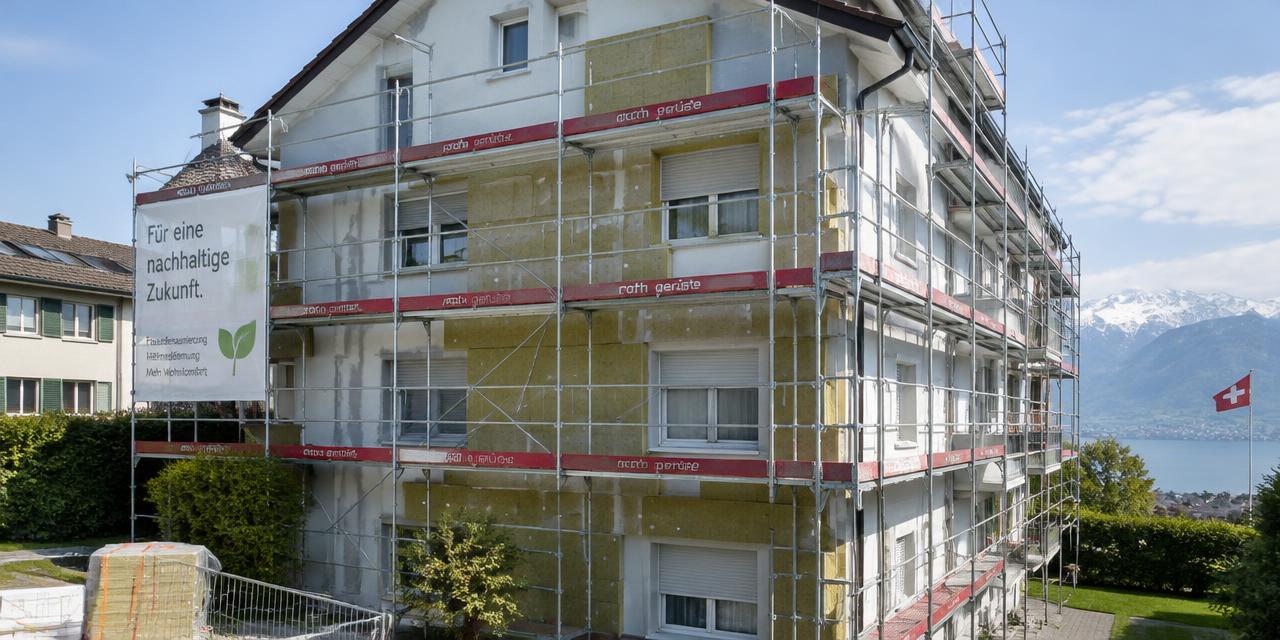
Carrying out facade insulation follows several logical steps. After obtaining permits and validating subsidies, setting up the scaffolding marks the effective start of the site.
In Vernier, the weather influences planning, especially in winter when the 54 frost days can slow down certain phases, such as plaster drying or the installation of certain materials. The ideal season to start is spring or early summer, periods more favorable for implementation without major climatic interruptions.
The typical process begins with preparing the supports, followed by fixing insulation panels and applying the reinforcement layer. Then come the finishes, such as exterior plaster or cladding. If you also plan work on the roof or windows, the schedule must be coordinated to optimize scaffolding assembly.
Each step must be validated by the technical managers to ensure that the final insulation matches the initial energy calculations and that the building's aesthetics meet the municipality's requirements.
To ensure the success of your work in Vernier, several errors must be avoided. Never fail to apply for a building permit if required, as post-facto regularization is complex. Do not start work before your subsidy application has been officially approved.
Ensure the selected company is qualified for facade work and understands the constraints related to the local building stock. Do not prioritize cost alone at the expense of the real energy performance of the chosen insulation.
Before asking for quotes, here is an essential checklist : verify that your renovation plans include adequate ventilation to avoid humidity problems after insulation; confirm that grouping works (facade, windows, roof) is taken into account to maximize economies of scale; ensure local thermal requirements are well integrated into the work description; check access conditions for scaffolding; and ask for a neutral analysis of your project to avoid sizing errors.
Rigorous planning from the start is the key to a successful and durable renovation.
Amounts based on area and target performance.
Geneva support for energy renovation of the building envelope.
www.ge.chCheck amounts and conditions with the provider before signing: apply before work starts in most cases.
1214 Vernier · about 0 km
Specialist in scaffolding assembly and traceability solutions for equipment safety via the Verticontrol app.
verticontrol.ch1214 Vernier · about 0 km
Geneva-based specialist in scaffolding assembly for all types of building construction, renovation, and transformation projects.
echami.ch1214 Vernier · about 0 km
Facetec SA is a company specializing in the design and installation of ventilated facades in French-speaking Switzerland since 1985.
facetec.ch1214 Vernier · about 0 km
Glass specialist in Geneva, BK Verre provides showers, kitchen splashbacks, railings, insulating glazing, and 24/7 emergency repairs.
bkverre.chSuggestions from the commercial register by distance and activity. Not an endorsement or partnership.
Yes, because external insulation alters the appearance of the building. It is imperative to consult the Office of Urban Planning before starting any work.
Absolutely, a subsidy application must be submitted before the start of the site. Work started beforehand is generally excluded from aid.
Yes, scaffolding is expensive. It is advisable to carry out roof, window, and insulation work at the same time to optimize costs.
Buildings built before 1990 may contain asbestos. A prior technical diagnosis is essential to ensure site safety.
Yes, with 54 frost days, drying periods for some insulators are limited. Spring and summer are recommended for your work.
The city aims for the 2000-Watt society goal, encouraging public and private buildings of high environmental quality.
Vernier offers free, personalized guidance for single-family home owners wishing to install solar panels.
Source : swisstopo – service d'altitude (MNT)
Source : Open-Meteo Historical Weather API (réanalyse ERA5, moyenne 2015-2024)
Source : Open-Meteo Historical Weather API (réanalyse ERA5, moyenne 2015-2024)
Source : Open-Meteo Historical Weather API (réanalyse ERA5, moyenne 2015-2024)
Source : Open-Meteo Historical Weather API (réanalyse ERA5, moyenne 2015-2024)
Source : Open-Meteo Historical Weather API (réanalyse ERA5, moyenne 2015-2024)
Source : ge.ch
Source : Guide Installations Solaires et Thermopompes - Canton de Genève