
Canton
Facade insulation — Buildings Programme (VD)
Contribution per insulated m², depending on energy requirements met.
Grants for thermal insulation of the building envelope (walls, roof) via the Buildings Programme.
www.leprogrammebatiments.chFacade insulation · Lausanne
Small project
CHF 20'000 – CHF 41'400
Typical project
CHF 36'800 – CHF 73'000
Large project
CHF 62'100 – CHF 120'400
Computed with our estimator for Lausanne (regional factor included), standard finish. Only the project size changes.
The city of Lausanne, located at an average altitude of 493 meters, faces demanding climatic conditions that directly impact the energy performance of residential buildings.8 °C and nearly 53 frost days per year, the heating demand is significant.
Energy needs are characterized by 2,914 heating degree-days, highlighting the importance of an efficient thermal envelope to limit heat loss. In this context, insulating the facade is a priority for homeowners wishing to sustainably reduce their bills.
The ideal time to undertake this work often aligns with the desire to bring the building into line with the carbon neutrality goals set for 2050. Lausanne, an 'Energy City' label holder since 1996 and recipient of the European Energy Award GOLD, strongly encourages this transition.
If your facade shows signs of wear or if your heating bills increase despite regular maintenance, thermal renovation becomes essential.
This intervention not only improves interior comfort during the cold months but also enhances the value of your property by aligning it with contemporary energy requirements while protecting the structure from moisture.
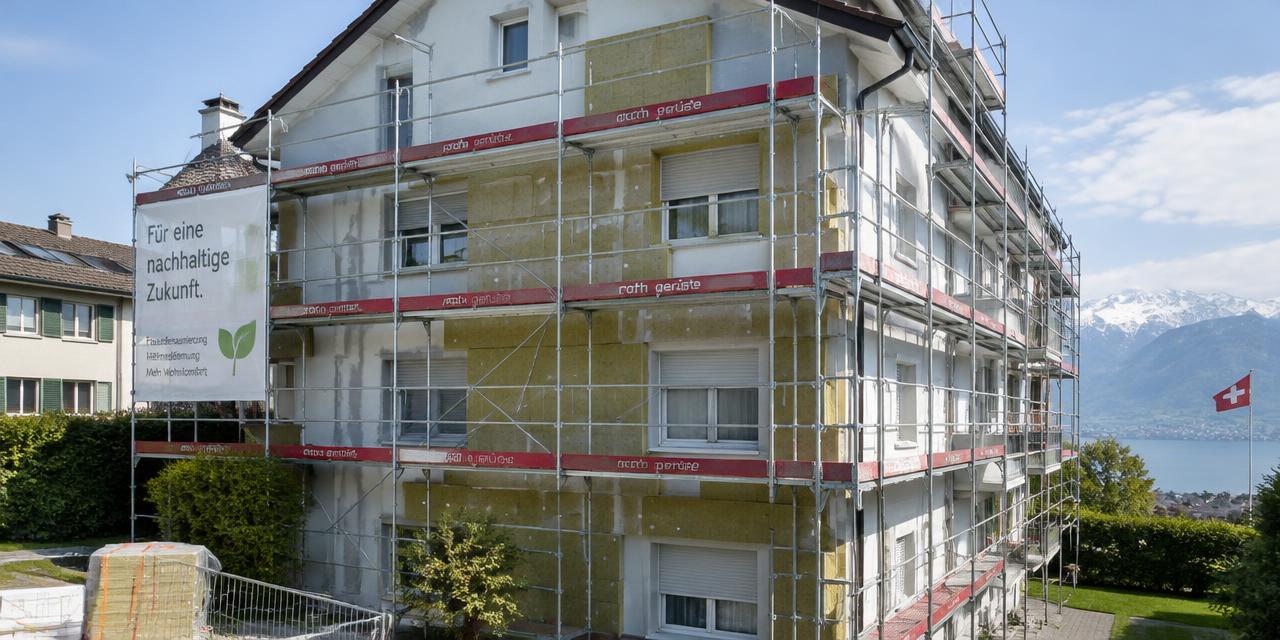
The facade insulation project is not limited to installing insulation boards; it requires deep consideration of the chosen system. Several types of external thermal insulation (ETICS) exist, using mineral (rock wool) or synthetic (expanded polystyrene) materials.
The choice will depend on the desired thermal performance, the material's water vapor permeability, and the desired finish (plaster, wood cladding, or panels). It is essential to ensure that the system is compatible with existing materials to avoid the risk of condensation behind the insulation.
Beyond the material, the overall design must account for specific junctions: connections with windows, the roof, and the ground. Using high-performance insulation allows for a reduction in the total thickness of the facade complex, a crucial factor if you are limited by the building footprint or existing dimensions.
It is also recommended to take advantage of the insulation installation to replace aging windows, as both tasks are complementary.
By structuring your project in this way, you often benefit from significant economies of scale on scaffolding installation, which accounts for a significant portion of the total cost of facade work.
The building stock in Lausanne, with about 24% single-family homes, shows a wide variety of construction eras. Each decade brings its own specific challenges. Buildings constructed before 1990 require special attention regarding the potential presence of asbestos in old plasters, joints, or adhesives.
Before any work, a rigorous asbestos diagnostic is mandatory to ensure the safety of workers and occupants. Existing networks (embedded pipes, electricity) must also be carefully analyzed to avoid any damage when attaching the insulation complex.
Lausanne relies on the architectural inventory of the Canton of Vaud to protect its built heritage. If your building is listed or located in a protected zone, constraints on the choice of materials and finishes may be strict.
It is therefore essential to check the protection status of your building with the municipality before developing any aesthetic project.
Furthermore, buildings built before the 1970s often have structures with little or no original insulation; the addition of a thermal envelope must therefore be thought through comprehensively to avoid shifting dew points to the inside, which could lead to mold problems if ventilation is not optimized in parallel.
In Lausanne, as in the rest of the Canton of Vaud, the building permit procedure varies depending on the nature and impact of the work. In general, facade work is subject to the simplified building permit procedure.
However, you may benefit from a permit exemption if your work does not involve a change of use, a significant change in dimensions, or a significant change in exterior appearance.
This rule is, however, very different if your building is listed or located in a protected zone, where authorities will be much more demanding regarding the conservation of original architectural elements.
It is highly recommended to contact the relevant municipal departments well before starting the work to confirm the need for a permit application. For air-to-water or air-to-air heat pumps often installed during global renovations, noise pollution must be taken into account from the planning stage.
If you are planning solar panels, be aware that they are generally subject to a simplified procedure or permit exemption.
In summary, external insulation changes the appearance of the building and often requires authorization; take no risks and always ask for written confirmation from the municipality before starting any work.
The Canton of Vaud offers support programs to encourage energy renovation work. The 'Programme Bâtiments' offers subsidies for facade insulation, calculated based on the insulated area and the energy requirements achieved.
A golden rule must be respected : a subsidy application must generally be submitted before the start of the work, or you may lose all eligibility. It is therefore crucial to check the official forms on the Programme Bâtiments website before placing any orders.
Regarding taxation, the owner taxpayer can deduct expenses for investments intended to save energy. These investments, which include the replacement of old building elements, are 100% deductible.
If your work results in a negative net income, you have the option to carry over the balance of the costs to the two following fiscal periods. However, you must choose between deducting actual expenses and the flat-rate deduction for each building.
Note that the flat-rate deduction is excluded if the building is used by third parties primarily for commercial purposes or if the gross rental income exceeds 150,000 francs. Anticipate these calculations with your tax advisor to optimize your investment.
The planning of an insulation project in Lausanne requires anticipating weather constraints. With an average of 53 frost days per year, it is essential to avoid periods of intense cold for the application of plasters, which require stable temperatures to dry correctly.
Spring and autumn are often the preferred seasons, although summer can be considered with appropriate protections against high heat. Planning always begins with the thermal study, followed by the permit request, the subsidy application, and finally the selection of contractors.
The work itself begins with the installation of the scaffolding. As scaffolding represents a significant part of the cost, it is strongly advised to group the facade, windows, and roof work together to share installation costs.
Once the scaffolding is in place, standard steps include preparing the substrates, installing insulation boards, reinforcing the base layer, applying the finishing layer, and finishing work (flashing, window sills). Each phase must be checked to avoid thermal bridges.
Coordination between different trades is key to limiting the duration of disturbances and ensuring the final quality of the installed insulation.
Facade insulation is a major investment that does not forgive improvisation. The first error to avoid is neglecting the condition of the substrate before installation; a damp or cracked facade must be treated beforehand. Never request quotes without having established a precise list of your energy goals.
Ensure that your contractors plan for rigorous management of thermal bridges, especially around window frames and balconies. Absolutely avoid starting work before receiving a positive response regarding your subsidy application.
Here is your checklist before requesting offers : check the heritage status of your building with the municipality, commission an expert for a preliminary thermal study, list all desired work (windows, roof, facade) to group the scaffolding installation, request an asbestos diagnostic if your house was built before 1990, obtain written confirmation regarding the need or exemption from a building permit, and prepare the file for the Programme Bâtiments.
By following these steps, you secure your project financially and technically while minimizing the risks of poor thermal performance.
Contribution per insulated m², depending on energy requirements met.
Grants for thermal insulation of the building envelope (walls, roof) via the Buildings Programme.
www.leprogrammebatiments.chCheck amounts and conditions with the provider before signing: apply before work starts in most cases.
1010 Lausanne · about 0.5 km
Claude Favre SA, based in Lausanne, carries out architectural sheet metal, roofing and facade work for new buildings, renovations, alterations and building maintenance.
claude-favre.ch1012 Lausanne · about 0.8 km
E.Barbier Peinture Sàrl is a company based in Bussigny specializing in painting, plastering, and facade renovation.
ebpeinture.ch1005 Lausanne · about 1.5 km
Lausanne-based company specializing in energy-efficient renovations: insulation, windows, heat pumps, and solar PV systems in the Vaud region.
proxima-construction.ch1005 Lausanne · about 1.5 km
La Boîte de Travaux is a renovation company based in French-speaking Switzerland that offers comprehensive project management with a single point of contact.
laboitedetravaux.chSuggestions from the commercial register by distance and activity. Not an endorsement or partnership.
You can benefit from the Programme Bâtiments which offers subsidies for insulating the thermal envelope. It is imperative to submit your subsidy application before starting the work to be eligible.
In Lausanne, facade work is subject to a simplified procedure. An exemption is sometimes possible if the exterior appearance is not changed, but written confirmation from the municipality is recommended.
Scaffolding accounts for a significant portion of costs. By grouping these tasks, you optimize installation costs and ensure better overall thermal coherence of the building.
Buildings from this era may contain asbestos in facade materials. An asbestos diagnostic is necessary to protect the health of occupants and workers.
Yes, investments aimed at saving energy are 100% deductible. You must choose between deducting actual expenses or the flat-rate deduction for each building.
It is best to avoid frost periods. Spring and autumn are ideal to ensure correct drying of materials and plasters.
You should contact the urban planning departments of the city of Lausanne. They will inform you about the cantonal architectural inventory applicable to your building.
Source : swisstopo – service d'altitude (MNT)
Source : Open-Meteo Historical Weather API (réanalyse ERA5, moyenne 2015-2024)
Source : Open-Meteo Historical Weather API (réanalyse ERA5, moyenne 2015-2024)
Source : Open-Meteo Historical Weather API (réanalyse ERA5, moyenne 2015-2024)
Source : Open-Meteo Historical Weather API (réanalyse ERA5, moyenne 2015-2024)
Source : Open-Meteo Historical Weather API (réanalyse ERA5, moyenne 2015-2024)
Source : Protection du patrimoine : cadre légal et réglementaire – Ville de Lausanne · estimate
Source : Canton de Fribourg: Permis de construire (example, this is Fribourg) · estimate
Source : Règlement sur la déduction des frais relatifs aux immeubles privés (RDFIP)
Source : lausanne.ch