
Canton
Solar PV — Geneva support
Variable additional grants; federal one-off payment by capacity.
Geneva strongly supports solar PV, with grants in addition to the federal one-off payment.
www.pronovo.chSolar panels · Vernier
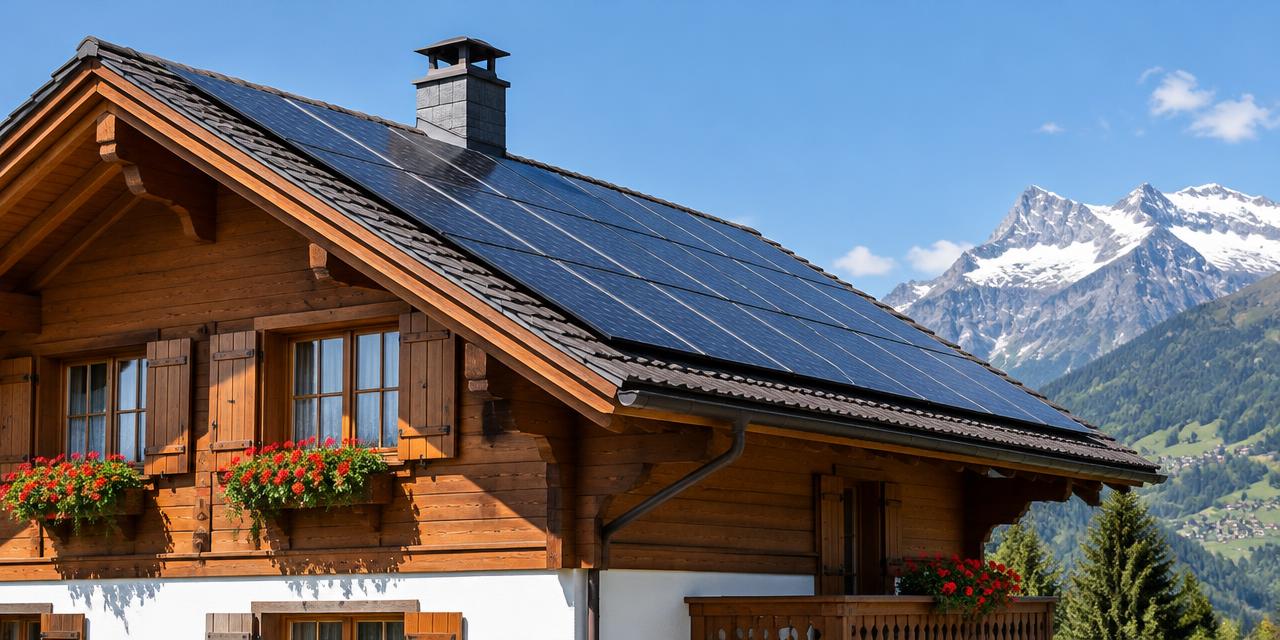
Small project
CHF 9'800 – CHF 18'500
Typical project
CHF 18'100 – CHF 32'900
Large project
CHF 31'400 – CHF 55'800
Computed with our estimator for Vernier (regional factor included), standard finish. Only the project size changes.
The municipality of Vernier, a pioneer with its Cité de l'énergie Gold label, is committed to the 2000-Watt society.
With favorable sunshine allowing for an estimated production of 1213 kWh/kWp/year on a south-facing roof, investing in photovoltaics is no longer just an ecological choice, but a necessity for enhancing property value.9 °C and about 54 frost days per year.
The current period is particularly favorable as it aligns with the local Energy Master Plan, which promotes high-quality densification.
By taking this opportunity to combine your installation with a global energy renovation, you anticipate future requirements for efficiency. The ideal time to act is before any roof repair, in order to optimize installation costs and technically integrate the panel mounts.
By acting now, you actively contribute to the climate goals of the City of Vernier, while securing your independence against fluctuating energy costs. The transition to local production is supported by authorities, providing homeowners with a clear framework to carry out their project in a sustainable manner.
The design of a photovoltaic system in Vernier relies on several technical variables. The choice of panels, whether monocrystalline or polycrystalline, influences the surface yield and aesthetics.
For roofs, the integration system can vary between an on-roof installation, which is more economical, and a full building-integrated system, which is aesthetically preferred in certain heritage sectors.
The total power of your installation must be sized according to your actual consumption, because profitability depends above all on the share of electricity consumed on site.
The inverter, the heart of your installation, transforms the direct current of the panels into domestic alternating current. Depending on your roof configuration (partial shading by trees or chimneys), you could opt for micro-inverters or power optimizers, ensuring independent production for each panel.
It is also worth considering storage, although optional, which allows you to consume your own solar energy during the evening. Finally, the choice of mounting materials must respect safety rules against wind and snow loads, taking into account local climatic conditions.
Vernier features a housing stock marked by a period of strong construction up to 1975, including dense complexes like Le Lignon or Les Avanchets. For owners of detached houses or small condominiums from this era, installing solar panels requires special attention to the state of the roof.
Older structures may require reinforcement before supporting the weight of the panels. Furthermore, the possible presence of hazardous materials, such as asbestos, in old insulation or roof elements imposes a rigorous check before any intervention.
It is crucial to have the state of the internal electrical network and the roof frame evaluated by a professional. Installations dating from before 1990 often require an upgrade of the electrical panel to accommodate the photovoltaic connection.
Additionally, deficient roof insulation could make your installation less efficient if thermal bridges persist. The support offered for free by the City of Vernier is a valuable resource for owners wishing to perform this technical and heritage diagnostic.
A preliminary audit allows you to anticipate these constraints and integrate the remediation works into the overall project.
In the canton of Genève, the Office of Urban Planning oversees building permits, but a simplified procedure is in force for photovoltaics. A simple prior declaration may suffice if your installation meets the conditions of compliance with zoning law, satisfactory landscape integration, and a power of less than 100 kVA.
For compliant pitched roofs or non-visible flat roofs, the procedure is even more direct. However, be vigilant if your property is located in a heritage protection zone: strict rules then apply, such as the limitation of protrusion from the roof slopes or the prohibition of reflections.
Listed buildings or those with high heritage value are subject to specific constraints and almost systematically require a permit. It is strictly forbidden to exceed the upper edge of the roof by more than one meter or to make the panels visible from a 45-degree angle of view from the ground for flat roofs.
In case of doubt, the City of Vernier offers free and personalized support to define your project and check if you can benefit from the simplified procedure. Never start work without having clarified this point with the municipal administration to avoid any work stoppage or subsequent compliance requirements.
The financing of a photovoltaic solar installation benefits from structured support, mainly through the federal one-off remuneration managed by Pronovo. This mechanism significantly reduces your initial investment.
In addition, Genève offers specific cantonal aid that is added to federal support, making the project more accessible. It is essential to follow the sequence of steps: you must imperatively submit your application for aid before starting the work.
Any installation started before the validation of the application risks not being eligible for subsidies.
, direct use of your production on site. In addition to direct aid, installation costs can sometimes be deducted from your taxable income according to the tax rules in force in the canton of Genève.
We advise you to consult the Pronovo website for technical details of the one-off remuneration and to contact the energy services of Vernier for advice on supplementary aid. Rigorous management of work receipts is necessary for the effective payment of this aid once the site has been accepted and commissioned.
The implementation of a solar project follows a rigorous planning logic. The first phase consists of the technical feasibility analysis and obtaining quotes, including verification with the municipality of Vernier. Once the choice of installer is validated and aid requested, work can begin.
It is preferable to avoid periods of extreme cold, characterized by the 54 annual frost days in Vernier, which can make working conditions on the roof perilous and slow down the installation of fixing systems. Spring and summer are often preferred to facilitate the assembly of the structures.
The project proceeds in several stages : installation of peripheral safety, installation of fixings, installation of panels, then electrical connection. Once the panels are installed, the installer performs compliance tests before commissioning.
The overall time depends on the complexity of your roof and the availability of equipment. Keep in mind that the personalized support offered by the municipality can help you better structure this schedule, avoiding periods of administrative overload.
Advance planning ensures a serene installation and quick commissioning so you can start producing your own energy without delay.
To ensure the success of your project in Vernier, avoid classic errors. Never sign a quote before checking with the Office of Urban Planning whether your project meets local constraints, especially heritage-related ones.
Forgetting to apply for subsidies before starting work is a frequent error that makes the investment less profitable. Do not neglect the condition of your roof: installing panels on a dilapidated frame can generate unforeseen renovation costs shortly after installation.
Finally, do not focus solely on the price of equipment, as a quality installation is primarily a matter of the technical competence of the installer.
Checklist before requesting quotes : 1. Have an energy diagnostic of your roof and current insulation performed. 2. Check if your house is located in a heritage protection zone. 3. Contact the support service of the City of Vernier for free advice. 4.
Prepare a record of your annual electricity consumption to size the installation as accurately as possible. 5. Ensure that the installer is certified and offers a maintenance contract. 6. Check the date of your last roof repairs. 7. Request comparative quotes including grid connection and electrical compliance costs.
8. Validate that the system is well grouped for better visual integration.
The durability of a photovoltaic installation is exceptional, often exceeding 25 to 30 years. However, optimal performance over the long term requires regular maintenance.
Although rain often allows for self-cleaning of the panels, an annual visual check is recommended to detect any dirt, leaf deposits, or damage caused by falling branches.
In Vernier, although the climate is moderate, an inspection after periods of strong wind or heavy snow is advised to ensure that the fixings have not shifted and that the cables are well protected.
The inverter, meanwhile, is the most heavily used element and might require replacement after ten or fifteen years. It is recommended to regularly monitor production data via the application provided by your installer. Any unexplained drop in production is a sign that technical intervention is necessary.
A maintenance contract with your installer can simplify this follow-up, ensuring quick responsiveness in case of failure. By taking care of your installation, you preserve its profitability and guarantee clean energy production for decades to come, thus contributing to the collective efforts of the municipality.
Variable additional grants; federal one-off payment by capacity.
Geneva strongly supports solar PV, with grants in addition to the federal one-off payment.
www.pronovo.chCheck amounts and conditions with the provider before signing: apply before work starts in most cases.
1214 Vernier · about 0 km
ABRIPROTECT SA specializes in the installation and maintenance of civil protection shelters, cellar partitions, and technical inspections using drones.
abriprotect.ch1214 Vernier · about 0 km
Facetec SA is a company specializing in the design and installation of ventilated facades in French-speaking Switzerland since 1985.
facetec.ch1214 Vernier · about 0 km
Geneva-based specialist in scaffolding assembly for all types of building construction, renovation, and transformation projects.
echami.ch1219 Châtelaine · about 1.9 km
Electro Concept SA is a Geneva-based company specializing in electrical installations, telecommunications, and solar photovoltaics.
electro-concept.chSuggestions from the commercial register by distance and activity. Not an endorsement or partnership.
You benefit from the federal one-off remuneration via Pronovo, complemented by cantonal Geneva aid. Remember to submit your applications imperatively before the start of work.
No, a simplified procedure via prior declaration is possible if certain compliance and integration conditions are met. Always check your eligibility with the town hall.
Yes, the municipality offers free and personalized support to define your project, manage calls for tender, and track commissioning. It is a valuable resource.
A photovoltaic installation generally lasts between 25 and 30 years. Regular maintenance helps maintain optimal performance throughout this period.
It is optional, but it allows you to increase self-consumption by using your solar energy in the evening. Profitability depends on your consumption habits.
Yes, but it is crucial to check the solidity of the roof frame and the absence of asbestos. A preliminary technical diagnosis is highly recommended before any commitment.
It is better to avoid the winter periods marked by frost. Spring and summer facilitate the work and conditions for safe installation.
Source : Open-Meteo Historical Weather API (réanalyse ERA5, moyenne 2015-2024) · estimate
Source : swisstopo – service d'altitude (MNT)
Source : Open-Meteo Historical Weather API (réanalyse ERA5, moyenne 2015-2024)
Source : Open-Meteo Historical Weather API (réanalyse ERA5, moyenne 2015-2024)
Source : Open-Meteo Historical Weather API (réanalyse ERA5, moyenne 2015-2024)
Source : Open-Meteo Historical Weather API (réanalyse ERA5, moyenne 2015-2024)
Source : Open-Meteo Historical Weather API (réanalyse ERA5, moyenne 2015-2024)
Source : ge.ch
Source : Guide Installations Solaires et Thermopompes - Canton de Genève