
Canton
Facade insulation — Buildings Programme (VD)
Contribution per insulated m², depending on energy requirements met.
Grants for thermal insulation of the building envelope (walls, roof) via the Buildings Programme.
www.leprogrammebatiments.chFacade insulation · Pully
Small project
CHF 20'000 – CHF 41'400
Typical project
CHF 36'800 – CHF 73'000
Large project
CHF 62'100 – CHF 120'400
Computed with our estimator for Pully (regional factor included), standard finish. Only the project size changes.
With an altitude of 426 meters and an average of 44 frost days per year, the climate in Pully places real thermal demands on buildings.
With heating degree days reaching 2776 Kj/year, efficient insulation is a necessity to maintain stable indoor temperatures, especially during winter when minimums frequently reach harsh levels. Facade insulation helps break thermal bridges responsible for major energy losses in untreated structures.
The ideal time to consider these works is during facade renovation or comprehensive thermal envelope renewal, ideally including window replacement. By participating in the Ecowatt program and the city's goals, which has been an 'Energy City' since 2017, you actively contribute to the 2050 Energy Strategy.6°C.
The choice of insulation system mainly depends on the nature of your current support and your performance objectives. Exterior thermal insulation (ETI) is the most common and effective solution for eliminating thermal bridges.
It consists of installing insulation panels, which can be expanded polystyrene, mineral wool, or bio-based materials like wood fiber. Each material offers specific characteristics in terms of thermal conductivity, fire resistance, and water vapor behavior.
Beyond the insulation, the choice of finish is decisive. You will have to choose between a thin render, allowing for various colors and textures, or cladding (wood, composite panels, metal). The quality level will influence not only the final aesthetic but also durability against weather.
It is advisable to consult a specialist to perform a precise thermal diagnostic, to ensure that the chosen system is compatible with your building's breathable structure and meets current fire safety standards.
Pully's real estate stock is varied, ranging from old buildings with traditional masonry to more contemporary villas. Buildings constructed before 1990 have specific risks that must be identified before any work begins.
The presence of asbestos in old mortars, joints, or certain facade insulation is a serious issue that requires a mandatory prior diagnostic before any drilling or demolition intervention.
Furthermore, old structures are not always equipped with adequate vapor barriers, which can lead to internal moisture problems after adding a very tight insulation layer. It is crucial to assess the condition of networks embedded in the facades or in the immediate vicinity.
Energy renovation is the right time to modernize these systems. Finally, insulation influences water vapor management: on old walls, the use of vapor-permeable materials is often recommended to avoid internal condensation, thus ensuring the longevity of your facade and the health of your living space.
Generally, facade insulation work is subject to the simplified building permit procedure in the Canton of Vaud. However, it is essential to check if your building is protected or located in a heritage protection zone.
If your building is listed in the inventory or located in a village zone, the constraints on external appearance, materials, and colors may be strict to preserve the sector's harmony.
Financial support for your project is primarily structured by the Buildings Program (VD). You can benefit from subsidies for thermal envelope insulation, the amount calculated per m² according to the energy requirements met. A golden rule: a subsidy request must generally be submitted before work begins.
Any intervention started without prior agreement risks depriving you of this valuable aid. Consult the Buildings Program website for details on technical requirements.
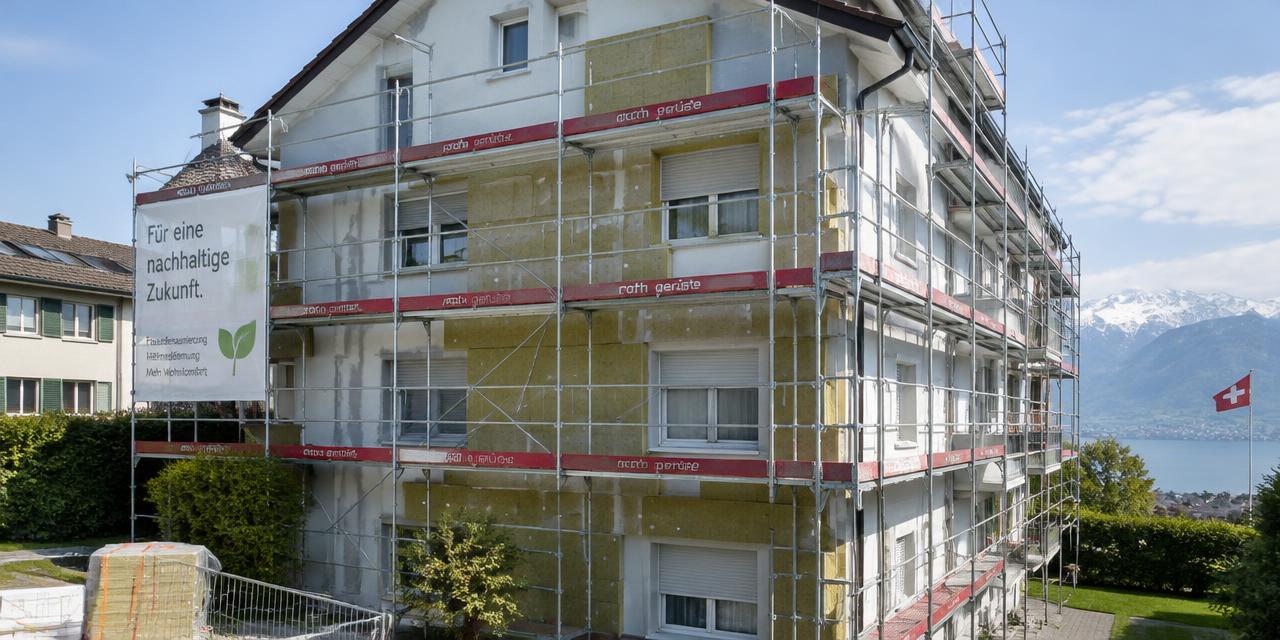
The schedule for a facade insulation project begins with a technical preparation phase including the installation of scaffolding. Since these represent a significant part of the cost, it is highly recommended to group your facade works with window replacement or roof renovation.
Once the scaffolding is in place, works begin with support preparation, followed by the attachment of insulation panels and the installation of the reinforcement layer.
The choice of season is crucial. Plastering works are weather-sensitive. With 44 frost days per year in Pully, it is best to plan the construction during frost-free periods, ideally between spring and early autumn, to ensure optimal product bonding.
The final phase consists of applying the finish and dismantling temporary structures. Rigorous planning with your contractor will allow steps to proceed without major interruptions, ensuring the success of your renovation project.
Before requesting quotes, ensure you have clarified all administrative and technical points to avoid unpleasant surprises. The first error is forgetting to submit your subsidy application before work begins.
Systematically check if your project requires authorization from the municipality of Pully so as not to be forced to restore your facade at your own expense. Never neglect the condition of the plinths or rainwater management when installing insulation.
Contribution per insulated m², depending on energy requirements met.
Grants for thermal insulation of the building envelope (walls, roof) via the Buildings Programme.
www.leprogrammebatiments.chCheck amounts and conditions with the provider before signing: apply before work starts in most cases.
1009 Pully · about 0 km
Specialist in waterproofing and insulation for flat roofs, terraces, balconies, and parking slabs for residential and commercial clients in French-speaking Switzerland.
lartisanetancheite.ch1009 Pully · about 0 km
Belet Toiture Sàrl is a company based in Pully specializing in roofing, tinsmithing, ventilated facades, and solar installations.
belet-ferblanterie-sanitaire.ch1009 Pully · about 0 km
Laurent Construction is a Swiss family-owned company specializing in building construction, civil engineering, demolition, and building renovation.
laurentsa.ch1009 Pully · about 0 km
General contractor based in Pully specializing in development, construction, and full renovation of residential buildings in French-speaking Switzerland.
ineom.chSuggestions from the commercial register by distance and activity. Not an endorsement or partnership.
Yes, exterior insulation modifies the building's appearance and often requires authorization. It is recommended to consult the municipal urban planning department before proceeding.
Generally no, a subsidy request must be submitted before work begins. Following this order is essential to receive aid.
Scaffolding represents a significant portion of the total cost. Grouping facade, windows, and roof work allows for significant savings.
The possible presence of asbestos requires a mandatory prior diagnostic. This ensures worker safety and compliance with health standards.
Yes, investments aimed at saving energy are 100% deductible from taxable income. You can also carry over expenses for two additional years.
Favor frost-free periods, ideally between spring and early autumn. The local climate counts an average of 44 frost days per year.
All information on aid is centralized on the Buildings Program website. It is the reference for energy subsidies in the canton.
Source : swisstopo – service d'altitude (MNT)
Source : Open-Meteo Historical Weather API (réanalyse ERA5, moyenne 2015-2024)
Source : Open-Meteo Historical Weather API (réanalyse ERA5, moyenne 2015-2024)
Source : Open-Meteo Historical Weather API (réanalyse ERA5, moyenne 2015-2024)
Source : Open-Meteo Historical Weather API (réanalyse ERA5, moyenne 2015-2024)
Source : Open-Meteo Historical Weather API (réanalyse ERA5, moyenne 2015-2024)
Source : ["République et canton de Genève (ge.ch)","Réseau suisse pour le patrimoine culturel (reseau-patrimoine-culturel.ch)","Energiestadt (energiestadt.ch)"] · estimate
Source : Canton de Fribourg: Permis de construire (example, this is Fribourg) · estimate
Source : Règlement sur la déduction des frais relatifs aux immeubles privés (RDFIP)
Source : Pully.ch - Energie