
Fasel-Piller Gebäudehülle AG
1716 Plaffeien · about 26 km
Swiss company specializing in building services, tinsmithing, roofing, and solar installations for the building envelope.
faselpillerag.chHeat pump installation · Thun
At a glance
Small project
CHF 30'600 – CHF 55'900
Typical project
CHF 38'600 – CHF 71'900
Large project
CHF 50'600 – CHF 95'800
| Project | Quantity | Low | High | Per unit |
|---|---|---|---|---|
| Small project | 80 m² | CHF 30'600 | CHF 55'900 | CHF 500 |
| Typical project | 160 m² | CHF 38'600 | CHF 71'900 | CHF 300 |
| Large project | 280 m² | CHF 50'600 | CHF 95'800 | CHF 300 |
Computed with our estimator for Thun (regional factor included), standard finish. Only the project size changes.
Included
Not included
In Thun, the federal building register lists 7'167 residential buildings and 22'890 dwellings. These municipal benchmarks help put your home in context, but do not replace an individual assessment.
69 % built before 1980
Construction year does not reveal past renovations: check the current insulation condition.
41 % · Gas
This distribution describes recorded buildings, not your system's consumption or efficiency.
| Energy | Heating | Hot water |
|---|---|---|
| Gas | 41 % | 33.9 % |
| Heating oil | 28 % | 30 % |
| District heating | 3 % | 1.3 % |
| Heat pump | 22 % | 8.8 % |
| Electricity | 2 % | 22.6 % |
| Wood | 3 % | 1.6 % |
| Solar thermal | 0 % | 1.5 % |
Each line gives the share of buildings using that energy, separately for heating and for hot water. The two columns do not always reach 100%: some buildings combine two systems, or reported none.
A standard non-condensing boiler is usually older and less efficient.
For renovation planning in Thun, official registry data identifies 4 heritage-protected buildings. If your property falls under this category, contact the municipality early to navigate permit requirements. Regarding building volume, the median is 914 m3 according to the SIA 416 standard; however, this figure covers only 5 houses out of 3587, representing a highly partial data set. Because recorded data for the year of renovation is unavailable for the local building stock, homeowners cannot rely on these statistics to determine the age of their property's last significant upgrades or specific energy efficiency needs.
Source : OFS — RegBL (export communal complet). Existing residential buildings; percentages of recorded values.
First check whether your area can connect to a priority district heating network. In many urban areas, this option is preferred by the authorities. If your property allows for a heat pump installation, make sure to consult the local solar and energy cadastre.
The transition to renewable energy requires an analysis of the existing building structure. Adequate thermal insulation is often necessary to maximise the pump's efficiency.
RenoIndex helps you anticipate these financial elements right from the start of your project planning.
The local design outdoor temperature sets the heat pump's capacity. In Thun, winters can be harsh, requiring a precise calculation of the heating load.
Under-sizing would leave you without sufficient heating during cold snaps, while over-sizing would lead to premature wear of the unit due to frequent short cycles.
Hiring a certified professional ensures your installation is perfectly tailored to your home's thermal requirements. For a reliable budget estimate, please consult our RenoIndex tool.
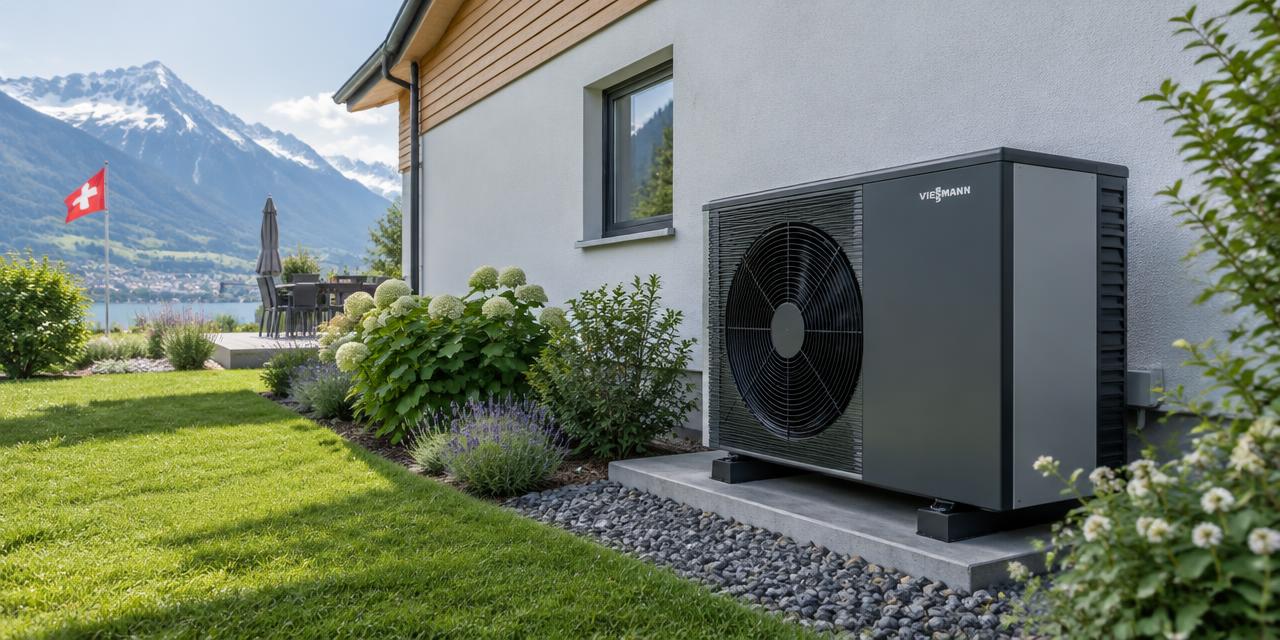
Outdoor air-water heat pumps must meet noise limits towards neighbours. The noise emitted by the fan can be a source of disturbance in dense residential areas.
It is advisable to position the outdoor unit away from rest areas, such as bedrooms, and potentially install noise barriers. The Canton of Bern imposes strict noise protection requirements during the permit application process.
Good planning from the start avoids expensive conflicts and later structural modifications.
Switching to a heat pump is a significant initial investment. However, property value appreciation and savings on energy bills lead to an attractive return on investment over the long term.
It is recommended to compare several quotes while checking compatibility with your existing heat emitters (radiators or underfloor heating). Do not forget to find out about available grants in the Canton of Bern to support your renovation.
To get a realistic price range for your project in Thun, use the free RenoIndex estimator today.
1. Estimate
Set a budget range with the estimator.
2. Grants
Apply before work starts.
3. Quotes
Compare at least 3 quotes.
4. Permit
Check with the municipality whether a permit is needed.
5. Works
Follow the site and do a written handover.
No specific grant listed for this work. Maintenance tax deductions may still apply.
1716 Plaffeien · about 26 km
Swiss company specializing in building services, tinsmithing, roofing, and solar installations for the building envelope.
faselpillerag.ch1717 St. Ursen · about 31 km
Company based in St. Ursen specializing in sanitary installations, bathroom renovations, and various heating systems.
fg-sanitaire.ch1724 Le Mouret · about 33.8 km
Fribourg specialist in heating, ventilation, and plumbing, expert in water treatment, technical maintenance, and HVAC troubleshooting.
rptechnique.ch1724 Bonnefontaine · about 33.8 km
Pred SA is a family business based in Le Mouret that installs, renovates, maintains and repairs heating systems, heat pumps and plumbing throughout the canton of Fribourg.
pred-sa.chSuggestions from the commercial register by distance and activity. Not an endorsement or partnership.
For any heat pump installation, a building permit application must be submitted to the municipality. In the Canton of Bern, noise protection requirements must be justified. We advise you to contact the local planning department to validate the compliance of your technical project.
Heat pumps operate most efficiently at low temperatures. If your current radiators are old and require high flow temperatures, replacement or resizing might be necessary. A heating specialist can assess if your current emitters are compatible or if they need to be changed to optimise your new installation.
Costs vary depending on the model, power, and installation complexity. To get a personalised estimate based on local prices, use the free online simulator provided by RenoIndex. It will give you a realistic budget range for your specific project.
The Canton of Bern offers various incentive programmes for replacing fossil fuel heating with renewable systems. Conditions change regularly. It is therefore important to consult the official website of the cantonal building programme before starting work to check your eligibility.