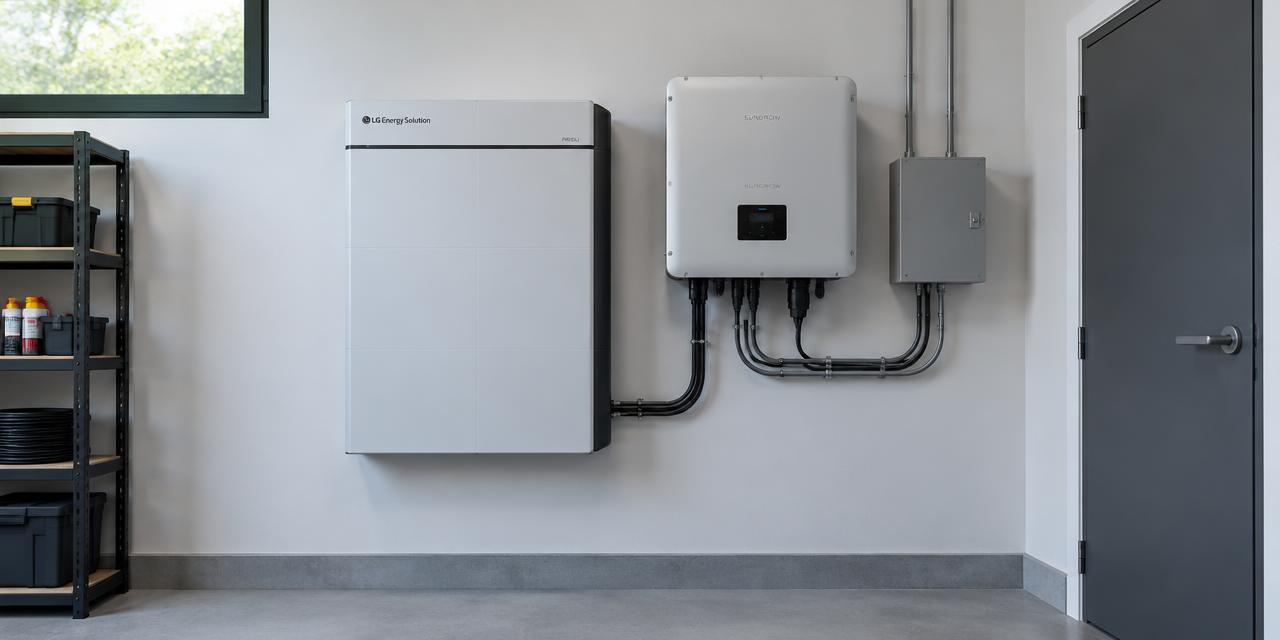
Solar battery installation in Biel: A complete guide
Are you considering optimizing your solar installation in Biel? Adding a solar battery allows you to use your green energy long after the sun has set. This guide walks you through the key steps to choose and install your storage system effectively. Learn how to maximize your self-consumption, lower your electricity bills, and contribute to the local energy transition. To get an accurate cost estimate, use our free RenoIndex estimator today to receive a reliable price range.
At a glance
Typical budget
CHF 7'200 – CHF 15'400
Midpoint
CHF 10'500
Grants found
0
Nearby companies
4
Worked examples in Biel/Bienne
Small project
CHF 4'000 – CHF 9'100
Typical project
CHF 7'200 – CHF 15'400
Large project
CHF 12'400 – CHF 25'400
Project
Quantity
Low
High
Per unit
Small project
5 kWh
CHF 4'000
CHF 9'100
CHF 1'200
Typical project
10 kWh
CHF 7'200
CHF 15'400
CHF 1'100
Large project
18 kWh
CHF 12'400
CHF 25'400
CHF 1'000
Computed with our estimator for Biel/Bienne (regional factor included), standard finish. Only the project size changes.
Cost split (typical project)
Labour :CHF 2'100(20 %)
Materials :CHF 7'300(70 %)
Other costs :CHF 1'100(10 %)
What the price covers
Included
Supply and installation
VAT
Battery, charge management and standard connection; options according to answers
Not included
Permits and architect fees
Unexpected structural issues
Possible subsidies
Solar panels and complete electrical refurbishment
Biel/Bienne's housing stock in figures
In Biel/Bienne, the federal building register lists 6'314 residential buildings and 31'200 dwellings. These municipal benchmarks help put your home in context, but do not replace an individual assessment.
80 %built before 1980
83 %heated by oil or gas
23.6 %electric hot water
2.2 %with declared solar thermal
Age of residential buildings
80 % built before 1980
Before 191919 %
1919–194528 %
1946–196021 %
1961–19708 %
1971–19804 %
1981–19905 %
1991–20006 %
2001–20105 %
Since 20114 %
Construction year does not reveal past renovations: check the current insulation condition.
Main heating energy
58 % · Gas
Gas58 %
Heating oil25 %
Heat pump10 %
District heating4 %
Wood2 %
Electricity1 %
This distribution describes recorded buildings, not your system's consumption or efficiency.
Heating and hot water: which energies?
Energy
Heating
Hot water
Gas
58 %
44.6 %
Heating oil
25 %
18.8 %
District heating
4 %
3.3 %
Heat pump
10 %
6.7 %
Electricity
1 %
23.6 %
Wood
2 %
1.1 %
Solar thermal
0 %
1.4 %
Each line gives the share of buildings using that energy, separately for heating and for hot water. The two columns do not always reach 100%: some buildings combine two systems, or reported none.
Type of heating system
Boiler (unspecified)45.7 %
Standard boiler24.4 %
Condensing boiler14.8 %
Heat pump10.3 %
Heat exchanger (district)3.7 %
Central electric heating0.7 %
A standard non-condensing boiler is usually older and less efficient.
Houses or apartment buildings?
Single-family houses31.8 %
Two-dwelling houses8.7 %
Apartment buildings (3+)59.5 %
16.6 % of buildings mix housing with shops or offices.
The typical building
storeys (median)
3
median footprint
132 m²
median dwelling area
75 m²
Renovations, heritage and volumes
For renovation projects in Biel, official building register figures highlight that nine buildings are under heritage protection, necessitating early consultation with municipal authorities for permit requirements. Regarding building volume, data coverage is currently very limited, with only four buildings measured according to SIA 416 standards out of 2011 units, showing a median volume of 683.5 m3. Because this data is highly partial, homeowners must conduct their own professional site measurements. Accurate volume assessments remain crucial for planning the appropriate scale of your heating and insulation upgrades to ensure your renovation project meets all technical and regulatory standards.
9
buildings flagged as protected
status known for 54 of 6'314 buildings; check with the municipality
A battery is worthwhile when solar output clearly exceeds your daytime use. By storing the excess energy generated during sunny hours, you avoid purchasing expensive grid electricity once the sun goes down.
This makes your home more self-sufficient and sustainable. The installation also helps smooth out demand peaks, relieving pressure on the power grid while improving the efficiency of your solar panels.
Analyzing your current consumption profile is an essential first step before investing in such technology in Biel to ensure long-term energy savings.
Sizing your storage system
Size capacity by evening consumption, not panel power. A common mistake is oversizing the battery, which unnecessarily increases costs. It is crucial to calculate your average nighttime needs precisely.
A battery that is too small will not cover your usage, while a battery that is too large will never fully charge during winter months. Make sure to tailor your capacity to your lifestyle.
For a personalized cost estimate based on the size of your installation, check out the free RenoIndex estimator.
Compatibility and technical installation
Check compatibility with your existing inverter before buying. Some newer models are hybrid units that already integrate battery management, while others require additional components.
It is recommended to contact a qualified electrician in Biel to evaluate the state of your electrical system. Ensure the chosen area for the battery is dry, temperate, and well-ventilated to guarantee its longevity.
An installation compliant with Swiss standards ensures not only the safety of your building but also the optimal performance of your home energy management system.
Profitability and planning
Investing in a battery depends on your consumption habits. In Switzerland, self-consumption is becoming increasingly attractive due to rising electricity tariffs.
Planning your project requires a holistic view : consider future needs, such as the potential installation of an EV charging station, which might justify a larger storage capacity.
Although grants can vary, a well-thought-out system is a sustainable investment. Use RenoIndex to get a clear price range and plan your renovation budget with peace of mind.
Your project in 5 steps
1. Estimate
Set a budget range with the estimator.
2. Grants
Apply before work starts.
3. Quotes
Compare at least 3 quotes.
4. Permit
Check with the municipality whether a permit is needed.
5. Works
Follow the site and do a written handover.
Grants and subsidies
No specific grant listed for this work. Maintenance tax deductions may still apply.
Companies in the area
Solar conseil Sàrl
2605 Sonceboz-Sombeval · about 6.7 km
Solar conseil Sàrl specializes in the installation of photovoltaic power plants, energy storage solutions, and energy efficiency consulting in the Jura and Bernese Jura regions.
Suggestions from the commercial register by distance and activity. Not an endorsement or partnership.
Frequently asked questions
Does a solar battery require special maintenance?
Most modern lithium batteries require almost no maintenance. However, it is advisable to have the system checked regularly by a professional to ensure optimal performance. Software updates for your energy management system are often done automatically via remote access.
Can I install a battery on an older system?
Yes, this is perfectly possible. If your existing inverter is not compatible, it may be necessary to add an additional battery inverter or replace the current one with a hybrid model. A local electrician can verify the ideal configuration.
What is the average lifespan of a battery?
The average lifespan of a residential solar battery is between 10 and 20 years, depending on technology and usage. Charge and discharge cycles influence this longevity. Smart management helps extend the useful life of your battery.
How can I get a price estimate for my project?
To get a quick and free estimate for the cost of your storage installation, you can use our online RenoIndex simulator. It will provide you with a price range tailored to the specifics of your renovation project.