
Canton
Facade insulation — Buildings Programme (VD)
Contribution per insulated m², depending on energy requirements met.
Grants for thermal insulation of the building envelope (walls, roof) via the Buildings Programme.
www.leprogrammebatiments.chFacade insulation · Écublens
Small project
CHF 20'000 – CHF 41'400
Typical project
CHF 36'800 – CHF 73'000
Large project
CHF 62'100 – CHF 120'400
Computed with our estimator for Écublens (regional factor included), standard finish. Only the project size changes.
Écublens, located at an altitude of 426 meters, experiences 48 days of frost per year.5 °C and significant heating requirements, facade thermal insulation is a priority for homeowners.
The Climate Plan of the City of Écublens, an Energy City label holder, aims for carbon neutrality by 2050 and a 35% reduction in greenhouse gas emissions by 2030 compared to 2020. Undertaking this work allows you not only to meet these ambitious energy transition goals but also to sustainably reduce your energy bills.
The ideal time to act often coincides with replacing windows or repairing the roof. By grouping these tasks, you optimize the return on your investment and minimize construction periods.
6 °C, the transitional seasons are often the most suitable for avoiding the constraints of deep freezes while ensuring high-quality implementation by local craftsmen.
Facade renovation relies on several technical choices that determine overall performance. The choice of insulation is crucial: whether synthetic, mineral, or bio-sourced materials, each option influences thermal behavior, wall thickness, and durability.
Exterior thermal insulation systems (ETICS) help eliminate thermal bridges, which is essential to meet current efficiency standards. The choice of finish—traditional plaster, wood cladding, or composite panels—influences not only the building's aesthetics but also future maintenance needs.
There are different levels of quality depending on your priorities. Some homeowners prefer high-performance solutions to minimize heating demand, while others seek a balance between initial cost and comfort.
Incorporating solar devices, given the global irradiation of 1371 kWh/m²/year in Écublens, is also an option to consider during facade renovation. It is advisable to discuss with a specialist to define the solution best suited to your building type while meeting your financial and sustainability objectives.
The housing stock in Écublens shows a wide diversity of construction eras, each bringing its own challenges. For older buildings, thermal insulation is often absent, making facade treatment particularly effective for comfort.
A key point of vigilance concerns potentially harmful materials in constructions dating from certain periods, particularly before 1990, where the presence of asbestos in glues or insulation can be a risk.
A preliminary diagnosis is mandatory to identify these substances before any mechanical intervention on the structure.
Facade renovation is also an opportunity to inspect the general state of integrated elements. Built-in networks or period fasteners may need updating. If you plan to improve insulation, ensure that the existing structure can support the weight of the insulation.
A rigorous analysis of original plans and on-site expertise help avoid costly surprises during work. Also, remember to check the seal of existing joinery, as an insulated facade without high-performance windows could lead to condensation or humidity problems inside your living spaces.
In the canton of Vaud, the procedure for a facade renovation depends on the nature of the work. As a general rule, work is subject to a simplified procedure or may be exempt from a building permit.
However, this exemption is not automatic if the work alters the exterior appearance, the building footprint, or if the building is protected or located in a protected area.
It is essential to contact the competent authorities, either the municipality of Écublens or the prefect, to confirm the status of your project before starting any detailed planning.
Although general rules for solar installations or facades are defined at the cantonal level, each municipality may have specificities related to its heritage. Exterior insulation often modifies the building's appearance, which is a determining criterion for obtaining authorization.
It is strongly recommended to prepare a complete file showing the planned materials and visual changes to facilitate the review by urban planning services. Anticipating these administrative steps is crucial to avoid blockages at the construction site.
To reduce the cost of your energy renovation work, the Buildings Program (VD) offers subsidies for thermal insulation of the building envelope, including facades. The contribution is calculated per square meter insulated, subject to compliance with energy requirements set by the program.
A golden rule must be followed : the grant application must be submitted before the start of work. No aid can be granted retroactively, which is why it is important to consult the official website before committing to any contractor.
Tax-wise, investments aimed at saving energy are tax-deductible. The deduction rate is 100% for this work. If costs cannot be fully deducted in the year of investment, the balance can be carried forward to the two following tax periods.
Note that if you receive a subsidy, you can only deduct the costs you actually bear yourself. You can choose, for each building, between deducting actual expenses or the flat-rate deduction, but carrying forward energy costs excludes the possibility of using the flat-rate deduction for that period.
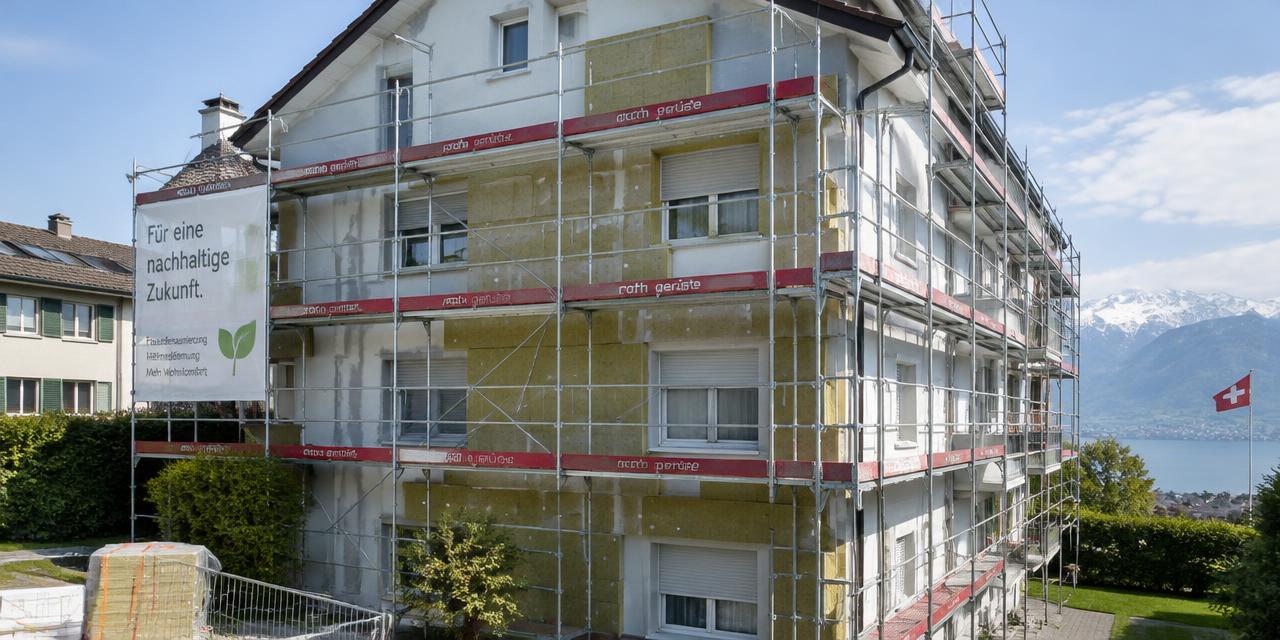
Planning a facade site begins with applying for permits and grants, steps that must precede any contractual commitment. Once the files are validated, site preparation begins with the installation of scaffolding.
These structures are a significant part of the project, so it is advisable to group facade, window, and roof work to make the assembly cost-effective.
Installing insulation is a meticulous step that requires mild weather conditions to ensure adhesion and correct drying of materials, especially avoiding the marked frost periods in Écublens.
After installing the insulation, finishing work includes the chosen plaster or cladding. Coordinating different trades is essential to avoid wasting time.
The total duration of the project varies according to the surface area and complexity of the building, but a clear schedule must be established with the company beforehand. Generally, late spring and early autumn offer the best conditions for this work, ensuring optimal drying and high-quality results.
One of the most frequent errors is neglecting the administrative order, such as applying for grants once the work has started, making aid impossible to obtain. It is also not advisable to treat the insulated facade without taking ventilation or windows into account, which can create internal humidity problems.
Checklist before estimates : 1) Check if your building requires authorization from the municipality. 2) Submit your grant applications before any contract. 3) Ask for an expertise on the presence of asbestos for older buildings. 4) Group your work with roof or window repairs to save on scaffolding.
5) Request detailed comparative estimates including the thermal performance of the chosen insulation materials.
Also, ensure that the chosen company has proven experience in the type of renovation targeted. Do not sign any estimate before receiving confirmation of your eligibility for aid. Check that the schedule takes local weather conditions into account to avoid frost.
By following this checklist rigorously, you minimize financial and technical risks while maximizing the energy value of your property in Écublens.
Contribution per insulated m², depending on energy requirements met.
Grants for thermal insulation of the building envelope (walls, roof) via the Buildings Programme.
www.leprogrammebatiments.chCheck amounts and conditions with the provider before signing: apply before work starts in most cases.
1024 Ecublens VD · about 0 km
Swiss company specializing in interior painting, plastering, and facade renovation for residential and industrial projects.
creatica.ch1024 Ecublens VD · about 0 km
Specialist in building maintenance and secure high-altitude work, including masonry and interventions on facades and roofs.
transactive.ch1024 Ecublens VD · about 0 km
General contractor based in Ecublens specializing in structural work, masonry, building renovation, concrete sawing, and core drilling in French-speaking Switzerland.
bkconstruction.ch1024 Ecublens (VD) · about 0 km
Company specialized in painting, plastering, ceilings, and insulation based in Ecublens.
rabogroup.chSuggestions from the commercial register by distance and activity. Not an endorsement or partnership.
You must imperatively submit your grant application to the Buildings Program before starting the work. Once the file is accepted, you can start the site and submit proof of completion to obtain the payment.
It depends on the scale of the work and the location of the building. A simplified procedure is often applied, but it is mandatory to check with the municipality of Écublens as heritage constraints may exist.
Yes, investments aimed at saving energy are 100% deductible. If the total deduction is not possible in the first year, you can carry forward the balance to the next two tax periods.
It is recommended to act during mild seasons, such as spring or autumn, to avoid freezing temperatures. These conditions allow for better material adhesion and optimal drying.
Grouping insulation with roof or window work makes the cost of scaffolding profitable. It also allows for harmonizing the thermal performance of the entire building envelope.
Yes, before 1990, harmful materials like asbestos may be present. A preliminary diagnosis is necessary to identify any risks before intervening mechanically on the structure.
The duration varies depending on the size and complexity of the building. It is essential to define a schedule with your company beforehand to avoid delays linked to weather conditions.
Source : swisstopo – service d'altitude (MNT)
Source : Open-Meteo Historical Weather API (réanalyse ERA5, moyenne 2015-2024)
Source : Open-Meteo Historical Weather API (réanalyse ERA5, moyenne 2015-2024)
Source : Open-Meteo Historical Weather API (réanalyse ERA5, moyenne 2015-2024)
Source : Open-Meteo Historical Weather API (réanalyse ERA5, moyenne 2015-2024)
Source : Open-Meteo Historical Weather API (réanalyse ERA5, moyenne 2015-2024)
Source : ge.ch · estimate
Source : Canton de Fribourg: Permis de construire (example, this is Fribourg) · estimate
Source : Règlement sur la déduction des frais relatifs aux immeubles privés (RDFIP)
Source : Ecublens.ch - Plan climat